Archives

Blog Archives

Cah Tawk

Energy Efficiency, Sustainability2 comments

This week’s feature presentation is one of my favorites for saving energy: automobiles.  Let’s take this recent post from Fuel Fix and dive right in.

The first one I read is “make sure your gas cap is broken or missing.”  That’s right.  You can save 3 cents per gallon if it is broken or missing.  I think they need some proofreading.  I suggest using a well-oiled and fully functional gas cap.  Where they get the 3 cents per gallon savings, I have no idea.  That’s like saying a 20 minute power walk will reduce the energy content of a milkshake by 50 calories per dollar.  Think about that a while.

Drive the speed limit.  I have trouble with this one.  Let’s say I’m traveling for “business”, meaning I simply need to get from A to B on a freeway.  There is nothing I want to get out of the way faster than such a drive.  A week ago today I had to drive from Wisconsin to the southeast shores of Lake Michigan.  After 45 minutes of stop and go approaching downtown Chicago Saturday afternoon, I was in no mood for the 55 mph signs in northern Indiana.  The fastest dudes doing 85-90 mph were my best friends.  I still clocked 33-34 mpg – the upper range for my car.

The other case is driving around home in Western Wisconsin, the greatest place to drive on the planet with baby-butt-smooth roads and lots of curves.  For example, on last week’s trip, we were rolling down our street as we pulled away from our house and my wife is fidgeting around placing this and that in the car and I said, “What in the world are you doing?”  I just throw my stuff in and go.  She was strapping stuff down because I like cornering.  No food or drink allowed!  Driving the posted speed limits around curves is just wrong, like a two hour wedding.

Stay off the brakes.  Tell you what – I’m going to dedicate an entire rant to this one.  Next.

Turn your car off.  Duh.  Millions of people should actually pay attention to this one.  The worst offender here is starting your car in the winter to let it warm up in the driveway or garage.  My parents always used to do this for comfort reasons I guess.  I just don’t get it.  Run out in the freezing cold, start the car and let it run for 15 minutes.  The engine probably pukes out more pollutants in 15 minutes of cold idling than while burning an entire tank going down the highway.  Why?  Combustion in a cold cylinder is not complete, resulting in hydrocarbons.  Pollution control devices catalytic converters (oxidizers) don’t work because they are too cold.  It does NOT damage an engine to take off from a cold start – and it pollutes less when you get it up to temperature fast.  Tip: for anyone without covered/indoor overnight parking and frost-covered cars in the morning, use Rain-X.   Use it anyway.  It greatly improves vision in rain, and bug guts, road slime/salt and goo roll right off.  It also makes physical ice-scraping much easier.

Tire pressure.  These guys say over inflating tires does no good.  Get this: rolling resistance due to tire flexion is one of the biggest losses of energy while driving down the road – probably more than the drag (wind resistance), starting, stopping and hauling freight.  Why do you say that Jeff?  First, because I get close to 20% better mileage in the summer compared to winter when tires are stiffer.  How do I know it’s the tires?  Because I drive big hills to and from work and in the winter, my car slows down going down the big hill and barely stays steady if I totally coast (take it out of gear).  In the summer, it speeds up while engine braking and when out of gear – zoom, like hot wheels down the track (millenials – look it up).

Here is another thing to consider: My car weighs about 3000 lbs with some gasoline and me in it.  I get about 35 mpg, or about 52.5 ton-miles per gallon.  Freight trains can move almost TEN TIMES as much freight/distance per gallon, not even counting the weight of the train cars and locomotives.  What’s the diff?  Rubber on concrete versus steel on steel.  Trains have virtually zero rolling resistance.  Tires are huge energy wasters.

The auto mechanic always puts my tires at 33 psi, presumably for a “smooth” ride.  Bullshit.  I pump them to just a few psi below the maximum as stated on the sidewall.  You can do what you want.

Keep your air filter clean.  Yah, sure.  A dirty filter makes it more difficult for your car to breathe but if you really want to save energy in this vain, remove your exhaust just downstream of the exhaust manifold like a race car.  Mufflers and all that pollution control crap in your exhaust system wastes energy.  That’s a fact, Jack.  You can do what you want.

They say keep the windows closed and run the air conditioner because the reduced drag saves more than it costs to run the air conditioner.  This is splitting hairs.  I’ve done both and I see no discernible difference.  As mentioned previously, I get better mileage driving fast in the summer with the air conditioner running than driving 55 in winter with no AC consumption, and the windows up of course.

Even though your kids may like to hang out the window or stand up through the sunroof for that free and easy feeling while you race them to daycare, I would discourage this activity as it increases drag and degrades mileage.  Send them down a steep hill on their bike if they clamor for the easy rider feeling.

To be continued.

Facility Management, Taliban Style

Energy Efficiency, Government, Investments, Uncategorized2 comments

Possibly the greatest thing about energy efficiency is there is no limit to learning. In what other occupation can engineers work with social scientists, urban planners, economists and 16th century Mongolian art majors?  Last week I attended a presentation by Christopher Russell, energy efficiency and finance swami, or is it guru?  The higher ranking one.  Or maybe I should just call him Colonel Russell.

His presentation started with the tale of two college campus facility managers, Doug and Dave as I recall, with names changed to protect the guilty.  I’ll call them Dick and Harry for double protection.

It doesn’t happen very often, but every once in a while a person tells an energy efficiency program or project fable that I find myself violently agreeing with.  In this case, Doug, er I mean, Dick was presented as an all-too-familiar customer representative/facility manager.  His attitude is “energy is a necessary evil, a fixed cost, and not a resource to be harnessed,” and his idea of success is to keep the phone from ringing with problems and complaints.  Gee, this sounds just like many HVAC and automatic controls contractors.  Just slap it together, stop the phone from ringing, and move on to the next project.  I don’t care what the energy consumption looks like, just stop the complaints.  Who cares what the energy implications are?  But I digress.

Doug Dick is a status quo thinker.  He believes the pie is fixed and everyone must fight like a boorish thug for their budget.  Then, once his slice sequestered, hoard it, and if necessary, spend it to (god forbid) reduce the budgeting leverage for next year.  This is standard practice for government, by the way, including the Navy (at least back when I was there).

Dick Doug is eventually handed a mandate from on high to reduce energy consumption in campus facilities by XX%.  Hire an energy efficiency professional to best determine maximum return on investment?  Hell no.  That would cost a lot of money, make Dick look dumb (he thinks), and the EE pros will recommend a slew of projects that upper management may get their hands on, which results in Dick having to do even more stuff!  Rather, Dick decides to be proactive for a change and implement an expensive project that will drag on a couple years to keep the greens off his back.  In this two year span, he thinks the fad will blow over… and then it hit me.  Dick, the facility manager, is like the Taliban.  He is dug in, resistant, and will never surrender.  He will weather the storm and wear down his adversaries with brutally intransigent patience.

I have a great deal of passion for energy efficiency or I wouldn’t be in this business for 16 years.  Reasons include; non-renewable resource preservation, saving money and increasing profit, risk mitigation, and all that sustainability stuff.  However, thanks to Mr. Russell’s analysis and one question I asked, something like a cold fusion miracle occurred.  He used an example, but I made up my own.  A detailed assessment for a new energy management system has been completed and the project data is shown in the table nearby.  I’m not going to puke all that information back at you in words, but I would just point out the lousy 5.8 year simple payback.  Most customers would laugh and tell you to get lost because they only do projects with a simple payback of 2.0 years or less.  A million years ago, I wrote an Energy Brief explaining why simple payback is a terrible metric to make decisions with.  One reason it is lousy, as discussed way back then, was because payback has nothing to do with wealth.  For example, what does a 2 year payback tell you about how much working capital the project will generate?  I can’t buy lunch with a payback.

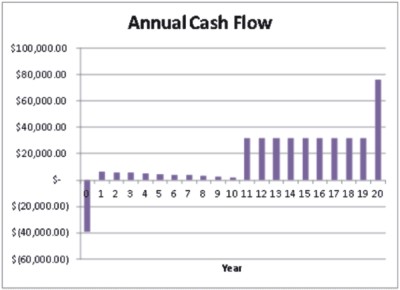
The annual cash flow shown includes the 15% down payment the smart guy, Dave, er Harry represents the plunk down of $39,000 for this project.  Over the 10 years of the loan there is a positive cash flow (savings greater than payments) of about $2,000-$6,000, depending on the interest paid on debt, which is tax deductable.  That looks pretty cool but still not that hot, Jeff.

Then we have the cumulative cash flow, and wow, this is suddenly becoming impressive.  At the end of the 20 year life of the project the cumulative cash flow is $360,000 for a not-too-shabby internal rate of return of 18% on the original $39k down payment.  Or you can do nothing and destroy $585,000 in capital on wasted energy[1].  Try to get that kind of return in the stock market[2]!  Speaking of which, I have that comparison too.

Warning: Place your index and middle fingers over each eye socket before gazing at the chart – to keep your eyeballs from popping out of your skull.

I apologize for the positive message this week.  This was a pathetic rant.  Next week I will discuss other features and benefits for investing in energy efficiency.


[1] Note this is for demonstration purposes only.  The wealth created by doing the project is

[2] 7.5% compounded average gain since 1972


Monty and Me

Energy Efficiency, Government, Sustainability1 comment

Back in August I wrote about our “non-energy policy” and that our federal administrations since Nixon have vowed to reduce or eliminate our dependence on foreign oil, especially from hostile regions – and exactly the opposite has occurred.  We are better positioned to control our energy destiny right now, for decades, more so than any time in my life.

Technology for tapping conventional fossil fuels has vastly outstripped and expanded the gap between inexpensive fossil fuel supply and alternative energy sources.  Unfortunately or fortunately, this is reality.  Two major energy sources being tapped of course include natural gas from shale using hydraulic fracturing and horizontal boring technology, and the second being oil extraction from the tar sands in Alberta.  Predicting future energy prices is typically a waste of time, but I just don’t see the price of natural gas rising to $10 again for a long, long time.  The NASDAQ might hit 5000 again before we see $10 gas.  Future petroleum prices are certainly more volatile because most of it comes from overseas and subject to unrest, world economy, and the value of the dollar.

So let’s get on with some pie in the sky possibilities.  The only reason it is pie in the sky?  Dysfunctional Washington DC.  What if they actually compromised to arrive at some decent solutions for the country for once?  On the one side we have a third of the population that wants no more production of fossil fuels or nuclear power whatsoever.  On the other side we have another third that wants no regulation or restraint on consumption whatsoever.  So let’s make a deal, Monty.

Low energy costs resulting from abundant natural gas is a boon to the economy – first in its production.  These freshly tapped sources of energy are a major job producer.  Second, low prices spur the manufacturing sector, which I believe everyone agrees we need badly.  The Wall Street Journal last week reported that industries that rely on natural gas as a feedstock are racing to build production facilities for manufacturing steel, fertilizers, glycol, plastics, and other chemicals.  The upshot?  One million manufacturing jobs in the next 15 years.  Whoa!

While abundant and inexpensive for now, it isn’t infinite.  The definition, or my definition anyway, of sustainability is to leave as much for future generations as possible.  Getting sustainable policy out of Gomorrah – the place that borrows 30 or 40 cents for every dollar it spends is next to impossible.  One quote worth sharing regarding the worthless 2 month payroll tax-cut extension, a guy quipped, “Why don’t we just cut out the middle man and ask for $40 a month from our kids?”  Obviously, they don’t care about “sustainability” for future generations.  But to get back on track – how about some reasonable restraints on consumption?

This is the conundrum of cheap energy.  Vehicles today are huge and powerful.  “This is what consumers want”, they say.  Really?  My personal preference for automobiles has gone the way of the dinosaur.  That is, the smallish two door coupe – lightweight, zippy, with good mileage.  Examples of discontinued models: Honda Prelude, Toyota Celica, Acura Integra/RSX, Nissan 240, Honda CRX.  Honda and Nissan make the Accord coupe and Altima coupe but those are big honkers with two doors, a la the 1977 Chevy Monte Carlo like my brother had.  The door alone weighed in at something near one of the Stonehenge rocks.

So how about some reasonable mileage standards?  The EPA recently doubled it from 27 mpg today to 54.5 in a mere 13 years.  This is crazy.  How about a little reality?  Why not something like 35 or even 40 mpg?  Fifty-four mpg has no chance of becoming reality, whereas more modest goals do.  Two ways to get there include diesel engines and petrol/electric hybrids.  When in college I owned a 1984 Ford Escort diesel.  That is correct, sir.  It was a bit of a dog but it was reliable as the sun coming up, even in below-zero temperatures and it topped 45 mpg, easily.  I could drive to Montana on a half tank it seemed.  This was almost 30 years ago!

And why don’t automakers develop some sexy hybrids?  I read an article a while back about drag racing freaks – and their power train for humongous power – electricity from a huge bank of 12 volt batteries.  Stored electricity can deliver a huge amount of power.  It can vaporize copper and ruin your day bad – arc flash, an explosion of gaseous copper.  This is not exactly safe or recommended but the point is, gas/electric hybrids with relatively tiny engines can also produce huge bursts of power for those who like to burn a little rubber once in a while.  Let’s face it, many people would rather decline a ride to the emergency room with a massive hemorrhaging head wound than be seen in a Toyota Prius.

There is a bogus argument that lightweight cars are not safe.  They are safe unless you plow into a tanker somebody else is driving.  If you want to be safe, drive a loaded cement truck or an 18 wheeler.  How many collisions do these vehicles lose against the other guy?  The people in the car, SUV, or van get walloped when tangling with these whompers and the truck drivers may walk away uninjured.  That’s just the way it is.  Small is only dangerous when tangling with something much larger.

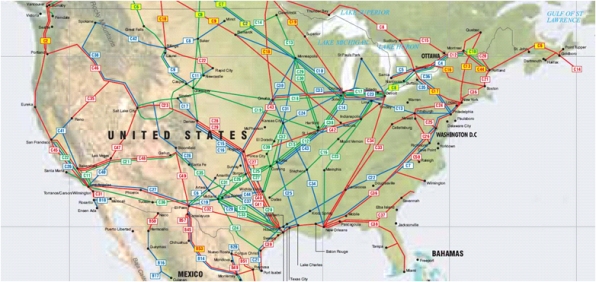
And there is the Keystone pipeline football.  To me, the choice is simple.  We either build a pipeline and buy oil from our good neighbors to the north, a major blow to the oil cartel or we say no, Canada ships the oil across the planet to China and we continue to buy from the volatile Middle East.  This is the reality.  The choice is not (1) buy oil from the tar sands OR (2) power the car with an empty PBR beer can and banana peel in the flux capacitor.  There are no other reasonable “or’s” at this point.  Compromise this inexpensive, abundant, local energy source with higher fuel standards.  The pipeline is an environmental hazard?  Give me a break, the country is covered in a Byzantine labyrinth of pipelines.

Petrol and natural gas featured nearby.

The final bridge to energy independence: start converting the large transportation fleet to natural gas.  Every single public transportation and school bus in the country should be converted to natural gas hybrid power trains.  With dozens of start/stops every day, buses are a slam dunk for hybrid technology.  Big rigs travel primarily on the interstate highway system so it would seem to me that getting a natural gas infrastructure in place to serve this network wouldn’t be that big of a challenge.  It would be no different than our regulated natural gas and electricity markets are today.

Diesel fuel runs about 43,000 Btu/dollar today, compared to possibly 200,000 Btu/dollar for natural gas, depending on delivery charges.  The commodity is hovering around only $3/million Btu.  One fifth the cost, no refining.  Help yourself to the emissions analysis.

Adding up the conversion to natural gas transportation and some modest, minimal sacrifices for fuel efficiency standards and we can probably cut our petroleum consumption by close to half – or at least 30%.  Combine this with “domestic” petroleum (Canada included) production and suddenly, Vlady, Hugo, and the Sheiks will be crying.  To this point, they are wallowing in our stupidity.

Quiz

Speaking of let’s make a deal – Monty Hall, the host of “Let’s Make A Deal” plays a game where participants dressed as the jack of hearts randomly pick one of three doors, one of which is in front of a grand prize.  Another has a pair of goats and the third has a bunch of rabbits behind them.  You want the grand prize.  Monty knows what is behind each door.  You randomly pick a door.  Monty opens one of the doors to reveal the goats.  Question: should you switch doors or stay with the door you picked?  Will it affect your odds of getting the grand prize?  First one to email me with the right answer gets some used Christmas cards.

Quote of the Week

From Elaine Gallagher Adams of the Rocky Mountain Institute: “Operating an uncommissioned building is like driving your car down the road with the gas cap hanging open and the blinker on; you look like an idiot.”

No Policy?

Energy Efficiency, Government, Renewable Energy, Sustainability, Utility Stuff0 comments

As administrations and congresses come and go, one thing remains the same: “there is no clear energy policy”, and “we need to reduce our dependence on foreign oil”.  Neither one is ever addressed.

First, what the heck is a clear energy policy anyway and are we sure we want one?  When the government messes with any market, the result is always negative for consumers and in some cases bordering on catastrophe.  The only exception I see is utilities, which lend themselves to monopolistic efficiency.  You may need to lie down after that head-spinning oxymoron.  But seriously, in order to have economies of scale, it makes sense to create giant, relatively efficient power plants where fuel can be hauled by the trainload of coal equivalent and power distributed inexpensively to end users.  So the government regulates these monopolies I would say with success as energy costs are dirt cheap.

Most other government interventions I can think of result in disaster.  Consider the current pathetically weak economy.  First off, the reason for the deep, deep recession we fell into three years ago was fueled like monsoon rains fuel future wildfires in the deserts of AZ and CA – by the government.  In the 1990s congress was pushing for home ownership for every American.  Add to this Fannie Freddie Mae Mac, which socialized the risk (taxpayers) and privatized the benefit (home buyers).  On top of this add politically motivated easy money by the federal reserve.  The result was exactly as I say – a growing stock of fuel for a massive fire to crash and burn.  Entities from the government, financial institutions, and individuals contributed to the massive bubble that popped with a horrific bang.  We are in the third year of a housing hangover – imagine a three-day hangover from a bender you may have enjoyed in your wild and crazy youth.

WARNING: What you are about to read may cause severe brain damage.  Position yourself to protect your head or don a helmet before reading.

From a resource preservation perspective, the “energy policy” we’ve had over the years has been good for energy conservation.  Why?  Because if there is one thing that motivates people more than anything, it’s money.  Conservationists and greenies say our energy prices are artificially low because of government subsidy.  I disagree, totally.  100%.  If we REALLY wanted low energy prices, including electricity and petrol, we could have it by tomorrow afternoon, theoretically.  We could collapse the oil prices immediately by passing bills and signing into law the domestic production of more oil in addition to importing from our friends, the Canadians.  Last time increased domestic production was discussed the argument was that it wouldn’t have an impact for 10 years and then it would be minimal.  Wrong!  As I mentioned before, people are not rats.  We prepare for, hedge and bet on future to reduce and take advantage of risk.  Announcing future substantial domestic production increases would have an immediate effect.  Conversely, the strategic oil reserve, if I remember correctly includes a month of US consumption and is not even worth talking about with regard to easing prices.

There are an estimated 3 trillion barrels of oil locked up in shale and a huge chunk of that is under mountain states of the United States.  Incidentally, at today’s consumption rate, shale oil alone would last nearly 100 years (worldwide).

We could also go forward with the pipeline from the tar sands of Alberta, Canada.  The tar sands hold an estimated 1.7 trillion barrels; enough to fuel the United States for over 200 years per my calculations.  With roughly 300 years of oil supply along the Rocky Mountains of North America alone, I think I can skip the flood of offshore oil available in the Gulf and up and down the east and west coasts of the country.  Peak oil?  Sure.  Sometime a few hundred years down the road.  It depends on what you call reserves.

Similarly, we have glut of natural gas like we haven’t experienced in my lifetime due to: (1) hydraulic fracturing technology and (2) horizontal drilling technology.  Without investigating exact numbers and areas, this vast trove runs from Ohio through Appalachia to New York with a bunch of states in between and around (as just one deposit).  And we already know the U.S. is the “Saudi Arabia” of coal.

The North American Oil stocks discussed above are under federal government control.  The oil shale in the west is mostly under U.S. government property.  We could build the pipeline from the tar sands to refineries all over the country if Washington chose to do so.

I almost forgot.  We are running low on oil from the North Slope of Alaska – that is, oil from the permitted area of the North Slope.  Flows are becoming too low to maintain enough temperature for the oil to flow freely from Prudhoe Bay to Valdez.  If more land isn’t opened for drilling, this fortune in assets, the pipeline, may need to be mothballed.

So we have an “energy policy”, consisting of greatly constrained domestic production in lieu of buying oil from the most volatile regions of the planet and in some cases, directly from dictators who will and do mow down their own people if they get out of line.  The “subsidies” include tax deductions for depleting reserves, like depreciation every other business uses, plus gobs of military spending to keep the “peace” in these volatile regions.  You may call that a big fat subsidy.  I call it a choice.

We are paying dearly for this energy policy: Tax dollars for defense, policy-driven HIGH energy prices, human lives, higher prices for renewable energy, higher prices for alternate fuels, e.g., natural gas versus coal, higher food prices because 40% of our largest crop is used to make fuel – one of the stupidest policies imaginable, and so on.

It isn’t all bad although there are mistakes along the way and shortages of honesty and full disclosure.  One positive byproduct is sustainability (except for ethanol) in reducing energy consumption today for use by future generations.  That is a good thing.  I most highly prefer to cut waste and not drill and mine willy nilly.

Ironically, it isn’t for altruism for future generations but out of selfishness that this is happening.  It’s selfish because Americans want tolerably priced energy but they don’t want look at its production or transport in any way, shape, or form – literally.  We therefore choose to go make messes in others’ countries.  On top of this, in the US where renewable energy is generated on the Great Plains and nobody there complains about it, greenies in the cities don’t even want transmission lines through the country  to charge their frivolous Nissan Leafs with it.  We should force them to decide where they want their power from.  They don’t want anything, except energy – by Merlin the magician.

Tidbits

If you have read many of these posts you would know I’m a blasphemous heretic with respect to climate change (or probably more of an out-of-the-closet loud mouth).  For a few samples, you may be interested in seeing Green Jacket, Cigar, Gold Rings and Disneyland, This is not Tee-Ball, and Law of Gravity, Repealed.  Without recapping any of that, this week I came across one more detail that screams don’t bother.  Manmade CO2 emissions are three percent (3%) of total CO2 emissions with nature making up the other 97%.  So if we spend a gazillion dollars and all sacrifice our firstborn we can reduce total CO2 emissions by maybe 1%.  Also, according to recently released analysis of NASA data by Ph.D. climate scientists, climate computer sims, upon which all the hype is based, far underestimate re-irradiation of heat back to space.  In English, the earth dumps heat through the atmosphere at much greater rates than the computers predict.  I have 14 trillion reasons we should instead be focusing on a far more irrefutable, immanent disaster we can actually do something about.

This just in:  The EPA, FDA and other sundry alphabet soup shills for business have declared the evil Bisphenol A (BPA) plastic is more or less harmless.

written by Jeffrey L. Ihnen, P.E., LEED AP

Machete to Sustainability

Sustainability0 comments

This Geography guy really needs to get out of the classroom and the city for that matter once in a while.  Modern agriculture is probably demagogued and more poorly understood than energy efficiency, and since this opinion piece addresses both I will dispense with its shredding.

I grew up on the farm 30 years ago in southern MN and northern IA, and I stay in touch spending a week each year reliving my childhood farming days.  My elder brothers still run the place.  They grow maybe 2,500 acres of corn and soybeans and raise and market maybe 25,000 hogs per year.  To the ignorant, they would be perceived as ecology-destroying corporate/factory farmers.

Wrong.

When I was a kid, farm chemicals were more dangerous, less effective, and more heavily applied.  Yet since they were so ineffective, noxious weed and grass control was largely provided by tillage which is environmentally unsustainable in two ways.  First, it takes a lot more diesel fuel, obviously.  Second, erosion was rampant.  If there was one thing I always pressed my father to do as a kid it was to reduce tillage to leave more crop residue on the surface to reduce erosion – from both rainwater runoff and wind.

Back in those days, everything was plowed black – as in, all crop residue buried.  Why?  To bury grass and weed seed along with it.  The spring snow melt would leave three inches of topsoil in our grove (where the snow drifts / dirt dunes were) and road ditches.  Who knows how many tons per acre landed in Indiana or Tennessee?  Moreover, in the spring, we would typically have to scramble out to the fields to run rotary hoe to stop blowing dirt from sand blasting the young crop that just broke ground.

In total, we would make about seven or eight trips over the field to till, plant, cultivate (weed), harvest, and plow.  For soybeans, we would actually use machetes to chop weeds during the mid-summer heat.  Find a fourth grader who would do that nowadays.  Parents would be hauled away in handcuffs for child abuse and maybe reckless endangerment.  This one looks just like my Grandmother’s.   My father would sharpen them every morning before we took to the fields.  No sheaths, guards or any of that kind of crap either.

For livestock, we used to raise hogs and cattle in more “humane” ways in the open field.  This makes for a nice image to the Geography professor but in truth what would happen is the sows would root holes in the soil for a nice cool spot in which to snooze.  Soon they would give birth to a litter of pigs.  Then the rains come.  After having lain on and crushed two or three pigs, the remaining ones would be freezing in the cold water and mud.  Ninety degrees is perfect for these little guys – not 60F and mud.

The good old days weren’t so good.

Fast forward thirty years.  Unlike the Geography professor claims, farming has changed, hugely, and in the direction of sustainability AND increased productivity.  Most crops are now Roundup ready, meaning they are genetically modified to withstand Roundup, which otherwise kills everything rooted in the ground.  This may sound horrible but it only kills what it lands on and is benign to soil, doesn’t drift, and doesn’t run off.  What are the implications?  Fuel use is drastically reduced and the minimum soil tillage results in practically no soil erosion, which brings other benefits in addition to being intrinsically sustainable.

First, when I was a kid and everything was plowed black, soil erosion continuously uncovered rocks on hills and hillsides.  We used to spend weeks before and after planting hauling rocks off the fields – more child abuse.  Have you ever had your foot run over by a rock wagon?  Neither have I.  Rocks are not kind to expensive farm equipment.  It would beat the crap out of tillage equipment, planters, and god help you if you ran one into a combine.

Second, water erosion destroys crops.  First, as it washes down from highlands it takes crop along with the soil to the lowland.  In the lowland, crops will survive in standing water from the runoff for just a few hours.  With modern minimum tillage made possible with Roundup, erosion is practically nil.  In addition to preventing runoff, erosion, and associated crop destruction, residue, otherwise known as stover or trash, helps soil retain moisture to carry crops through dry spells.  It would be common to have 10-15% of our crop land flooded every year; now there is practically none.

The Geography professor claims 107 gallons of fuel are burned to produce an acre of crop.  This is crazy.  First, recent conventional thinking was that to break even a Midwest farmer needs about $500 revenue per acre.  That covers seed, rent or farm payments, chemicals, fuel, overhead, this, that, and the other.  Well 107 gallons is not far from $500 alone.  Second, it probably takes about a half gallon of fuel per acre each to plant and harvest and maybe another couple gallons for tillage (minimal) spring and fall .  That’s about three gallons per acre, direct.  Chemicals and fertilizers?  I have my Roundup booklet right next to me and that says it takes about 20 ounces per acre.  That’s a British pint, give or take a spit, per acre.  Does the fertilizer take the other 102 gallons per acre?  I don’t think so.  A ballpark estimate is 100 lbs per acre.  That’s probably in the 10-15 gallon/acre fuel equivalent, ballpark.  So, I’m seeing 20 gallons equivalent, maximum.

Note however, many modern factory farms produce their own fertilizer for free.  The Geography professor may think the factory farmers are ruthless dingbats, thriving on tortured, cramped, sick livestock, quietly dumping manure in the creeks because it’s cheap and easy.

The modern confinement barn where livestock is mass produced is always portrayed as a hellish inhumane place for livestock.  Wrong.  Sick, stressed, uncomfortable livestock does not eat or grow.  Growing is the key to making a profit.  It’s that simple and irrefutable.  The modern farm is as productivity centric and competitive as Wal-Mart is with its supply chain.  Adapt or die.  Everything revolves around keeping livestock healthy, dry, cool/warm, and frisky.  They even get lots of natural ventilation and daylight – how is your work station in this regard, by the way?

Back to the fertilizer.  The manure produced by the confinement barns provides nearly all fertilizer for the corn crop needed to feed the hogs.  Let me clarify this: the waste displaces an enormous amount of “artificial” petroleum-derived fertilizer – and it’s produced and applied locally.  It is knifed into the soil in the fall in precise quantities to maximize value of all fertilizer needs: potash, phosphate, and nitrogen.  Its nutrient content is better known than it is for a Snickers bar.  Typically, just enough is applied to satisfy the most abundant one of these so as to not over fertilize or waste any of it.  The remainder, which is hardly any, if any is made up by petroleum or natural gas derived fertilizers.

Fields are mapped for soil nutrient levels with GPS positioning systems.  “Fertilizer” application is adjusted continuously as it is spread to provide just enough per the specific needs of each location.  Resources are leveraged to the maximum extent possible.  Like any other business, sustainability, energy efficiency and profit are not exclusive competing interests in Midwest agriculture.

Did I mention, an acre of land today produces about 50% more crop than when I was a kid?  And another thing – crop genetics have improved such that grain drying, often provided by propane, a petroleum derivative, has declined significantly.

Is it perfect?  Heck no, but it’s a world better than most people realize and I could go on for several more pages regarding how much more sustainable and less abusive things are today compared to the “family farms” of the 1970s and earlier.  The only digression I see is the absence of machete wielding 4th graders earning a few bucks for college.

written by Jeffrey L. Ihnen, P.E., LEED AP

B.A.N.A.N.A.S. – Go Bananas

Energy Efficiency, Renewable Energy, Sustainability0 comments

This was a dopey high school cheer of my older brother’s and sister’s sporting days in high school.  “Go bananas.  B-A-N-A-N-A-S.  Go bananas!”  How lame.  What does it mean?  I much preferred, “Watermelon.  Watermelon.  Watermelon rind.  Look at the scoreboard and see who’s behind.  You! You! You! You!”  This was always led by the rowdy crowd after the opposing team’s cheerleaders would do a dopey skit, like the banana thing.

One of the first posts I wrote was Renewable NIMBY, that people purport to be in favor of renewable energy unless they have to look at it or pay for it.  In case you’ve been cryogenically frozen since the 1950s, NIMBY means “not in my back yard”.  People really like renewable energy so long as somebody else pays for it and it’s installed in North Dakota, where not so incidentally citizens are experiencing a booming economy by exploiting energy production, mostly on private land.

Last week I became mentally unglued upon reading about environmentalists blocking a paper mill in Port Angeles, Washington, from using wood waste for its strong appetite for thermal energy (steam).  Nippon Paper has reduced its fossil fuel consumption by 88% and virtually eliminated the need for petroleum since 2000.  What a smashing success.  This is beyond President Obama’s wildest dreams for clean energy, reducing carbon dioxide emissions and dependence on imported energy.  Yet environmental groups including the Sierra Club are fighting to shut it down and send 200-plus decent people to the unemployment lines.

Do you consider yourself an environmentalist?  If you’re like me, the answer is, yes but I’m not in the whacko, nut-job category like these Port Angeles protesters are.

Port Angeles is of interest to me as I have visited there several times and I like it.  It’s the last substantial town on the Olympic Peninsula on the way to the Pacific Ocean.  It sits at the base of the Olympic Mountains and rain forests and other fantastic natural beauteous places abound all within an easy day-trip.  It has a fair amount of tourism, but also industry as well and real people.  Like many other industrial cities along the northern tier of states, it is struggling, and this sort of whacko “environmentalism” makes up a good share of the decay.

And consider sustainability, for which I recently read a good definition [paraphrasing]: leave the environment in as good or better condition than you found it, for future generations.  This Nippon case seems to be a poster child for this.  There is much logging on the Olympic Peninsula, from a renewable resource – trees.  They plant seedlings by the square mile growing into beautiful new forests absorbing tons of carbon dioxide.  Nippon uses the remains of local waste rather than fossil fuel to operate its paper plant.

One local whacko, a psychologist which seems to speak for itself, says the biomass plant is for pure greed at the expense of public health.  News alert: she has no idea what she is talking about.  What would she prefer?  Close the plant and landfill the logging waste?  I can all but promise you the emissions from wood waste will have less impact than using any other reasonable energy source.  It will not be like burning a pile of wet twigs and leaves like we used to for roasting hotdogs and burning our eyes out.  It will be clean.  It’s carbon neutral.  Emissions are regulated by the EPA.  Do you think the EPA, which puts carbon dioxide you are producing right now and every minute of the day in the threat category, is going to allow this or any other manufacturer to emit one billionth of the hazardous emissions required to give a mouse a headache?  I’ll let you know when I think the EPA is getting too slack.  That will happen when I return to earth as a Labrador retriever.

Some carpers on the same side of the political spectrum whine about greedy corporations sending jobs overseas.  Hmm.  I wonder how these Nippon-protesting whackos and their ridiculous protests play into this?  Consider how far into nutland this is.  At the UW-Madison, we just spent millions of dollars to convert a district steam plant from burning coal to biomass – the same sort of thing these people on the Olympic Peninsula are protesting.  If it’s good enough for Madisonians, trust me, it’s good enough anywhere.

NIMBY in some precincts is giving way to BANANA – “build absolutely nothing anywhere, near anything”… by whining halfwits and cretins killing our society – WHACKOS©.

written by Jeffrey L. Ihnen, P.E., LEED AP

The Unholy Holiday Tree

Energy Efficiency, Sustainability0 comments

If you’ve been a regular reader of this blog you must have disagreed with something or maybe more strongly taken exception or offense to something.  In this week’s post, maybe I can pick up everyone else.

Christmases were great when I was kid.  It was by far my favorite holiday.  I couldn’t wait for my mom to put up the same crappy artificial tree every year.  It consisted of a broomstick like trunk with holes drilled to support the “branches”.  The branches consisted of twisted No. 9 wire with plastic pine needles that I guess may be best described as like bristles in a brush.  The ends had a cluster of bristles.  The branches and twigs looked like spiral pipe cleaners.

“It’s like martinis.  A couple at a time is perfect.  Twenty is a little messy and painful.”

We were able to pile enough tinsel rope and ornaments on it to make it look respectable.  In a way it was better than most trees, real or fake because we had lots of one-off ornaments made by us kids, or given as gifts for this or that.  There were almost no box collections of glass balls, which typically broke one by one as we played football on our knees in the living room.  My knees burn and back hurts just thinking about it.  This was the football version of Nerf basketball.  Somebody would inevitably get tackled into the tree sending ornaments flying.  It wasn’t a good time until something broke or mom came tromping in with the wooden spoon.

Well that burned off as the years passed and the holiday break just became an over-welcome break from school and time to play holiday basketball tournaments in high school.  In college I had a chance to get together with friends for more robust celebration.  Now as an old man, it’s a nice break to get a reprieve from email and fire fighting and a time to catch up and actually take a couple days off for real.  The only downside is we have to drive to my mom’s with a house full of siblings, their kids and extended family.  It isn’t as though I don’t like people in my family.  I just don’t like being trapped in a relatively small house with all of them at once.  It’s like martinis.  A couple at a time is perfect.  Twenty is a little messy and painful.  But this is the greatest thing in the world for Mom so it’s worth it.

We get a Christmas tree for our office every year.  At one point the clean up crew got fed up with the needles so we converted to a fake tree.  Now we’re back to real trees probably because we now have a hardwood floor rather than crappy carpet, so cleanup’s a breeze, I think.

This year our tree arrived and I thought, wow what a spectacular tree.  I spend many hours, many, many hours trying to grow trees like that on my wooded lot.  Growing trees on my lot is like fish fry making it to spawning age.  Only about 2% of them make it without getting mowed off by 100 pound rodents others call whitetail deer.  I have a hell of a time getting the trees above munching height.  It’s difficult to grow tall trees when they get munched off every year.  An electric fence and individual fence barriers are installed for protection.  I’m sure my neighbors think I’m a whack job but we know them quite well and they know I don’t have horns and a pointy tail.

Then once trees get above munching height they become targets for the damn bucks that do their antler scraping on them and in probably two minutes they can destroy a beautiful 5 year old tree.  I usually refer to hunting as killing defenseless animals, per my former boss’s definition, but at my house it’s pest eradication.  When I was a kid I hunted all the time for everything that was fair game, but now I beg my neighbor to eradicate the varmints but he’s too sportsman like – too much of a hunter.  It has to be a clean shot, the right size varmint, the right gender and all that kind of crap.  Just take them out.  I’ll pay the butcher.

So at Christmastime people are out chopping down perfect trees that I’m trying to grow.  Our office tree like most others is blocking views to outdoors in our office and lights are deployed up the wazoo.  It (was) surrounded by many frivolous gifts wrapped in goofy wrapping paper or fancy bags that when burned only are half consumed as the rest is some combination of non-combustible clay and other paint residue (not that I’ve tried this).  All this flies in the face of LEED and sustainability.

For the office Christmas party, we are encouraged to get $10-15 gifts for a random gift exchange.  Guys this is the rule: 12-packs of damn good beer only.

So my green solution is this:  Chip in for a reusable keg (otherwise known as half barrels in this goofy state) of damn good beer.  We drink our limit of 24 ounces with our reusable glasses (real glass ones).  Use one of the potted plants for the Christmas tree.  At my house, we use our fig tree and in fact, I liked it so much last year, we left the lights (LED of course) installed all year.  The lights are on a timer.  The wrapping paper for the keg can be one reusable bow used annually.  We don’t need no stinking wrapping paper.  The women can either partake in the beer consumption, get a box of wine or even a barrel, or a bulk tank of floral hand lotion.  Whatever it takes; just no cluttery knickknacks.

The tree growers can bring their skills to my house.  I would gladly pay $30-$50 a pop for these perfect trees that are currently being massacred and I’m not talking about buying the big trees.  Plant seedlings and tend them until they get above munching and scraping size.

Now that my friends, is a sustainable Christmas.

Tidbits

After our tree was installed in the office this year, I asked where are the candy canes?  Get some candy canes so I can get my sugar fix.  So Deb, our receptionist kindly populated the tree with candy canes.  I ask, why can’t somebody patent a candy cane wrapper that is easy to remove.  Getting the wrapper off a candy cane is like skinning a frozen earth worm.  After a while of biting and clawing at it, just eat the whole thing.  Same thing goes for compact disc wrappers.  Good grief, what is it about these things?  It says lift here but that peels off a tiny sliver of super sticky tape.  So you have to work for five minutes to get the thing open.  Think of the lost GDP.

written by Jeffrey L. Ihnen, P.E., LEED AP

Feral Cat, What Say You?

Energy Efficiency, Government, LEED, Stimulus, Sustainability0 comments

Back in August I came close to posting a blog “Enough of the Empire State Building Already” but that one faded away.  In case you never read anything about energy savings and sustainability, the building is undergoing a $20 million renovation to improve energy efficiency.  The project would shave the facility’s $11 million energy bill (a cool $4 per square foot) by 38%.  Johnson Control ran ads in every trade magazine I get and various publications, including major newspapers, ran articles by the dozens.

Coming in a close second to the Empire State Building was the Northland Pines High School in Eagle River, WI.  Apparently it was the first LEED Gold certified High School for New Construction Version 2.1.  Ok.  It seems everybody associated with the project ran an ad for their greatness: manufacturers and vendors of stuff used for construction, contractors, service providers, congress people, the governor, priests, rabbis, dog catcher, and the feral animals themselves.  This went on for months.

Well it all hit the fan.  As I was flipping through my stack of trade magazines this long holiday weekend, I saw in HPAC (short for Heating Plumbing and Air Conditioning but they actually go by HPAC – HPAC.com) in their August issue that a group of stakeholders including the building committee, a couple licensed professional engineers, and other taxpayers are appealing the certification with the USGBC.  They claim the design does not and cannot meet indoor air quality standard ASHRAE 62, minimum energy performance, ASHRAE Standard 90.1, OR the minimum commissioning requirements.  Ouch!  What do you feral animals have to say for yourselves now?

I’m not going to do a ton of investigating of this crime but I have no reason at all to believe the appellants are not standing on firm ground.  What is interesting is the firestorm of HPAC reader comments, which read like blog comments of far left and far right cutting each others’ livers out.  Jeezo, the comments are still swirling three issues AFTER the first mention of it in August.  Comments include the following, each of which I respond to:

  • One of the points I raised concerned legal liabilities and the USGBC’s refusal to accept responsibility for advice about guideline compliance.

o   The USGBC shouldn’t have responsibility for advice it gives.  It’s up to the design and construction teams.  The guidelines are available.  If they can’t read, find new firms to do the job.

  • The USGBC seems to prey on undereducated, uninformed owners and the public.

o   Nice.  There are certainly uninformed folks, but I’m sure the USGBC is a deceitful money grubbing outfit headed by Gordon Gekko’s offspring.  The guy would probably dump a five gallon bucket of used motor oil in the lake if you paid him $100.

  • LEED is a standard of relative greenness, not a contract for overpaid lawyers and underemployed engineers to litigate.  …the LEED process has been a powerful force bringing green design mainstream.

o   Agreed.

  • LEED is bogus.  Let common sense prevail.  Why can’t you simply tell the architect/engineer firm(s) to design the most EE building you can without a third party intervening?

o   Because cheap and crappy always wins the bid and the average firm doesn’t really know squat about REALLY producing an efficient, comfortable, and code-compliant facility.

  • I agree [not me – the next guy reader/commenter].  USGBC does not check if equipment is installed per drawings.

o   If it did, it would cost a fortune and no one would do it.

  • [in response to the previous statement the next guy says] Get a life.  LEED is a standard of relative greenness… blah blah.  [The exact same statement as above by the same guy, published two months in a row]
  • [in response to the previous]  Mr. Perkins just doesn’t get it.  Building green just to get LEED points, rather than building a building that will improve the health of occupants[with minimal] lifetime costs, is total BS… Too many folks just care about LEED certification, not if a building really works.

o   In my opinion, LEED actually improves the odds that a building “really works”.  It requires somebody to at least fake their way through commissioning and at least think about designing for efficiency and healthy environments.  To say LEED diverts designers and contractors away from these things is irresponsible.

I mentioned before in this blog that our MO is to fix immediate problems first and take corrective action later.  Too frequently building owners/stakeholders go after the party they think is responsible and meanwhile the building festers away.  The second too-frequent approach is to hire the same fools responsible for the kludge to fix it.

Owners and stakeholders should first fix the problem by hiring somebody who knows what they are doing.  This does two things, both of which they want to fix a screwed up building: (1) gets the building working optimally as soon as possible and (2) by doing so gives them leverage with the responsible parties for some sort of settlement.

Attacking USGBC for establishing green building methods and metrics but not enforcing them with an iron fist is ridiculous.  Why not go after ASHRAE for not coming down on people like a ton of bricks for not following ASHRAE’s standards?  Energy codes that are state law in many states aren’t even enforced in some of them.  I’m not sure about the rest of the parties involved with LEED projects but engineers have codes of ethics.  I would say blowing off owner desires, cutting corners and lying about what was or was not done probably violates these ethics.  How about attacking these losers and scoundrels and running their underwear up the flagpole instead?

Tidbits

I would guess you haven’t heard but the Chicago Climate Exchange is shutting down.   At one point in this blog I explained I think that trading something that has no value in and of itself is unprecedented.  Currency is only thing I can think of that has no intrinsic value but currency is actually a means to put value on things.  I can buy groceries with currency.  I can’t buy anything with a carbon credit.

Numerous corporations were buying carbon credits and even “supporting” the legislation in the event some sort of cap and trade passed.  The legislation disintegrated and there remain only a few ashes of political will to even whisper the phrase.  The carbon value that existed was 100% speculation.  The value that remains is 100% nothing.

As I mentioned in a recent post, if cap and trade didn’t pass during last congress with unstoppable majorities in both houses and the White House, I don’t see it happening.  This does not rule out the EPA creating their own laws to put a price on carbon dioxide.

In “The Nebulous Green Job” I ranted about Green Jobs, of all things.   As it turns out the green jobs stimulus portion of the stimulus has not been too stimulating.  The Washington Post reports that the recently green-educated graduates are having difficulty finding work in solar energy installation, green landscaping, recycling, and green building demolition.  Well, heeeyeah!  Electricians and plumbers are on the prowl for PV and solar water heating systems.  There is already a live and well recycling and building demo industry.  I just burned up “the tube” in my microwave oven this weekend and the nice local do-everything, small but mighty superman store otherwise known as Coon Valley Dairy Supply replaced it.  I asked what they did with the old ones.  A local guy picks them up and strips them down into piles of materials to be sold to buyers – no government green-job intervention included.  Cool!  If there is a market people will find it and fill it.

written by Jeffrey L. Ihnen, P.E., LEED AP

LEED and Immortality

Energy Efficiency, Government, LEED, Sustainability0 comments

I was recently reading a letter to the editor in The Wall Street Journal where the reader blasted ag biotech companies like Dow Chemical and Monsanto for creating “superweeds”.  Monsanto transformed crop farming with the development of Roundup herbicide, which kills practically anything with roots but is otherwise quite benign (oxymoron alert).  They later developed genetically modified seeds for plants that are immune to the weed killer.  But weeds, like bacteria, have morphed to become immune to Roundup.  The letter goes on to compare the superweeds to antibiotic–resistant organisms.  Except, nobody is going to be killed by a superweed.  So I finished reading that and thought, “yep, we should just surrender to the weeds.”  The guy proposed no solutions.

The bottom line: there are tradeoffs with just about everything.  Likewise, LEED is not without flaws due to a nuisance called reality.  This recent report by Environment and Human Health, Inc. seems to indicate LEED certified buildings are as dangerous as catching a falling knife while standing on a mixture of burning coals and broken glass in a cloud of radon and asbestos dust while bathing in beams of UV and high energy gamma radiation.  Good grief.  What do they expect?  LEED buildings to be as safe as surgery suites with massive air changes of fresh air, positively pressurized and filtered to 0.1 micrometer (that’s 3x better than required)?  LEED is not intended to be the fountain of youth and anyone who thinks it is will have buyer’s remorse because LEED will not make you immortal.

These people are whining that the tight buildings promoted by LEED lead to higher concentrations of “toxic” chemicals indoors.  Anything can be considered toxic. A year or two ago a woman overdosed on water for a stupid radio contest to see who could down the most water in a short period of time – all to win some concert tickets or something.  It was lethal.  Dead.  The EPA has declared CO2, a vital gas we cannot live without, to be dangerous enough that they must regulate it.  The Supremes obliged.  Peanuts can also be lethal.  Should we have a credit for a peanut-free facility?  What about fire?  We have fire codes, alarms, strobes, exit signs, multiple egresses, emergency lights, sprinklers, and extinguishers.  People still die in fires and explosions.  What should LEED become? A specification for a bomb-proof rubber room with no sharp objects, electricity, or natural gas with 20 air changes per hour?

Study finding: There is no federal standard or regulation of green building standards.  Thank God!  One of the reasons LEED has been spectacularly successful is it’s directors are primarily engineers, architects, developers, and manufacturers – people who live in the real world, want to make the world a better place, and they need to get things done and move on.  If this were turned over to the feds, count on the price of certification to triple.  The whole thing would become politicized and the companies with the deepest pockets will turn Washington into their primary delivery channel for their products and services.  NO THANK YOU!

Finding: Energy efficiency has priority over health.  Note to EEHI: The two Es in LEED stand for energy and environmental (design).  The primary objective is sustainability, which means something different to everyone but everyone would agree it includes elements of resource preservation and minimal impact on environment due to garbage, water runoff, energy and water consumption, transportation and a bunch of other stuff.  The objective is to minimize these impacts while improving indoor environment by promoting the assurance of ventilation levels, air filtering, minimization of volatile organic compound emissions (paint and adhesive smell), and in fact there is a credit for extra ventilation over and above the minimum “required”.

Finding:  The Green Building Council’s award of “platinum,” “gold”, and “silver” status conveys the false impression of a healthy and safe building environment.  What?  How is this?

Finding:  Energy conservation efforts have made buildings tighter, often reducing air exchange between the indoors and outdoors.  It is becoming clear, these people haven’t gone beyond the list of credits.  Ventilation is governed by ASHRAE Standard 62, which states “This standard is intended for regulatory application to new buildings, additions to existing buildings and those changes to existing buildings that are identified in the body of the standard”.  So there you have it – regulation!

Finding: Tens of thousands of different building materials and products are now sold in global markets. Many of these products contain chemicals recognized by the U.S. National Toxicology Program, the CDC, or the World Health Organization to be hazardous.  And the point is….?  Gasoline is explosive, therefore, LEED is bad.  OH, I get it.  Sorry for being so slow minded.

Finding: No Level of LEED Certification Assures Health Protection.  Tell me.  Does ANYTHING assure health protection?  Answer: NO.  Why?  Because somebody is doing something really stupid somewhere every second of the day and if they get hurt the “assurers of health protection” get sued out of existence.  These people should look on the back side of their sun visors in their cars.

Finding/conclusion: LEED Credit System—Something For All, Guarantees for None.  That is correct sir!  If LEED guaranteed anything, it wouldn’t exist.  There are a thousand reasons for no guarantees, starting with the main one: the design and construction team responsible for LEED certification cannot prevent the owner from doing stupid things from day one.

Academic “experts” can blast anything to bits from the ivory tower.  Perhaps they should consider the cost of living by their creed and what the market will bear.  LEED, even when done poorly reduces resource depletion, pollution, and improves indoor environment compared to the status quo, on average, all else equal.  Maybe they should start their own LEED on steroids and just sit and wait for the phone to ring before assaulting the next advancement in comprehensive sustainable design and construction practices.

written by Jeffrey L. Ihnen, P.E., LEED AP

Beer or Air

Energy Efficiency, LEED, Sustainability0 comments

Last week these columns featured Wal-Mart and its silencing of critics via green and sustainable business practices.  Are they really saving energy compared to their peers?  Skylights, dimming fluorescent lights, and LED refrigerated case lights triggered by occupancy sensors – but what’s the totality?

Lexus makes hybrid vehicles.  One is a $110,000 sedan with a 5 liter V8 with fighter-jet horsepower weighing in at 20 miles per gallon.  A Caterpillar earth mover may get that kind of highway mileage.  The point is, a facility / organization can be green in name only.  Note that in no way am I inferring Wal-Mart stores are Caterpillar earth movers.

I think to a large extent the sustainability of many facilities and organizations are like those presents under the tree in the food court at the mall that I used to go to in the 1980s.  It looks good, but you know there’s nothing in there.  Conversely, a wrapped present under our office tree that looks like a 12 pack of beer is a 12 pack of beer!  Believe me when I tell you that when a guy whose name is drawn has a choice between a concealed package that looks like beer and one that could contain clothing or worse, like some knickknack, the beer-looking one will be snapped up like my dogs on cheese.

This one always cracks me up: “We are going to follow the LEED® method, but we’re not going to pay for the certification”.  This is foolish.  If an organization is honestly going to follow LEED, the price of registration, documentation, and certification is minimal – like less than buying the custom mats for the new car.  The LEED wannabe process is toothless.  Anything that is worthwhile has a high risk of getting dropped: energy modeling, efficient design, and components that achieve efficiency, and commissioning.  Decent commissioning costs 75 cents per square foot depending on the type of facility.  You’re going to spend $75,000 on commissioning and jump through all kinds of other hoops but skip the few thousand dollars for certification?  This is like getting enough credits to graduate but skipping the degree.  Try explaining that one to the state examining board when you try to get your professional engineering license.

LEED isn’t flawless or bullet proof, but it does serve as a hammer to get people to move and it forces the owner and other stakeholders to make difficult decisions rather than just throwing things out if they are too expensive or difficult.

For energy efficiency, a good rating system similar to the EPA gas mileage ratings is the ENERGY STAR® Label for Commercial Buildings.  Why?  Because it is based on actual energy consumption comparing to peer facilities (on a square foot basis) in the same climate zone.  Earning the ENERGY STAR means the building uses less energy per square foot than 75% of peer buildings.  In addition, ENERGY STAR requires a building inspection by a licensed engineer to ensure the owner isn’t cheating by not providing sufficient ventilation or enough light for required tasks or by letting air conditions drift out of the comfort zone, which believe it or not is well defined.  Registration is free.  The only cost is for the engineering services.  If energy efficiency improvements are needed, there are extra costs for that of course, but there is a return on that investment.

Finally, we at Michaels have developed a custom energy efficiency program that uses actual savings demonstrated by energy bills before and after implementation.  Rather than just doing studies, assisting clients with implementation and moving on to the next project, we monitor savings once after a few months and again after a full year of post-implementation operation.  We don’t run away from results, sweep it under the rug (watch the hand), or just hope for the best.  We embrace real results because we want to know things are working right, and demonstrated success sells more success.  If I’m buying, I want facts and references, not a dog and pony show where promises are made with no follow through on comprehensive savings.

Salesman, get away from me, and no, I don’t want your dopey maintenance plan.

written by Jeffrey L. Ihnen, P.E., LEED AP

← Older posts