DoGooder Equity
Upon reading some manager/principal/owner interviews in business publications, the publisher asks, “What keeps you awake at night?” My answer to that would be: Nothing. The reason for this is utilities are regulated monopolies and the energy efficiency program portfolios they run are cost effective. I.e., we, as an industry, are contributing to net wealth generation for consumers and not just redistributing it – it’s EE or power plants, poles and wires and either way, the consumer pays, and we are helping them pay less.
A major reason I am a huge advocate of EE programs is that they are cost effective, and what does that mean? – it typically means it is cheaper to run programs than build power plants and requisite transmission systems to pipe the electricity to points of use (distribution). I sleep knowing I’m contributing to a wealthier, more efficient society that also happens to burn less resources.
One such cost-effectiveness test is the ratepayer impact measure test or RIM test. The RIM test “measures what happens to customer bills or rates due to changes in utility revenues and operating costs caused by the program”[1]. Programs that pass the RIM test have a benefit to cost ratio greater than 1.0, indicating unit energy costs are reduced as a result of programs and therefore, programs benefit all customers whether or not they participate in programs.
So, I’m really liking this. Customers that choose to do nothing benefit, but participants benefit even more. However, like everything else, politics, do-gooderism, and waste seep into program portfolios.
Regulators generally frown upon and disallow utilities to make money on their programs. This needs to change, and I’ve discussed this in the past. The regulated utility business was created on a forever upward trend in demand and sales. This has ground to a halt, and in some cases reversing largely as a result of EE programs. Well by golly, whaddya say we let utilities in on the action in a cost effective manner where all B/Cs are >1.0? Not allowing this is kind of the mirror image of do-gooderism. Do-gooders don’t allow utilities to make money because they are obliged to give it away, apparently.
Small business programs are generally not cost effective but they exist often in the form of direct install (DI) programs for equity, as in fairness, reasons. Small businesses as a whole send millions of dollars in EE riders (EE charges, typically 1% of the bill) to fund programs, but they are very difficult to serve effectively for a whole raft of reasons that can be part of another rant. Rather than market to, and actually get small businesses to pay for projects like everyone else, it is less expensive from a program perspective to just give them stuff – replace lighting for example. I.e. cost of free < cost of laborious arm twisting. I understand this angle, but it is doesn’t make a lot of sense in the presence of a RIM B/C > 1.
Another political thing that seeps in is workforce development and jobs. This torques me as it often adds to the cost and subtracts from the benefits to ratepayers. In our space (buzzword of the year, which means market), it takes years and years and years to gain expertise to look at a building and say, that was built in 1979[2], it has rooftop units[3], electric reheat[4], the comfort is terrible[5], and half the variable air volume boxes likely do not function properly[6], partitions (interior walls) have been erected and demolished four times over and the zoning is dorked – all information gathered by Google Earth and street views without even stepping foot in the building or even the state in which it resides. And so on and so forth for 20s buildings, 60s buildings, 80s buildings, 90s buildings. A person learns what to expect after having been in dozens of these buildings and simply looking at a satellite image, and a street view is a bonus.
Regulators, administrators, and possibly third-party program implementers in some jurisdictions expect to train contractors how to fix these buildings. Again, it’s do-gooderism over greater net wealth generation. I would hire business partners (subs) that are competent and highly qualified to deliver results, as needed and locally when it makes sense. I do not want to teach a 7th grade science class to set a broken femur – pins, rods, casts and all, which is essentially the equivalent of effectively indentifying and developing all cost effective measures that exist in a typical poorly-performing, wasteful facility or process. It takes years, not a couple days or week to develop these skills. Doing so is expensive, inefficient, ineffective, and bad for ratepayers.
We will create the need to hire people for our subs and ourselves. What difference does it make if Jimmy and Sue work on our team or someone else’s? That’s the way it works – the best for everyone involved. Does anyone expect Fluor to be forced to hire local schmucks to build its power plants? When it makes sense, such as buying concrete locally rather than trucking it from three states away, yes. For structural engineering, not so much.
[1] California Public Utilities Commission
[2] From the architecture – dark and depressing.
[3] Can see them on Google Earth.
[4] Because Jimmy Carter thought we were going to run out of natural gas – no kidding.
[5] Because they distributed heat from the ceiling and heat rises.
[6] Everyone on the perimeter has a 1500 Watt space heater at their work station.
Taxman, Yeah, I’m the Tax man
Taxman, Yeah, I’m the Taxman
Thank you American Council for an Energy Efficient Economy for clearing the decks to talk about tax policy and energy efficiency – enabling me with its Three Tax Reforms to Encourage Modernization of the Manufacturing Sector.
Allow me to divulge some truths about our confiscation, er I mean, federal tax policies. In five words: small business gets the shaft. Small businesses earn their profits in the US and they are pass-through entities, the profits from which are taxed at the
owners’ personal tax rates far above typical effective corporate tax rates. The IRS extracts a pound of flesh for every three pounds produced. Corporations; not so much. (see the chart nearby). I can tell you why/how but that’s a story for beer time somewhere.
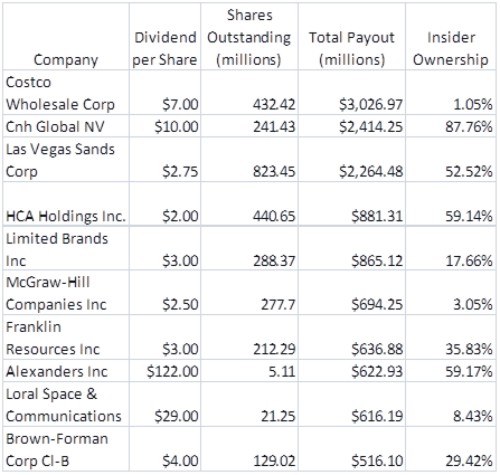
A case study in monetary and tax policy perversion of capital: Interest rates are nearly zero as the Ben Bernanke prints money to finance the deficit and debt[1]. Taxes (the “cliff”) are set to rise in a few days so what are corporations doing? Dumping cash to shareholders. Costco for one is borrowing $3.5 billion to pay a one time $3 billion special dividend to shareholders. The debt will be repaid by future earnings. And former CEO, Jim Sinegal wants the rest of us and in particular small business to pay higher taxes. Hypocrite.
In fact, as of last week reported special one-time corporate dividends totaled roughly $23 billion and note, Apple with $90 billion in cash is not included in this list.

Conclusion: taxes matter.
The first proposal by ACEEE is to lower the tax on repatriated money. ACEEE claims the cost to the treasury would be low. I disagree. The cost to the treasury will be negative. In other words, the treasury will increase its haul because the current 35% of $0 is $0. Ten percent of hundreds of billions of dollars is billions and billions of dollars – not even counting the ensuing corporate, income, property and all kinds of taxes business expansion in the US will deliver. I have no doubt the majority of lawmakers in Washington are clueless about these things. A confiscatory tax rate that can / will be / is avoided produces no revenue to the treasury. The result is a pre-cliff surge in tax revenue in 2012 on LOW taxes followed by a dearth next year. I’ll provide the data when it becomes available.
- Bottom line: I strongly agree with ACEEE that repatriated dollars should be taxed at a far lower rate, if taxed at all.
The second proposal is to use accelerated depreciation to get a near term tax benefit from energy efficiency projects. ACEEE claims this will not cost the treasury anything because it simply shifts the tax burden to out years. I too like this policy but I would want it across the board. Defining an energy efficiency project would be a mess. Trust me. We have seen many absurd claims in self-directed (customer directed) / opt-out (of EE programs) projects. Companies, let alone the IRS, do not know what energy efficiency is. For example, spending money to consolidate manufacturing to one facility, or from two shifts seven days a week to three shifts five days a week is NOT energy efficiency. But customers think it is.
- Bottom line: I agree with ACEEE but let’s use accelerated depreciation across the board for all types of investment.
The third proposal is a tax credit of 35% of the investment in EE to be repaid over 10 years. I understand the benefit but linking it to reality is a bit more complicated than the first two. If the project lowered energy consumption by the cost of implementation over 10 years (e.g., 10 year payback), this gives the customer a tax incentive in year one to be repaid over the 10 years. So it seems like financing the tax payments.
- Bottom line: This wouldn’t be attractive to me and like the second one, it is too burdensome and easily gamed.
Number four is Jeff Ihnen’s idea: lower the corporate tax rate across the board and nix all the perverting tax loopholes and credits. Let’s move from the highest corporate tax rate in the world to one of the lowest, say 10%. Eliminate the tax on repatriated capital. The treasury is getting nothing from it now and allowing those dollars to flow back will allow companies to expand here in the US, creating corporate income tax, jobs and associated personal income tax. A summary of enormous benefits:
- Jobs – Washington’s clueless fixation.
- Higher tax revenue.
- MORE energy efficiency[2].
- Insourcing jobs.
- Capital will flood into the most productive country in the world – ours.
- Greenhouse gas reduction – think of that! China is building coal plants willy nilly. The US is shutting them down ON TOP of being more energy efficient and more productive.
Everyone except perhaps our foreign competitors and Washington wins here. However, there remains one mammoth obstacle: ignorance and/or lust for power in Washington. Lowering and flattening the tax code while getting rid of deductions and credits takes away power, manipulation, and ability to divide the electorate to win or buy the next election.
[1] Home owners may think this is good but there is no free lunch and I can explain that another day.
[2] Energy efficiency builds the bottom line and taking less in taxes makes it more attractive.
Old School EE
Forging on from last week’s Arthur Fonzarelli crash into Arnold’s chicken stand, this week I will posit some challenges and problems presented with state takeovers of energy efficiency programs. Per last week’s post, Wisconsin has fallen from 8th place in the nation to 17th place since the state essentially took over its energy efficiency programs. This is according to the American Council for an Energy Efficient Economy, ACEEE, a well respected national think tank (my term) and advocacy organization for energy efficiency.
One problem is the money moves further away from where it is collected. The further program spending is from the point of collection, the less care there is in its cost effective investment and avoidance of waste. This is natural, and it is a fact. A local, charitable non-profit is going to more carefully spend its money because local donors are right there to see the results for themselves. If they want continuing donations, the local charity will be very frugal. Moving on to local government, citizens know school board members, city council members, county commissioners, and so forth. Do you think these representatives are going to be a little more sensitive to their largess when constituents may verbally tear them apart while filling up the tank at Kwik Trip or blast them in front of everyone at the next board meeting?
On the other end, taxing and spending at the federal level comes with very little accountability or care. We have revenue rolling in from all over the country – income, payroll, Medicare, excise, corporate, and a few dozen other taxes and fees – and we have spending at 1.5 times that rate all over the world. Spenders don’t care about taxpayers because they are not personally confronted by them. The people responsible are insulated like mob bosses. Write to one. You’ll get a form letter describing how great their legislation is on an unrelated topic. Nice. Have you ever been around a US senator or house representative? They ooze with goo, and slide like (per my Tennessee friend) a greased eel in a barrel of snot.
When money is collected by a utility and spent for its customers, there is clearly more responsibility in spending that money. For one thing, they are under the eyes and thumbs of the regulators. They are in Wisconsin too, but the regulators hand pick the administrators, and thus there is an inescapable bias – like what is the best car on the market – mine because I selected it and I’m smart. It’s human nature, man. That’s all I’m sayin’.
Utilities have relationships with customers, and those are very important to the utility. For state-run programs, not so much. This presents another round of challenges.
First, good account managers understand their customers’ businesses and needs. They are a tremendous resource and lever in a utility-run program. With utility-administered programs, money is budgeted for account managers to assist with energy efficiency projects, so they are deeply involved in many cases. For state run programs, not only is the budget absent, there is no carrot (goals) for saving customers’ energy. Account manager time is extremely taxed so if it isn’t part of their responsibilities, they simply will not / cannot help.
Another result of not understanding customer business and needs is a lack of deep, structural, and lasting energy efficiency planning. It is akin to the difference between long-term planning for a small business such as ours versus hitting quarterly earnings targets for a large corporation. There is a huge difference between twisting a customer’s arm to replace all their lighting and throwing some program money at them, versus digging in and solving problems, reducing maintenance costs, improving productivity, and increasing profits and operating income – and maintaining and in fact continuing down the road. Account managers live for this stuff. We live for this stuff. Persistence!
As alluded to in last week’s post, Wisconsin’s programs are low-cost and widget[1] based. The programs are very similar to those in Illinois and Michigan. Recall that while Wisconsin slipped from 8th to 17th since 1998, Michigan climbed from 46th to 12th (ouch). Michigan also has low-cost widget based programs, but Michigan is very new to energy efficiency (and programs are run by utilities). Conversely, Wisconsin represents a very mature market for EE.
Meanwhile, utilities in neighboring Minnesota and Iowa, two other mature markets, have moved on to successful industrial, process, retrocommissioning, and new construction programs for commercial and industrial customers. They have vibrant energy analysis programs to assist customers with identifying, planning, and prioritizing implementation of cost effective measures. Wisconsin point-blank shuns this sort of informational / road-map assistance to guide complex customers to higher profit and improved cash flow.
Furthermore, where utilities own the programs there is de facto competition among them to look good to their customers and to the regulators. There is vibrancy. Things change. Things improve. They have to keep pace. They want to be better. In absence of this: same old, same old, until the entire state is compared against others and then the results aren’t liked.
In my 17 years in the business, I can tell you the days of en masse studies and energy audits rotting on the shelf with no ensuing action; and customers not caring about energy cost and not viewing energy as a strategic resource have changed dramatically.
We were even told by one of our major utility clients in a neighboring state that their management sees energy efficiency as a source of income rather than a “red headed stepchild”[2] as it used to be viewed. Times have changed, dramatically. Like Dan York from ACEEE mentioned in his letter to the Cap Times, “neighboring states rank higher than Wisconsin because they continue to push for higher energy savings through increased investments in energy efficiency. Wisconsin, by contrast, is standing still and by doing so, is getting left behind”.
[1] Widget-based simply means standard option A versus more efficient, somewhat more expensive option B.
[2] I’ll trade gray hair for red if anyone is interested.
Is This the Real Life? Is This Just Fantasy?
When I was a kid, I liked to play games; board games, cards, video games, pinball, racing with an electric racetrack, and even golf with clubs on grass outdoors! BTW, these things kick butt over any video game, any day.
Somewhere between the ages of 12 and 14, I lost interest in this crap. Why? Because life is enough game for me. It’s all about competition, and I’d rather beat others on the court, field, or classroom doing real things with my own skills. And now, it is business in which I compete.
When I go to conferences or seminars, aside from networking, I want to learn. I want to learn what others are doing so I can compare and contrast, and I may even learn something I didn’t know, or learn more about something I knew little about. I don’t want to play dopey games that have no consequences.
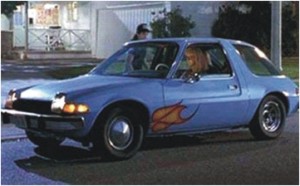
For example, last week I attended the E Source Forum in Denver. I ignorantly sauntered into a session called Optimizing DSM (demand side management, aka energy efficiency) Programs. Tell me something I don’t know, or at least give me something to laugh at, whether it’s humor or a laughably mediocre/poor performing program that is sold as the greatest thing since squeezable cheese whiz – like a new personal transportation device developed in a bubble, ignorant of other programs (cars). As an example, metaphorically
speaking, if the program were a car, it would be the Wayne’s World AMC Pacer. Isn’t it fantastic?! Uh, yeah sure.
In a triple flip of fate, it just so happens the theme song with the Pacer is Queen’s Bohemian Rhapsody; “Is this the real life? Is this just fantasy?…”
Back to the real life, upon sitting down for the session, I quickly learned this was a trap – It was a fantasy of: you have a crappy program, design a new one in twenty minutes after reading everything you need to know on two sheets of paper. The prisoners at our table (our team) each played one of six or eight characters like market analyst, program designer, marketing guy, evaluator, implementer, etc.
We were a municipal utility with 300,000 customers, all of which hated us. Our goals would increase five fold over three years. The current program consists almost entirely of lighting (this is actually realistic), and the sector at hand is small business. All the trade allies hate us because we have gyrating incentives depending on the season and which way the wind is blowing. Our budget was $16. Go.
Thank goodness some people like to do this stuff. My inclination was to get away from lighting – the training wheels of EE programs. The Forum featured numerous sessions on the latest and greatest training wheels, and I successfully avoided them all. The one thing I like about lighting is lack of it – spaces that are either daylit or dimly lit. Anyway, nobody at our table was going for my divergence from training wheels. We did the usual status quo act, and I was fine with that. Let’s just get out of here.
There were about eight teams; four on our scenario and about four on a residential program fantasy. The winning team/program gets a chocolate bar and deserved ridicule. My colleague’s (who shall remain un-ID’d) team won and true to form, there were no boundaries to their fantasy – money, physics, geography, time – don’t let these petty issues get in the way. Every trade ally gets a free iPad. Every participating customer gets an all-expense paid, two-week vacation in sunny Damascus. The judges went for that. Ok. It’s all yours. Enjoy your day in the fantasyland sun but once you walk out the door, it’s time to leave it all behind and face the truth, little silhouetto of a man.
Otherwise, it was a great conference, pretty much. We were able to spend a lot of quality time with clients and meet and greet new people, aka networking.
In other news, the most overused buzzword of 2012 and/or possibly 2013 is “space”, as in market. Used in a sentence, “We operate in the large C&I space.” I would suggest a drinking game, where for every time the word space is muttered, everyone takes a shot of tequila. After 10 minutes in an EE conference social hour, no one would be left standing. The entire city would be out of booze. Yes indeed, at the end of the day, after kicking the can down the road, I’d like to throw space, paradigmatic synergisms, and the entire middle class, under the bus.
Opting to Make Money
In many states that are relatively new to energy efficiency, legislators often cave to large energy users and allow them to opt out of programs because hey, they use a ton of energy and therefore, OBVIOUSLY to any moron, they control and manage these costs as well as any dunce could. Why should they throw money at a program that won’t help them?
Come to think of it, programs available to these large users in many places are dysfunctional, poorly conceived, and not thought through from the perspective of the customer, so I can see their point to some extent. I already have a type of colossal program failure that has been proven to produce nothing in many jurisdictions and I’ll talk about that next week or some other time.
The only real reason for large users opting out is that they think they can better spend the relatively tiny bit of money they would contribute to the program or more likely, they’d rather not pay anything and continue with business as usual. Both are foolish.
Let’s just use an example of a large user with $10 million in energy costs, paying 1% to the EE fund, which is $100,000. This sounds like a lot of money. It is not for a company of this size.
Allow me to demonstrate how foolish opting out is, using a rule of thumb that program incentives typically equal one year’s energy savings at minimum (I have seen incentives as high as FOUR year’s savings, in which case a psychiatric evaluation should be ordered up for opt-outs). Companies that opt out generally have to meet the savings goals the utility needs to meet in return for opting out, and this too, is generally in the region of 1% of sales, or in the case of the customer, 1% of consumption.
Take an opt-out and opt-in comparison for the above $10 million customer for a $200,000 project with $100,000 savings. ASSUMING no difference in customer time (time is money) and expense[1], the ROI is exactly the same. The opt-in customer pays $100k to the EE pot and gets it all back as an incentive for doing the project. However, the reporting for the opt-out customer will take at least $10k, I would guess, if they do a decent job.
Now suppose the investment is doubled to $400,000. The opt-in customer still only pays $100k into the program but gets $200k back in incentives. The customer starts to take other peoples’ money as he implements larger projects. Suddenly, the ROI starts quickly rising above the opt-out scenario.
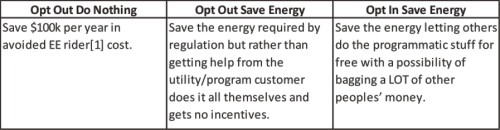
The only way the opt-out customer comes out ahead is if they plan to do nothing, in which case, rather than paying $100k into the EE pot, they pay nothing, all else equal. So, the scenarios become:

The “opt-out do nothing” scenario cannot stand, because customers agree to meet their goals, and this too, is where the BS continues. The typical opt-out customer includes manufacturers. Efficiency to manufacturers many times means high output and no shutdowns – not low energy use per unit of production – aka, ENERGY efficiency. Due to the lack of EE expertise beyond lighting, we see many doozers when evaluating projects from customers that opt out.
To use one example I used before (company name and project totally made up to protect the guilty), a baseball bat manufacturer switches from manufacturing wooden bats to aluminum bats. Wood requires the operation of a large kiln for drying, lathes, lacquer and all this sort of stuff. Making aluminum bats allows them to shut down the kiln, turn off the lathes, lay off half the workers, close half the facility, and increase production. The energy consumption per bat decreases. Problem: this is a totally different manufacturing process. The baseline is not the manufacture of wooden bats. The baseline is standard practice for making aluminum bats. What is that? At the point of evaluation, they don’t know. No alternatives were explored when they switched. There are no savings here. What a mess.
Another one includes a “behavioral” change where instead of running shifts every day of the week, the customer switches to running around the clock fewer days, primarily due to long wait times to start up and shut down every day, wasting energy and labor. Programs are not meant to incentivize avoidance of obvious absurdities. We probably don’t have the whole story, which may include going from 24/7 operation to 24/4 operation. No, reducing production is not energy efficiency.
Smart large users opt in and leverage the program for all it’s worth. Even the hugest, most goal-driven companies saving dozens of megawatts (no kidding) leverage programs to the max. Somebody has to save energy and demand and it may as well be me, large user. I take money paid from my less intelligent competitors and other citizens; my utility loves me because I am making giant steps toward their mandated goals; my colleagues in other parts of the country are envious; my CEO loves me because I’m substantially adding to the bottom line and reducing risk; and I take a huge administrative/management burden off my plate and give it to the program/utility.
If this is not a competitive advantage, I don’t know what is.
[1] Opt-out customers must file their own plans and reports just like the larger utility program and that takes substantial time to do any sort of reasonably acceptable job.
[2] A rider is an added fee, usually per unit energy used for energy efficiency, fuel cost adjustments and other things.
Independence, Finally
Here is some good news in my view. Despite nearly 40 years of political claptrap to reduce our dependence on foreign oil, technology from the private sector, not cockamamie pie in the sky, physics-defying dumb ideas will deliver it. That is, unless of course Washington snatches defeat from the jaws of victory, which it is 100% capable of doing.
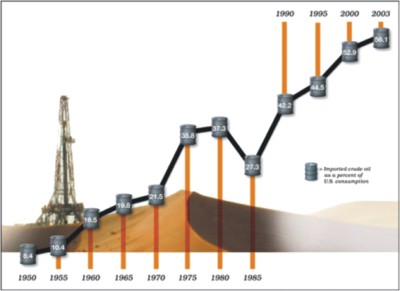
I went looking for data on our dependence on foreign oil since the first oil shocks of the 1970s. There is one significant dip in the import percentage chart nearby and that is due to (1) a deep recession in the early 1980s, and (2) cars shrunk in size and weight in a period of a couple years by at least 30%. They have since ballooned back to monster tanker size. Have you stood next to a 6000 pound Dodge Charger[1] lately?
The second chart shows consumption, production, and imports of crude, as reported by the DOE’s Energy Information Administration. Production has only recently increased after a nearly unabated 40 year decline.
As an example of Federal Government lunacy, see the transcript from GWB’s State of the Union show excerpt from 2006. According to that, by now, 2012, we were to have plentiful, clean, safe, nukes (none), cellulosic ethanol (none), better batteries (like ones that don’t start on fire?), and this dandy: hydrogen for emissions free transportation (you’re killing me).
The 2006 goal was to reduce petrol imports by 75% by 2025 – another “pull a number out of the air” for a round of applause. I would boo, or possibly I’d be more civil and just laugh aloud like Dr. Evil and No. 2.
The Wall Street Journal recently reported that the explosion in domestic natural gas and oil production due to hydraulic fracturing could chop oil imports from the hostile Middle East in half by the end of the decade and end it altogether by 2035. Whoa! Think of living in that kind of world!
Time out for this note: We have only been worried about running out of natural gas and crude oil for about 35 years, but as the years pass, the reserves keep growing driven by the private sector’s salacious quest for profit. It’s just pure evil.
Aside from geological and extraction technology delivered by the private sector, another critical element of this unstoppable energy boom is that the shale formations being targeted for drilling are in the control of private land owners, free of the Washington straightjacket.
Not only will oil production increase in North America, kicking our dictatorial adversaries where it hurts most, natural gas is likely to become a significant transportation fuel. And, like it or not, a huge benefit of coal and natural gas is that they are virtually ready for consumption as extracted from the earth. Crude oil obviously is not.
Even with this abundance of conventional fuel sources, the pursuit of alternatives will continue. Actually, the abundance and accompanying low cost is likely to draw the sinister profit seekers to hotly pursue alternative fuels. I project, with high certainty, that breakthroughs in alternate fuels will come from some of the most hated sectors in business: big oil and big chemical. This isn’t like starting a software company or social media site. It requires massive investment in R&D, high priced technical experts, equipment, and facilities, and freedom from the ignorance of dumb ideas and red tape.
This will be a bittersweet sister smooch.
[1] Wild guess. The point is, they are enormous hulksters.
Progress?
I was becoming concerned this week at rant time, Sunday morning, 9:00 AM. We had our company picnic the day before on an overcast and nearly perfect day in cheese land. Sunday was similar. There were orioles, grosbeaks, yellow finches, house finches, ruby throated hummingbirds, downy woodpeckers, red breasted woodpeckers, cardinals, nuthatches, chickadees and other customers freeloading on our smorgasbord of bird offerings. But then while reviewing my sources, one of which is the Google energy efficiency updates, emailed promptly at 4:51 PM CDT everyday, I came across this cheery piece. There’s the topic of the week.
It started out with the article that “Sex is Better with Energy Efficiency”, which talked about abysmal EE marketing and we all know why. Because EE is as sexy as, I don’t know – a tumbleweed? Road kill? A tree stump? Something like this?
Backing up a little, there were huge changes in media in the 1980s and 1990s. In the 1980s, obviously the biggest breakthrough was MTV with Madonna and Michael Jackson videos. Twenty-four hour “specialty” startups like CNN and ESPN came onto the scene. In the 1990s, information dissemination exploded another order of magnitude with Netscape and email. Now we have Twitter and tens of thousands, hundreds of thousands, millions, bazillions of websites. You can find millions of sheep and websites that will feed whatever theory, phobia, and frenzy you want.
Let’s go to the headlines in the referenced blog. Climate change caused: the Duluth flood, western wildfires, disappearance of arctic ice (uncovering more oil reserves to hasten global warming), ruinous healthcare, hottest May on record, paranoid oil companies, 72% of everyone, accelerating temperature increases, cannibalism amongst Antarctica’s penguins. I made the penguin thing up myself.
Global warming is a threat. There is no doubt about it and I’ve never claimed otherwise. But ambulance chasing the latest natural disaster insults the intelligence of any human being. First a side note: the record 24 hour rainfall for Duluth is now a measly 7.25 inches? That is amazing. We had historic flooding in the La Crosse area a few years ago (back to back years even), and the first one was about a foot of rain in a 24 hour period. On our sidewalk, it almost filled a 5 gallon bucket to the top with just water falling out of the sky. Incredible!
Last year we had a pathetically warm winter, but the previous several were reminiscent of the old fashioned cold snowy ones when I was a kid. In my freshman year of college, we had a heavy snow in October, and it never melted through the winter until May or something. A couple years later, it was pathetically warm again. The year I graduated – the night before moving out of the 4 plex after graduation, it was minus 28F. You don’t forget things like that. Notice I apply “pathetic” to warm conditions. I like it cold when it should be cold so I don’t want global warming at all – even for selfish reasons.
Climatic temperatures have risen a couple degrees over the past century, but for natural disasters, people should look back in history to see some of the whompers. Consider the dust bowl in the 1930s. Look at the kid nearby, 1936. He would be about my father’s age and could very well still be living somewhere – snowbirding on a beach in Florida or something? That’s Oklahoma in the picture folks. Not Saudi Arabia. Imagine if that happened today!
The climate change movement would do well with me if the ambulance chasing ceased. For example, the strong hurricanes a few years ago, including Katrina, were reportedly a global warming issue. But then there were none for about three straight years – actually haven’t had squat since that year. What happened? Last year there was major flooding along the Missouri River, the result of a very cold and snowy winter in its watershed. Not long before that, the river was at all time lows. For two or three years in a row, before last winter, the east coast had obscene levels of snow – and we got gypped in the Midwest. Give us some record snow already! It’s our turn!
Twenty-four hour news has to cover something so they cover the hell out of any anomaly – like it’s the first time it’s EVER happened. And any schmo sitting in their basement can be taken seriously if he whips up enough frenzy. If a person took 1% of this seriously they would have to be hospitalized for hypochondria.
Call me crazy, but when a tornado flattens a town, take care of sick and injured, and secure food, water and shelter first. Buy furniture later. As environmentalist Bjorn Lomborg points out per the UN even, deaths due to natural disaster including global warming average 27,000 per year. Lack of clean water and poor sanitation are responsible for 3 million deaths per year. Clean water and sanitation in a huge part of the world is cost prohibitive to the locals. But the ability for the west to develop clean water for them is a relative peanut.
Lastly, financial collapse like that which happened in the Great Depression will happen again. It isn’t a matter of if, but when, and it will all be the result of political self interest mixed with stupidity and ignorance of history and thinking, “it’s different this time”. No. It isn’t.
The ironic thing both the economy/social welfare systems and global warming have in common is; by the time they become grave threats, people will have heard the wolf cries for too long. When the threat level reaches the danger zone, people have long since been tone deaf.
Universal Widgetitis
As blasted in this blog many times, most recently in Widgetman, humans almost always have their priorities far out of whack. With EE for example, facility owners should probably establish marshal law to ensure lights are shut off overnight in their office buildings before they start adding photovoltaic panels. But then, I guess, to the casual observer (schlep) one can see how green the building is during the day, but at night when the building is lit like the headlamp of an oncoming train when no one is there, the wonderful PV panels cannot be seen and nobody pays attention or cares that the lights are burning bright to keep the cockroaches in their holes.
The human desire for widgets over self improvement, learning, hard work, and results for the greatest achievement in whatever the pursuit may be is universal. A perfect illustration for this is the triathlon. I’m not a triathlete for several reasons, the first of which I wouldn’t make it out of the water, the most dangerous part of the tri, alive. Maybe I could do something substantial like an Olympic distance or half ironman with gobs and gobs and gobs of time swimming.
The other barrier to tris, to me, is they require gobs of crap, but a barrier to me may be a reason to do them for others because people like crap (widgets). For the swim, a wetsuit is a great idea because hypothermia in the water can result in death. They also add buoyancy, which I would desperately need.
After the swim – the bike and run is where people get widgetitis. Let’s start with the bicycle. I would guess at least half the bikes in a half-iron are the Cervelos or equivalent Trek, this, that or the other. These are the Formula 1 race cars for the cycling universe. Some cost north of $6,000 easily, and they are pretty much only used for racing because they are stiff and uncomfortable to ride (I am told). But, they are extremely light and aerodynamic – the frame, the wheels, the frame and the wheels together, and the handlebars. If you own one of these and don’t shave your chops and legs, you’re wasting money.
Then there are the aero helmets for another $150, which is ridiculous because it must cost as much to design and manufacture a toilet plunger as it does for one of these things.
As I watch some people mounting and donning this stuff for their 56 mile ride I’m thinking, “Why don’t you lose that 20 pound sand bag of a spare tire, and then pay $5000 to shave 6 ounces off the bike and get the aerodynamics that will save you 30 seconds on a 56 mile ride?” In combination, these bikers are like a Formula 1 race car with an 18 horsepower Briggs and Stratton lawnmower engine.
Moving onto the run, which I actually can do, we have additional widgets of the day. Some of the Formula 1 drivers may use a beverage belt thingy with eight or ten little bottles of sport and energy drinks of some sort. They each probably contain 100 calories and a bunch of expensive mineral crap they don’t need. They remind me of my little green army guys when I was a kid, but rather than having a belt full of grenades, it’s a belt full of little flasks. There are probably 10 water/Gatorade stops on the course, so what’s the point in carrying this cargo?
Then there are compression thingies for the calves and arms. What are these for? They’re like the spoiler on the old bitchin’ camaros from the 1970s (check out the song sometime by the Dead Milkmen). They look “cool” (to some people), but they serve a dopey, theoretical purpose. The theory is they increase veinal (return) blood flow. Good for bed-ridden or stationary people, but triathlons? Working muscles need blood flow and these things restrict it. The fad is in the NBA as well. Lastly, I would add that triathlons occur in the summer when it’s hot. What you need: the right shoes for your foot type and maximum heat rejection. Compression things are insulation. Bad. BTW, remember cho-pat straps and nasal strips? Gone. You won’t see these compression things in five years either.
There are similarities with energy efficiency. At the moment, LEDs are the hot item, but to my knowledge, they produce no more lumens per Watt than a decent T8 fluorescent lamp. They have other advantages, however, like a forever service life, and they don’t result in skunky beer they tell me. Electric cars will be in the nasal strip category as they will be swamped by hybrids with possibly some decent market share by plug-in hybrids. Then, of course, there is the Cervelo owner with the 20 pound spare tire equal for buildings: the LEED triple platinum with PV, solar water heating, individual temperature and ventilation control, variable speed drives operating at full speed, and heating water temperature controlled to 160F all the time.
Forget the widgets and apply yourself first.[1]
[1] Finishing a triathlon is a great accomplishment and while I have no vested interest, by all means, buy all the stuff you want!
Intelligencize This
Last week ACEEE produced a webinar, “Intelligent Efficiency”. I was late to the party but as I came online, an ACEEE guy, Neal Elliott was talking and the topic was intriguing – system-wide, holistic, intelligent efficiency. I thought, hmm, maybe somebody read this entire series of rants and was possibly preaching from the gospels of the obvious.
Next up was a guy from Schneider Electric and he gave a boring advertisement of – Schneider Electric. Next was a guy from Johnson Controls to talk about what else – the Empire State building. The Empire State Building EE overhaul has been in every trade magazine, newspaper, crap magazine (Time, Newsweek), The National Enquirer, Star, Vogue, Bon Appétit, Weight Watchers, Cigar Aficionado, Esquire, Cosmo, Sports Illustrated, Readers Digest, Playboy, Parent, billboards, newspaper ads, taxis, subway cars (next to the toe fungus, tattoo removal, gout prevention, sleep apnea and hernia repair shop ads), buses, elevators, church and synagogue bulletins, PSAs, restaurant menus, grocery carts, cereal boxes, milk cartons, toilet stalls, gasoline pumps, dentist, veterinary, and doctor offices, 60 Minutes, 20/20, The Apprentice, Dancing with the Stars, Letterman, Leno, SNL, and Jimmy Kimmel. I immediately pulled the plug before nausea set in. I only have about two or three more times I can absorb shameless JCI / Empire State building propaganda before I throw up till my gall bladder bleeds. Get it already?
Fortunately, ACEEE published a paper on the topic. Intelligent Efficiency includes three components: People Centered Efficiency, Technology Centered Efficiency, and Service Oriented Efficiency.
People efficiency includes the constant bombardment of information so consumers can change behavior to save energy. An example given includes monitoring home energy use over time to see when and how much energy is used to modify behavior. Similarly, information can be provided at the organization or community level to “invite human behavior” into the system.
Technology efficiency includes gizmos that optimize facility, industrial and transportation efficiencies. Users program and commission the gizmos and watch the savings accumulate. Sounds good. However, they are talking beyond fixing systems that are already controlled by energy management systems. They are talking about anticipatory elements like weather forecasting – turnip milking.
Service oriented technology includes stuff like virtual meetings, webcams, webinars and beaming up Scotty.
In regard to people efficiency, people need to give a crap before they are going to do anything. I go back to something I wrote many posts ago – something I took from a senior member of a client of ours. She compared smart meters and energy information bombardment for customers with that of nutrition information bombardment. Has there ever been more nutrition information available and in your face, and have obesity rates ever been higher? Answers: no and no. Regarding energy efficiency, this just in: American’s know how to save energy in many ways, but don’t – great timing. Six in ten say they lack knowledge for EE as a major reason for not doing anything. The other four vastly over estimate their capability. And wouldn’t you know it, nearly all programs merely throw money at EE and very few provide decent information for commercial and industrial. Actually, some jurisdictions close to home (hint, hint) discourage and in fact see customized EE plans as a waste of money. Ignorance is bliss.
When it comes to intelligent controls and artificial intelligence, how about fixing the grotesque levels of waste that is present in many commercial and industrial buildings. To put it in lay-androgynous-person terms, many facilities have the equivalent of the furnace, air conditioner, oven and wash machine running balls out[1] while all the windows are open and on top of this, comfort and/or production still suffer. I scream this over and over but apparently closing the windows and turning off the heater in summertime isn’t sexy enough. Lack of specific, custom INFORMATION is the problem. We’ll have a case study with a real project as a perfect example with a happy ending sometime this summer.
I suggest starting with the things that save 25% right off the top with an ROI of 150% before installing anticipatory fuzzy logic to determine peak coffee making time to trim back on the air conditioning to reduce electrical demand. Ok?
Here is a dirty secret as an example. The country could save billions on energy cost simply by opening throttle valves and controlling pumps properly with variable speed drives in commercial and especially industrial facilities. Barrier: Manufacturing staff barely have time to keep the wheels on. Expenses, especially labor, is cut to the bone and companies are making record profit, but they don’t have time for EE spotting and implementation. The EE program “energy adVISEr” should point this out, but if it isn’t a T12 light bulb, it isn’t in the “adVISEr’s” wheelhouse. One has to know what a valve, or a pump for that matter, looks like to fix it.
One final note – one of the primary barriers to “intelligent efficiency” as noted in the report is high up-front cost. This could be the case in some instances, but we have experienced facilities with the report’s referenced brands of controls – the latest and greatest fully capable of everything they are talking about – controlling systems that are wasting epic tankers of money.
Controls don’t save energy. Smart people using controls save energy. Educated and informed facility and process managers maintain the savings. Is anyone listening?
[1] Did you know that “balls out” is in reference to governors that control / maintain engine speed? “Balls out” simply means the engine is running fast.
Better than Doritos

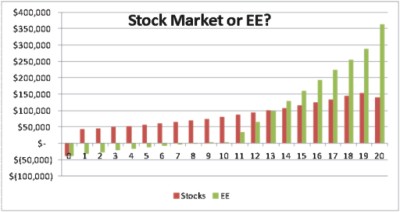
Last week we looked at the financial benefits of energy efficiency as compared to the stock market. I’m going to take this a few steps further, as forewarned last week.
In both cases we start with the $39,000 investment and the stock market simply grows at its long-term average of 7.5% (Dow Jones Industrials). Obviously, a smooth appreciation of your investment is not the case and if you don’t have a strong stomach, you should avoid equities. Why is it called the Dow Jones Industrial Average anyway? It’s full of service companies, banks, and retailers. It includes Microsoft, but not Apple, which has over twice the market capitalization. A company like Apple, which is absolutely huge, would probably make up half the movement in the DJIA.
The EE investment on the other hand immediately starts paying dividends – actually net cash in the bank to the tune of $6,200. This dividend shrinks as the interest payments, which are tax-deductible, go away until the lease/loan is entirely paid off. Over this period, the stocks, on average, would catch up to be almost exactly the same after 10 years. However, in the 10th year, the $30,800 annualized payments for the EE investment disappear and suddenly the investment starts earning 115% of the initial investment, year after year, for the next 10 years.
You may notice the dip at the end of the stock market valuation in year 20. That is the capital gains tax whack of 15% you have to pay when you cash out, wiping out the last few years of gains. There is no capital gains whack on the EE investment. All tax implications have run their course as they affect the annual energy savings, interest payments, and depreciation. Actually, in year 20 when the EE investment reaches the end of its useful life, the remaining value of the investment is fully depreciated. Since the depreciation period is 39 years, like that of any facility, almost 50% of the depreciation occurs at the end of life, resulting in a $44,000 surge in after tax income which is almost equal to one year’s energy savings.
Aside from generating over 250% the wealth generated in a stock market investment over a 20 year period, EE offers the very attractive benefits of risk mitigation and certainty for return on investment.
Energy prices are volatile and today there is as much uncertainty in energy prices as there has ever been, which is why investors and companies are sitting on the sidelines hoarding cash. Specifically, nobody knows how many power plants the EPA will eventually shut down. Will they allow hydraulic fracturing that has produced the glut and current rock bottom prices for natural gas to continue? The beauty of investing in energy efficiency is if prices go up, you save even more than you projected. Rising prices is not a good thing, but by investing in energy efficiency you have insulated yourself against this and even improved your ROI. Conversely, if energy prices fall, your ROI drops, but who cares? You are paying less and your profit, or after tax income, improves.
In IPO Return, Treasury Risk, I described the low risk in energy efficiency, in most cases. Whoever determines the savings potential must not be a dufus, hack, or cheat.
Everyone knows there is always competition for scarce capital within an organization. Very few investments (uses of capital) have the certainty of EE. If a manufacturer decides to add another line of production, they better hope demand for the product increases as projected. And by the way, what is the return on that product? 10%? What ROI does a grocery store facelift have? Is that going to result in $363,000 capital formation over the next 20 years?
How about risk in plain old strategy against competitors or to sedate rabid mobs of protestors? In this article, Holman Jenkins compares and contrasts McDonald’s response to heat from child obesity activism to that of Pepsi, which of course makes soda with the poisonous high fructose corn syrup and other salt/fat bomb stuff people, including me, love. Nacho cheese Doritos – mmmm! They were awesome in 7th grade and they are awesome in 2012. McDonald’s strategy was to add healthy stuff to their menu. Never mind, because nobody buys happy meals with apple slices. It makes them feel better just knowing healthy stuff is available (not making this up). Pepsi, on the other hand, apparently messed with its product line with poor results, no stock market gain in 5 years. The bottom line is business is fraught with risk at every turn. It’s very difficult to beat the low risk and high return of energy efficiency.
The only “downside” with energy efficiency is its potential for a given end user is capped. It’s like short selling a stock. The most you can make is the entire value of the sale. The most energy you can save is the total you are paying now. However, energy efficiency is far safer than shorting a stock. The downside of shorting a stock is infinite. There is minimal downside risk to energy efficiency.

Finally, to look at a couple factors, it is interesting that end of life value varies linearly with down payment and with corporate tax rate. The percent down makes little difference. Lower taxes are clearly a boon to energy efficiency.
Next week: I’ll be sure to find something to gripe about.
← Older posts