Archives

Blog Archives

Mad States of Saudi America

Energy Efficiency, Uncategorized0 comments

Remember peak oil?  That was the glorious theory, which at some point will occur and no one will know, or maybe it won’t matter, that the stewards of the planet have maxed out oil production, and we would be headed for terminal depletion – and we adopt Mad Max-like diplomacy to survive.  By the way, the Mad Max dog is an Australian Cattle Dog, or Blue Heeler, and his name is Dogmeat and he has his own Facebook page.  We had a Red Heeler when I was a kid, and her nickname was Tough Dog for a reason.  Not mean.  Tough.  So I’ve always had a soft spot for Dogmeat.

Last week the International Energy Agency, a French-based organization, declared the US would blow past the Saudis in oil production, a mere eight years from now in 2020.  Eat your heart out, Vlady.  That may actually be the case, but in this article from the Houston Chronicle, IEA goes on to make other absurd predictions.  They project that with Obama’s push for vastly higher corporate average fuel economy standards to reach 55 mpg by 2025, we will be “all but self sufficient by 2035”.  Stop the press.

Projecting energy and other commodity markets employ plenty of eggheads but this is for sure: they have a dismal record for accuracy.  Years ago when I was clearing out some archive junk back at our old office, I came across a DOE projection of energy costs from 1980.  The projected cost of natural gas then was $3 per therm, not dekatherm, by 2000.  I think in 2000, natural gas was actually selling for 10% of that projected price, i.e., 30 cents per therm.  Right now it is selling at the hub for 37 cents per therm.  These long term projections are worthless as are promises to reach some goal by 2050.

Pumped up domestic production (pun alert) will put some downward pressure on prices, all else equal.  And like the President says, “As I’ve said before”, the general populous doesn’t care about saving energy or being green unless it improves their own bottom line or somebody else is picking up the tab.  When the benefits of saving energy and being green outweigh (another pun alert), the desired 4 ton hulk SUV, folks may instead buy a reasonable minivan or even a, gulp, station wagon.

Achieving a 55 mpg average in the projected market of energy independence is most likely not going to happen.  The only thing holding me to “most likely” is the diesel engine, which to my knowledge, and I stand at least a 50/50 chance of being wrong on this, is unavailable in any domestically produced automobiles.  It is entirely conceivable to design a diesel hybrid that is tire-squealing fast.

Stored electricity can pour enormous power to rubber on the road.  A 1972 Datsun with a converted power train to a few dozen twelve-volt batteries, and a couple forklift motor drives, will blow away a modern Corvette, for example.  People do this as hobbies, but I surely wouldn’t, Shirley.   A fast diesel hybrid would be really cool, but boring, as I like manual transmissions, but it should satisfy many in the mass market.  Note, however, that huge hulks like the Chevy Suburban would still have awful mileage – moving a four ton monster requires gobs of energy, period.

Despite every president from Richard Milhous Nixon (does anyone know anyone named Milhous?) promising to do something about dependence on foreign oil, it appears likely that we are going to get there, or at least virtually get there via greedy money grubbers developing new technology to extract energy stores here in the states.  Ironically, the feds, who remember are supposed to want us to get off foreign oil, have yet to devise a way to greatly curtail this new gusher of energy supply, because it comes from beneath privately held land.  If North Dakota, Ohio, Pennsylvania, Michigan, and other states with massive stores of oil and natural gas were a giant national park purchased by the federal government, like Alaska, we wouldn’t be in this position.  I wouldn’t be writing about the Mad States of Saudi America.

Think of the fallout if this happens, and we no longer need 20% of our oil from the Middle East.  The US has patrolled the region and kept the relative peace, sort of, since WWII, at an estimated cost of $70 billion per year, per The Wall Street Journal.  This is the first estimate I’ve seen for this, and it is interesting because I have always heard from the peak oilers that oil from the Middle East is heavily subsidized.  According to my calculations from information gleaned from the referenced WSJ article, the value of oil the US purchases from the Middle East is $131 billion per year.  By golly, I would certainly agree with the peak oilers on this one.  Why not get out of there and let the Chinese and Russians keep the rockets and bombs to a dull roar for themselves.  Maybe even the Europeans would be forced to do something for themselves for once.

The potential implications here are extraordinary, but it remains to be seen how Washington will dork it up.

Nationalize EE – Boooo!

Energy Efficiency, Government, Utility Stuff1 comment

The widget world of energy efficiency is governed by the Technical Resource Manual, or TRM.  A technical resource manual includes energy calculations requiring baselines and efficient equipment specifications, hours of use, and duty cycles.  It also includes cost differences for baseline and efficient equipment.  Costs and savings from TRMs are used across the board for mass market, and even in some cases large, far too large in my opinion, equipment.

Technical resource manuals may be held at the state level, which may apply to all programs/utilities in the state, or at the utility level.  Some in our industry are advocating for a national TRM and developing a repository of TRMs from throughout the country.  This is a self-serving waste of time and a bad idea for consumers/customers.  It is self serving because some companies lobby for things so they can get a massive project to make it happen, but this rant is about why this is a waste of time and a bad idea.

In a nutshell, it is a waste of time because Vermont is not Texas.  Vermont is not Texas politically, climatically, economically, demographically, and a couple dozen other lorem ipsumicallies.  Nor is the market in Texas the same as Vermont.  Utilities within certain states don’t even want to use a statewide TRM from their state.  Why?  Reasons might include the utility doesn’t like the state TRM because it is technically inferior or it doesn’t match even their relatively localized customer base.  Possibly the utility has been implementing programs for a couple decades while maybe the munis and rural electric cooperatives have been at it for only a few years.  The demographics and markets are much different.

Federalism may sound like centralizing power and control, but it is the opposite.  It involves decentralized power and states rights and this is the way EE programs and associated TRMs should be controlled and maintained.  One reason is simply one size does not fit all, whatsoever.  The other is turning any of this over to the woeful DOE is terrifying as it should be for any state, utility or ratepayer.

Even with state-administered programs, program administration, implementation, and evaluation become politically motivated, consciously or subconsciously.  There is a theoretical oversight mechanism, but the truth of the matter is, all parties have a vested interest in declaring the program portfolio as wonderful and the citizens should be so lucky to be endowed with such greatness of the state.  The state is responsible for everything – implementation, evaluation and oversight.  If during honest and accurate evaluation, substantial flaws and unsavory findings are uncovered, is the state going to want to allow these findings to show the state’s implementation side of things sucks?  I don’t think so.  Go along to get along.

Conversely, private sector implementation (utilities) with public sector evaluation or public sector oversight of evaluation is going to result in more brutally honest assessment.  For about the 36th time, the role of government is to help ensure people don’t get ripped off, but if government is the rip-off, who do you turn to?  SOL, buddy.

Turning over TRMs to the feds would be a disaster for several reasons, the first of which is it will become subject to political pressure by manufacturers, their lobbyists and federal hacks.  Believing otherwise is naïve.  Secondly, it’s like everything else, the further the decision making is from where the money is collected and spent, the more wasteful it becomes.  Money collected from people in your hometown is more carefully spent than money collected from fools in another time zone.

Regarding EE, states and markets are about as unique as buildings.  Consider motives behind the push to nationalize TRMs or even maintenance policy, the hilarious-if-it-weren’t-true terrible track record of the DOE, and loss of control states would have for their unique situations.  Like many other things, only Washington will like it.

Ok.  I can’t let this pass, because it explains almost exactly what I said about two years ago in Playing with Fire.  The Wall Street Journal opinion writers just penned this: which states the Federal Reserve’s “quantitative easing” (buying US debt with freshly printed money), doesn’t fool anyone, raises commodity costs, takes onus off drunken binge spending in Washington, and is building a debt bomb which sooner or later needs to be financed with real people’s money – oh, and does absolutely nothing to spur the economy with any persistence.  The cycle goes like this:

  • Print money flooding the bond market with cash which drives down interest rates.
  • Banks have no incentive to lend money because it’s all risk (of rising interest rates) and no reward (low interest earnings).
  • Investors, particularly retired people, have no low-risk decent-return place to put short term cash.
  • Economy ticks up driving commodity prices higher and inflationary pressure, with dime a dozen dollars.
  • Rising commodity prices and inflationary pressure pull the economy down.
  • Repeat.

To be successful, one has to recognize what failure looks like.  Getting off this merry-go-round will be painful.  We’re deadening the agony of a hangover with a few shots of booze and doing it again and again.

Independence, Finally

Energy Efficiency, Government, Investments, Uncategorized0 comments

Here is some good news in my view.  Despite nearly 40 years of political claptrap to reduce our dependence on foreign oil, technology from the private sector, not cockamamie pie in the sky, physics-defying dumb ideas will deliver it.  That is, unless of course Washington snatches defeat from the jaws of victory, which it is 100% capable of doing.

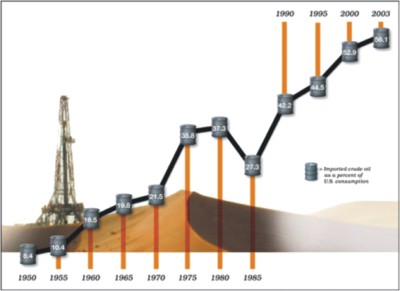
I went looking for data on our dependence on foreign oil since the first oil shocks of the 1970s.  There is one significant dip in the import percentage chart nearby and that is due to (1) a deep recession in the early 1980s, and (2) cars shrunk in size and weight in a period of a couple years by at least 30%.  They have since ballooned back to monster tanker size.  Have you stood next to a 6000 pound Dodge Charger[1] lately?

The second chart shows consumption, production, and imports of crude, as reported by the DOE’s Energy Information Administration.  Production has only recently increased after a nearly unabated 40 year decline.

As an example of Federal Government lunacy, see the transcript from GWB’s State of the Union show excerpt from 2006.  According to that, by now, 2012, we were to have plentiful, clean, safe, nukes (none), cellulosic ethanol (none), better batteries (like ones that don’t start on fire?), and this dandy: hydrogen for emissions free transportation (you’re killing me).

The 2006 goal was to reduce petrol imports by 75% by 2025 – another “pull a number out of the air” for a round of applause.  I would boo, or possibly I’d be more civil and just laugh aloud like Dr. Evil and No. 2.

The Wall Street Journal recently reported that the explosion in domestic natural gas and oil production due to hydraulic fracturing could chop oil imports from the hostile Middle East in half by the end of the decade and end it altogether by 2035.  Whoa!  Think of living in that kind of world!

Time out for this note:  We have only been worried about running out of natural gas and crude oil for about 35 years, but as the years pass, the reserves keep growing driven by the private sector’s salacious quest for profit.  It’s just pure evil.

Aside from geological and extraction technology delivered by the private sector, another critical element of this unstoppable energy boom is that the shale formations being targeted for drilling are in the control of private land owners, free of the Washington straightjacket.

Not only will oil production increase in North America, kicking our dictatorial adversaries where it hurts most, natural gas is likely to become a significant transportation fuel.  And, like it or not, a huge benefit of coal and natural gas is that they are virtually ready for consumption as extracted from the earth.  Crude oil obviously is not.

Even with this abundance of conventional fuel sources, the pursuit of alternatives will continue.  Actually, the abundance and accompanying low cost is likely to draw the sinister profit seekers to hotly pursue alternative fuels.  I project, with high certainty, that breakthroughs in alternate fuels will come from some of the most hated sectors in business: big oil and big chemical.  This isn’t like starting a software company or social media site.  It requires massive investment in R&D, high priced technical experts, equipment, and facilities, and freedom from the ignorance of dumb ideas and red tape.

This will be a bittersweet sister smooch.


[1] Wild guess.  The point is, they are enormous hulksters.

The Smoking Gleick

Government, Sustainability0 comments

Last week I described a hypothetical, unethical scam to achieve a desired outcome, which leads up to this week’s rant, which I didn’t have space for last week.

I first came across this in The Wall Street Journal editorial page.  The Heartland institute, which I had never heard of, or at best I forgot about, is a global-warming-crisis skeptic.  From the horse’s mouth, they believe global warming is real, that man contributes, but they are skeptics of the alarmism and the magnitude of man’s impacts.

They are a privately funded non-profit and yes, they get money from big oil just like I do.  I get a $20,000 per month stipend from the petroleum institute to write this stuff.

Actually, that’s a fat lie.  I don’t get a damn thing from anyone, other than applause to write this stuff.  On a side note, the empire howls that Heartland is funded by big oil.  Well golly.  The empire is funded almost entirely by state (universities), federal (DOE, DOC, EPA, NASA), and foreign governments (UN) around the globe with marketing (activism) by other non-profits.  Hey – I’m just telling it like it is, man.

The WSJ piece above talks about the tiny budget of the rebels compared to the marketing arms of the empire, the International Panel on Climate Change.  It is interesting but not so much a scandal.  Here is the major scandal that is almost totally unreported:

In order to get dirt on the Heartland Institute, a guy named Peter Gleick, one of the “peer reviewers” and most outspoken guy on global warming, PhD, distinguished scholar, blah, blah, blah, (PUKE), impersonated a board member from the Heartland Institute.

He made his way to a receptionist at the institute and in a moment of weakness, the receptionist forwarded a bunch of internal documents in hopes that Gleick would find the smoking gun.  There was none.

Here, he completely loses it, like going postal all over the internet.  He writes a two-page memo in the name of a board member, otherwise known as forgery, and “leaks” it to the press.  The press goes wild on the smoking gun forged by the despicable Gleick.  The guy is a PhD dunce and apparently doesn’t know smart people can use electronic fingerprints on a document to determine its origin and the neon arrows all point to Gleick’s computer.

Where is the outrage?  TIME reports “Cheating Hurts Climate Science”.  ABC reports “Why The Heartland Scandal Doesn’t Matter”.  Give me a break, man.  This wasn’t a no-name, know-nothing hack in junior high doing this for fun.  This is like the Watergate scandal times a thousand because it wasn’t just the impersonating the opposition and hacking his way in, it was fabricating documents (lying) and “leaking” them to the press.

You can draw your own conclusions, but a leader of the empire hacks his way into the rebel network (bad enough) finding nothing, he lies and forges documents and sends them to the press.  When a formerly respected leader of the empire breaks in, can’t find anything, and fabricates a scandal, it paints a pretty clear picture.  An apology would be a joke.  Resigning from his quackery and operating a rickshaw in Cambodia for the rest of his life would be more appropriate.

If the empire has any credibility, they will tar, feather, and excommunicate Gleick.  If his name shows up on anything for the cause going forward, it will clearly demonstrate there are no standards.  Put another way, if we have to make things up to demonstrate EE programs are cost effective for ratepayers, I’m out of here.

Tidbits

In the uh-oh, I told you so category, General Motors is idling 1300 from their Volt manufacturing line. Uh huh.  That’s what candidates say right before they drop out and what GM said a few weeks before bankruptcy.

Also in the news, plug-in delivery van maker Bright Automotive is shutting down, as is Aptera Motors, a California three-wheeled electric vehicle maker.

This one is really good – in the name of our children, let’s all sing kumbaya, set the climate wars aside and save the world.  That’s the headline.  Then in the article, Friedman knees all those on the one side of the “war” in the groin:  “If you are so reckless as to dismiss all climate science as a hoax, and do not accept the data that our planet is getting hotter and the oceans rising, I can’t help you. That’s between you and your beach house – and your children, whose future you’re imperiling.”

Now there’s a truce If I’ve ever seen one.

Occupying Ignorance

Energy Efficiency, Government, Sustainability0 comments

Have you had your fill of Occupy Wall Street, (OWS) which has spilled over into dinky, surrounding, wannabe towns including one nearby with a population of a whopping 4,000?  Apparently, these in-duh-viduals are protesting rich people and the fact that the rich keep getting richer and the poor, well, are the poor.  My response: that’s life.  Life isn’t fair.  I don’t like the word “fair”.  Rather, I like “not cheating”.  “Fair” is too often used by whiners.  Some of these OWSers are self described anarchists and communists.  Oh yeah, there you go.  That’s what we need is communism.  There’s a model of equal outcomes.  How is that Venezuela model working?

I have not a covetous cell in my body.  Steve Jobs, or at least his widow, is a multi-gazillionaire having lead his company from the brink of collapse in the 1990s to the world’s most highly valued company, ahead of Wal-Mart, Exxon Mobil, and Microsoft.  Speaking of Microsoft, as Steve Jobs once said, Bill Gates has never developed any innovative products in his life, but yet he is a billionaire because he was good at steeling ideas within the law, I guess, and developing a monopoly.  Good for him!

The real problem and reason the OWS whiners are misguided is crony capitalism.  The DOE and administrations dish out billions of dollars to crony campaign donors who in turn send a big chunk back for reelection campaigns, before or after their ill-conceived company fails and the executives walk away with millions.  Or it’s egg before the chicken.  The cronies donate a bunch of money and get their investment in government back 10 fold once their guy gets into power.

Let’s see… in the underground economy, there is a name for this: money laundering.  So all OWSers should be marching on and petitioning Washington, the root of their grievances.  You have to understand the problem to solve it.  This is clearly a bipartisan activity and nothing new.  However, I would say the recent fanning of the flames, pitting citizens against one another is a bit unprecedented and shameless.  Watch the hand!  You guys get in a food fight while we (Washington) continue to rip you off.

While I have not a covetous cell in my body, I have billions and billions of cells of rage against crony capitalism, money laundering, cheating, dishonesty, malfeasance, and vast wastes of money and resources.

As mentioned before, Washington should, like utilities have done in recent years, get back to their core business of protecting and defending its citizens against enemies, foreign and domestic.  This is the only thing they do remarkably well, although I’m sure there are gobs of waste, but how many plots have been busted and bad guys destroyed in the past decade or so?

Washington is a horrible venture capitalist because (1) they make decisions based on politics and not favorable or acceptable risk/reward, which follows with (2) they are using other peoples’ money so they obviously do not care.  It seems there are failed green energy, green jobs companies and/or scandals in the paper each day.  Or take my favorite, ethanol.  Many are concerned about our ability to feed ourselves as the planet takes on its 7 billionth human, this month or thereabouts.  Meanwhile, over 4 billion bushels of high energy corn go to make a tiny dent in our fuel needs and negligible impact on our petroleum imports.  That’s roughly 30 pounds of corn for every human on the planet, or maybe 50,000 calories – enough to keep an offensive (as in the team with the ball) lineman going for a couple hours.  No.  Really it’s enough human fuel for 20-30 days for a mortal human being.

Similar to OWSers, there are end users of energy that whine about high energy costs and hate their utility as a result.  Isn’t it ironic that nobody seems to care about energy costs, as in the total cost of running a business, except when prices rise?  And end users should consider what is driving prices upward: I would guess the vast majority of price increases is due to emission regulation and construction of wind farms.  These things are legislated at state and federal levels.  I, unlike the prima donnas (think JFK junior, hypocrite in chief) living in population centers and telling everyone else how to live, do not mind the sight of these behemoths on the landscape.

On a side note, other hypocrites for renewable energy and lower energy cost protest construction of transmission lines from where the wind blows to where people live and wind doesn’t blow.  In addition to transporting renewable energy to population centers, it adds reliability and more supply options to the grid.  More options mean lower prices.  The solution is simple if you ask me.  See I-90 in southern Minnesota.  Just run the transmission lines down the damn ugly interstate highways where there is already immanent domain and land!  It’s flat. It’s open.  What?  Would it mess up the beauty of billboards for Wisconsin Dells, gentlemen’s clubs, and truck stops?  This is a no brainer.  What for the love of Pete is all the hassle about?  And there aren’t even any dairy cattle near the interstate to pick up the electromagnetic waves causing birth defects like four headed two legged calves.

Whining end users share a loser trait with the OWSers – they would be far better off taking control of their own well being rather than itching and moaning about something they have little control over.  And by the way, the control they do have is mainly with their corrupt finaglers in Washington.  Very few are accountable.  These people represent the very few competitive congressional districts, states, or the entire country, while most are not accountable.  The unaccountable include political appointees like Lisa Jackson running the EPA, or Bonnie Fwank and Charlie Rangel, each of whom would have to be caught live on national TV steeling an armored car and maybe running over a few pedestrians to not get reelected.  I don’t think felons can be elected from their jail cell but who knows.  Felons, dead people, pets and alternate personalities can and do all vote.

For-profit end users that howl about their energy costs are very likely to have more energy cost reduction opportunity than those who don’t.  This is Jeff Ihnen’s untested hypothesis.  Why?  Because the howlers don’t like, and in some cases, detest their energy provider and do not trust them.  Detestment (a new word) does not foster cooperation, which is extremely helpful, bordering on essential to control energy consumption and cost.

I have also yet to come across a for-profit, with a strong efficiency track record at the corporate level, howl about their evil energy providers.  Well known EE champions with track records that fit this profile include 3M, Pepsico, General Mills, and Simplot.

The message to end users of all shapes and sizes is first control what you can best control – yourself and your organization, and second, pay attention to what’s going on in state and federal governments –  each of which are big drivers of energy supply, regulation, and generation sources – the primary drivers of energy price.

Tidbits

I thought this was a great headline for an opinion piece in Saturday’s Wall Street Journal, by Holman Jenkins: “Hooray,  A Financial Firm Fails”, describing of John Corzine’s MF Global collapse.  What’s even more impressive is that Corzine, formerly of Goldman Sachs, formerly U.S. Senator, formerly New Jersey Governor, is in the admiral’s club of crony capitalists.  Failure is progress.  Eat your heart out.

Atmospheric Cooling = Strong Tornadoes

Energy Efficiency0 comments

We interrupt this rant for this special announcement.  Our cold spring in the northern plains is wreaking havoc in the form of tornadoes in the southern and middle parts of the country.

I think the weather phenomena had a lot to do with my interest in mechanical engineering.  Growing up on the farm in the flatlands, I had seen a great many black clouds approaching on the horizon.  As they drew closer, they would either brighten to a lighter gray and rain, or they get ugly.  If the approach is led by a dark band of clouds followed by blue-green solid color all the way to the horizon, there would be some serious energy release.  If there is continuous rumbling, it generally means hail – tornadic-type winds aloft.

Weather should marvel any mechanical engineer with interest in the thermal fluids side of the curriculum.  All weather conditions are driven by temperature differences in the atmosphere and it’s influenced heavily by ocean temperatures to the west from which prevailing winds and jet stream flow, at least in the northern hemisphere.  It’s a massive thermodynamic, fluids, and heat transfer model.

What is causing this year’s massive tornadic outbreak?  Unusually cold mid and upper atmosphere derived from cyclically cold Pacific waters.

The two best weather guys I’ve seen in the business are Tom Skilling from WGN and Joe Bastardi from AccuWeather.com.  Bastardi is a historian and doesn’t get whisked away with the hype.  He states the mid levels of the atmosphere have cooled very rapidly in the past year as it did 60 years ago.  Did you know this?  No.  Why?  Because nobody is reporting it.  This makes sense because powerful storms, which are like engines, are driven by great temperature differences; NOT an overheating atmosphere.

Tornadoes form when warm air from the southeast plows into cold air from the northwest.  The warm, moist air rises into the cold mid levels of the atmosphere, and of course what goes up, must come down.  Condensing water vapor turns to rain and if cold and turbulent enough develops hail falling to the ground cooling the air as it falls.  This air flow can become strong enough to cause straight line downdrafts that can flatten buildings and trees like a tornado.  When the warm air channels, it can become like the vortex in your bathtub or sink.  It will start to rotate to form a tornado.  For a great cartoon of this, click here.  For the real deal, see this minute-long video from National Geographic – devastating.

Fortunately, the pattern that set up these storms in the south just broke over the weekend.  Hopefully, we won’t get our turn in the north but it’s certainly possible.  The jet stream, or line between cold and warm air has lifted far north, hence the warmer weather we are experiencing in the north.

All engines, including power plants, your car’s engine, jet engines, are driven by hot and cold sinks.  The greater the temperature difference, the greater the power, and efficiency.  A tornado is an engine. It is driven by temperature differences in the atmosphere and the “load” is the destruction it wreaks on the ground.  When towns like Joplin, MO appear to be run over by a giant lawnmower, the giant lawnmower requires tremendous power, delivered by an F4 or F5 tornado.

This presents an opportunity to generate electricity.  No; not from tornadoes, but from waste heat being dumped from power plants.

I would guess that when anyone thinks of a nuclear plant, they think of these cooling towers.  These towers work on a very simple concept.  Warm water from the power plant is pumped to the top and showered down through the tower.  Openings at the bottom let in cool dry air from the surroundings.  The warming and humidifying of the air causes it to rise and a natural draft occurs.  Therefore, fans are not needed.  Towers need to be tall enough and shaped like they are to generate sufficient air flow via “stack effect” to provide required cooling capacity.

This presents an opportunity to generate electricity.  Not just from the vertical rise in the tower, but all the way to the upper atmosphere.  If rotation were induced, an engine could be developed between the hot exhaust and the always very-cold upper atmosphere – a standing tornado, essentially.

Don’t laugh.  I first came across this in one of the power industry’s trade magazines a year or two ago, and it made a lot of sense.  It’s called an atmospheric vortex engine.  Here is a good paper on the topic from the Canadians, ay?

So I ask, why is the DOE not pursuing something like this, rather than the STUPID electric car?  Silly me.  This is potentially cost effective energy efficiency with huge potential from a ubiquitous plentiful source of free waste energy; not an ALICE IN WONDERLAND pipe dream.  If we can build nuclear reactors and sophisticated huge steam turbines, surely this simple concept can be harnessed.

Seventy percent of energy required to fuel a thermal power plant (natural gas, coal, nuclear, fuel oil) is dumped to the surroundings.  Think of the potential – and nothing extraordinary is required.  Nature takes care of the vast temperature difference to drive the engine.  The efficiency of this second heat engine would be approximately 30% per the above paper.  This could take conventional power plant efficiency from the standard 30% to roughly 50%, roughly a 70% increase.  This is enormous.

Tidbits

I’ve always considered global warming to be driven by politics and self interest, knowingly or unknowingly – as in, I can make money from this.  It is fanned by sensational films like that described in the aforementioned Dumb Bear post, Al Gore (who’s film the UK banned from its schools) and even National Geographic – it sells – see how it works?  It’s easy.  More below.

The very cold spring and gobs of snow this winter have been devastating.  Dude!  Aspen reopened for skiing over the Memorial Day weekend – with more base now than it had on New Years Day!  This is normal?  It’s insane!  Mammoth Mountain in the Sierras still has 200-plus inches of snow – plan to ski through July 4!

How does paranoia void of logic and reason perpetuate?  The Center for Decision Sciences at Columbia Business School did a survey of 1,200 in-duh-viduals, “Those who felt that the current day was warmer than usual for the time of year were more likely to believe in and worry about global warming than those who thought it was cooler outside. They were also more likely to donate the money they earned from taking the survey to a charity that did work on climate change.”  Even if INDOORS is hotter, people tend to fear global warming more!

In other findings: if you eat soup frequently, check with an emotional counselor; want that job, wash your hands in hot water just prior to interview; worried about crime, get out of dodge when it’s hot outside.

written by Jeffrey L. Ihnen, P.E., LEED AP

Prudes Trafficking Cud

Energy Efficiency0 comments

Having been in the EE industry for 15+ years and regularly attending conferences around the country (for just a few years), I find myself being volunteered to contribute to these conferences with planning, presenting papers, and “peer” reviewing others’ papers.  The planning, peer reviewing, and being peer reviewed are learning experiences as I gain awareness of how others think and what they find interesting and important.  I say “awareness” and not necessarily “understanding” because quite frankly, the way some people think, baffles me.

For example, I was talking with a gun collector the other day and prior to this I had thought people collected weapons like some people collect motorcycles.  They just clean and polish them weekly, talk to them like house plants and adore their magnificence.  Wrong.  He likes going to the range and shooting them.  I can understand this because I on the other hand enjoy going to the beach and skipping silver dollars off the water.  I get a rush from feelings of wealth and power as I do this.  This is not all.  I take a Porche 911 to the beach with my rolls of silver dollars because it would be really deflating to climb into the 2002 Honda Civic after my fill of dollar skipping.

The dollar-skipping Porsche story is a lie but I was just trying to draw a comparison to the weapon thing and came up short.

I am in the midst of reviewing some papers for the International Energy Program Evaluation Conference (IEPEC), but fortunately they are not boring.  In fact, I even used the overarching results from one of them as a lever in a recent proposal I wrote.  I reviewed them and presented one round of comments to the authors and I truly hope they found my comments to be beneficial and constructive to improving their papers.  My comments included suggestions like moving and rearranging some things, rewriting some sentences I had to read several times to understand, separating these from those, and I found a few typographical errors.  I thought I had written quite a few comments and I hoped they weren’t PO’d, and after hearing back, I don’t think they were.

However, I also had the chance to review comments others had written for peer review of papers our staff (not I) wrote for the ACEEE Summer Study for Industry.  Whoa!  Some were quite nasty, and likely written by an academic / government prude, anonymously of course.  Some of the findings, paraphrased to be more like Wonder Bread than a habanero pepper, are provided below.

No references documenting similar work.

The topic of the paper included a financing program for energy efficiency programs that has worked spectacularly.  The paper essentially started by saying utility financing programs suck, which outside the program(s) discussed in the paper is a universal truth.  Do I need a reference to prove the Minnesota Vikings have never won the Super Bowl?  Do I need a reference to say they blew three conference championship games since 1998?

I use references when I’m uncertain of something or if I am saying something controversial or hard to believe or as you can see below, to make a point.  If I know what I’m talking about, I don’t bother with references.

Papers should include mostly the author’s expertise, gained knowledge, and wisdom of his experiences, not a compilation of other peoples’ work.  Do we want high school term papers or real-life EE market experiences and lessons learned?  Quite frankly, when I reviewed the IEPEC papers I paid no attention whatsoever to the references (don’t tell the prude police).  There were plenty of fresh data to chew on and sitting here today a couple weeks after those reviews, I don’t think they needed any references at all.

No data to back up the premise.

This was ridiculous.  Data were clearly provided to demonstrate the wild success of the reported “financing” program.  There wasn’t much data to show other financing programs suck, but I don’t need a study to tell me beer from a major league baseball game is more expensive than beer purchased from a grocery store either.

There is plenty of research on barriers to EE in scholarly publications from think tanks like ACEEE or from the DOE and national laboratories.

The DOE?  Is this the same DOE that promoted the destruction of millions of dollars worth of working assets as economic stimulus – i.e., throwing rocks through windows to spur economic growth?  I used to work for the DOE.  I don’t need the DOE to tell me the barriers to EE.  Scholarly?  Ha ha.  It is to laugh.  (Daffy Duck)

I’ve seen lists of EE barriers and they typically miss one of the 800 lb gorillas.  One of the most notable lists of barriers comes from the 2009 McKinsey study.  A basic barrier I don’t see in their list is lack of time due to competing priorities of end users.  Since lack of time isn’t noted, is it therefore not a barrier?

One ACEEE paper, which in fact looks pretty good, does not mention risk aversion as a barrier.  I can tell you, risk aversion is a major barrier.  Many projects will not go forward without a performance guarantee.  Since risk aversion is not noted, is it not a barrier?  Maybe it is merely an obstacle!

Lacks the intellectual rigor that ACEEE requires.

Don’t rock the boat.  I think I’m going to throw up.

This sort of comment casts a cloud over ACEEE in my mind.  To be clear, I like ACEEE.  They put on good conferences and produce/sponsor some informative papers – stuff I can use.

Reads like an advertisement and offers no new information or analysis.

This is entirely bogus.  The word “Michaels” does not appear in the paper.  Yet I review one (1) paper from the last summer study for industry – one that is close to home involving Focus on Energy – and “Focus” is noted no fewer than 31 times.  For example, Focus:

  • promotes savings and technologies through
  • is a statewide energy conservation program (not efficiency?)
  • is managed by SAIC
  • program’s success comes through their active (should be “its”, not “their”)
  • program’s success results from leveraging
  • program tends to be vocal promoters
  • energy advisor has reviewed and blessed (blessed?  This is the intellectual rigor he talks about?)
  • absent a program such as Focus on Energy, would not have been installed
  • blah, blah, Focus, blah, blah

Nope.  No self promotion here!  I believe the prude should review some past works.

Ok.  I had to sneak a peak at one more paper; this time from one of the benevolent, intellectually superior, omniscient, and of course objective DOE laboratories.  This one was on the salvation that wireless technology will bring.  Have a seat; empty your mouth of any food or drink.  The paper was co-authored by a vendor of the technology using analysis provided by Honeywell.  Suely, there is no agenda or self interest in this one.

To once again clarify myself, I do not begrudge anyone for tooting their horn.  Anyone who thinks busy professionals write papers and present results at conferences with no self interest is a naïve stupe.

There is limited evidence to support the conclusions.  There is a small out of date case study but it lacks justification for any of the assertions.

C’mon dude!  The results:  Traditional financing programs: 0.  Subject “financing” program: savings of 1.5% of sales for many years.  In case you are new to EE program goals, 1.5% is enormous, like the Oregon Ducks averaging 47 points per football game or the Badgers scoring 83 points in one football game last year.  Both are incredible.  Don’t believe it?  Look it up yourself, prude!

I do not want to read high school term papers of reconstituted cud.  I do not want to read a doctoral thesis or six-line sentences full of four syllable words.  I want to read something I can use or at least find interesting.

written by Jeffrey L. Ihnen, P.E., LEED AP

Pregnant Snake Armpits

Energy Efficiency, Government, Stimulus0 comments

Although I don’t appreciate talking about it, we have a black list of companies and organizations for which we will not again partner with, work with, or bid their request for proposals.  What type of activities land somebody on this list?

Companies or organizations that take our business development efforts and give it to someone else.

We are working on retro-commissioning for a major player in the Midwest grocery market.  As with most of our investment-grade studies for energy retrofit or retro-commissioning, we like to use contractors to provide us with pricing because we expect they will get the work and therefore, the pricing is going to be more accurate in addition to having accountability for the prices at implementation time.  The contractor was very reluctant to help because he was afraid he would help develop pricing and concepts and then somebody else would get the work.  I laughed out of familiarity with such shenanigans.

Unfortunately, while working on the grocer project, we were victims of just what the contractor was talking about, on a different project.  We had completed an energy study for a quasi non-profit, quasi-government outfit (Jeff, how many times do you have to get burned before you learn?) and we were moving into developing the design and provided a proposal.  We had already pretty well nailed down the scope of the project.

Inject another righteous government agency to “help” this end user.  Well, they took our developed scope of work and put out a competitive request for proposals with OUR work on it.  So now we’re faced with throwing away all the development we had already done just to be competitive with the other bidders who were handed this on a silver platter.  As I wrote last week, it’s a rainy day in hell when a government outfit takes anything but the low bid, otherwise known as the cheapest, crappiest system imaginable; one that meets only the major recognizable features, like equipment efficiency.    There are plenty of places to cut cost on the design and on the project itself.

That agency is blacklisted.

Companies that use our credentials to win a job and then dump us like a cheap date.

Last year we had “teamed” with a local architect on a LEED project for a new nearby federal facility.  I must digress for a moment.  This project was in progress when the “stimulus” was passed – you know the one that was supposed to break loose the shovel-ready projects.  If this wasn’t shovel-ready, I don’t know what was.  The plans and specifications had been lying about for year or two waiting for approval to proceed.  It drug on for months once the stimulus passed.

Come to think of it, this one too was in our hip pocket and they bid the work out again.  I’m not sure why because the design was 90% completed but I suppose some milestone had passed and federal statutes required a rebid or something.

So now that it’s competitive, once again after doing a bunch of development and front end work, we have to cut cost to beneath the cheap and crappy level.  So our client, the architect asked us to chop our down our price.  We provided a counter offer and waited.   And waited, and waited.

We already had 20 or so LEED projects under our belt compared to near zilch for the architect.  Finally, we get a hold of the scumbag, er, I mean client, and he says, oh yeah, “The good news is, we won the project.  The bad news is, you aren’t on the team.”  This is lower than a pregnant snake’s armpit.  (stolen from the aussies and modified by me).

Blacklisted.

Companies or organizations that use our proposal in attempt to beat “their” firm down in price.

This one is more difficult to nail down but let’s just say if it walks like a duck and quacks like a duck…  A large organization pursued by a bunch of consultants / contractors has been working with a provider for years and maybe they want a new or modified service, or maybe it’s just the same stuff they’ve been provided with many times.  Now they suddenly want a proposal from us.  This is either a Sarbanes Oxley corporate requirement (ok), process to actually evaluate invited bidders (ok), charade to fake a bureaucrat into thinking the chosen one was competitively selected (not ok), or a hammer to beat down the firm they know they are going to hire (not ok).  Essentially, we are wasting a bunch of our time to benefit only the buyer.  The other bidder(s) gets screwed too.

Blacklisted after a few of these – typically takes a few rounds of abuse to have this scam come into clear focus.

Wolves in sheep clothing.

Over the years we’ve been pursued by numerous companies that would like to partner with us.  It would be a marriage made in heaven.  Next step: an initial public offering on the NASDAQ!  Uh huh.  Sure.  These dirt bags just want access to our clients and for some reason, controls companies and performance contractors make up a substantial portion of this bunch.

Show me the money before I lift a finger or you are blacklisted.

A better way.

Recently a business partner stated it well, “What do we have in business and life but our reputations?”  And I always say to our company’s people, you best treat well everyone you work with in the company, our clients, and even the competition.  You never know who will one day be your client or supervisor, employee, or maybe someone you want to partner with, or get help from.

Everyone involved in business transactions should benefit – consultant, owner, utility, shareholders, and contractor.  Clearly and unfortunately, some entities think they can get ahead while screwing others and thinking they are getting a good deal or making extra profit.  Sooner or later these outfits run out of victims to exploit.  It shouldn’t be a fixed pie that everyone fights over.  It should be a pie from which everyone’s slice grows.

Tidbits

It appears Sacramento is contemplating the same fateful robbery of EE program dollars by hocking the stream of energy efficiency money.   In WI, this grab actually happened and crippled programs.  Ironically, or maybe not so, they would be both carried out under Democrat governors.

Outrage of the Week

Maybe I should start an outrage of the week?  Well here is the inaugural.  The DOE is calling it “Market-Driven Solutions” to work with behemoths like Target and Wal-Mart to develop new efficient rooftop heating and cooling units.  Is this the same Wal-Mart with $420 billion worldwide sales and $14.4 billion in annual earnings?  Chu, you have got to be kidding me.

Like General Electric, why doesn’t Wal-Mart get back to what they used to do well; innovate, rather than going to Washington with its hand out.  Time to put a “strong sell” on Wal-Mart stock.  They’re washed up.

This is a free market solution: an RFP for manufacturers of rooftop units to develop units that meet Wal-Mart’s specifications, reliably, and supply them with heating and cooling equipment for the next 100 stores.  After 100 stores, the incumbent has a huge advantage for (hopefully) proven success.

A portion of the $1.6 trillion, or as I like to say $1.6 million million, deficit is funding this kind of crap.  This wouldn’t be funny even if it weren’t true.

Oxymoron of the week: “DOE facilitates market-driven solutions”.

written by Jeffrey L. Ihnen, P.E., LEED AP

Green Jacket, Cigar, Gold Rings, and Disneyland

Energy Efficiency, Government, LEED, Renewable Energy, Stimulus, Sustainability0 comments

I attended the Midwest Energy Efficiency Alliance last week and it was an interesting environment, to say the least.  This was the 4th or 5th MEEA conference I have attended.

Behavioral stuff is an up and coming topic/issue in the EE industry.  I am planning to do a rant that to save energy, people have to give a crap.  I just need something to push me over the edge.  After all, just about all lasting energy efficiency requires behavioral changes.  Only inanimate, stationary, non-energy consuming stuff, e.g., insulation, doesn’t require behavior change.  Everything else has a behavioral component for maintenance, avoiding rebound and things like that.

What was probably most interesting to me was the political environment addressed by speakers at the conference.  For whatever reason, MEEA likes to attract people from Washington DC to discuss current events.  Essentially, people from the Department of Energy, Alliance to Save Energy, and Center for American Progress, to name a few, are on the defensive with the congressional wipeout last fall.  The theme I absorbed was one of playing defense and riding out this storm.  The mood for some was as though their dog had just left them and passed on to k9 heaven.

One speaker was afraid of the jobs that were going to be lost but also threw wild numbers around – like the energy efficiency portion of the stimulus produced $50 billion in economic activity and that the regulation put in place and on auto pilot will produce billions of baskets of bread from the heavens in the next couple years.

Energy efficiency is not like giving a child an immunization.  I’m a member of Rotary International and one of Rotary’s missions is to end polio worldwide.  We were down to just a few very poor and politically repressed countries like Afghanistan and Sudan, but like anything, completely eliminating something is very difficult.  Anyway, I’ve seen many photos of children bawling their eyes out as volunteers dripped immunization in their mouth.  This may seem unpleasant to the tikes but it is obviously in their favor and has a practically infinite benefit/cost ratio.

Conversely, we can’t ram energy efficiency down peoples’ throats.  How many times do I have to say it?  The price of ramming things down American’s throats: 63 house seats, 6 senate seats, 5 net governorships with a near sweep in the Midwest, and a tidal wave of state house flips.  Here’s how regulations work: increase the cost of doing business and businesses move out of the state or overseas and then they get blasted for being Benedict Arnolds by the very folks who impose the regulations.

Like light bulbs I discussed last week, energy efficiency is gathering really positive momentum, not because of top down regulation, but because it’s good for business.  See Save Energy – Get Out of Jail where Wal-Mart used “green” to get thousands of critics off its back.  They in turn are requiring energy efficiency standards for their suppliers.  I just red about Holcim cement getting ENERGY STAR® ratings on five of their plants.  I can’t speak with certainty but I don’t think they are taking the time and expense to get ENERGY STAR to pump up their four-wheel-driven employees.  They are obviously doing it for marketing.

And the DOE person was concerned about the jobs that will be lost once the stimulus is gone.  What jobs?  I’ve never lived through such a bizarre two years in my life and I’ve been in business for 20 years – eewe, old codger, I am.  It’s been crazy.  Talk about modifying behavior.  Millions of people purchasing vehicles a few months before they otherwise would, leaving in its wake a predictable buying vacuum – how many jobs did that create?  I don’t know, but I just read that Ford is planning to bring on 7,000 workers about 17 months after the cash for clunkers fiasco.  The $8,000 first-time home buyer credit – same thing.  The housing market is still searching for a bottom.  Just let it bomb and let’s get on with the recovery.  With regard to EE, probably hundreds of millions of dollars have been spent pursuing federal grants.  Enormous efforts have been expended trying to get free money.  This, my friends, is not stimulative.  It’s fighting over other people’s money to be repaid sometime in the future by said people.  This too as with my rant last week was a bipartisan bad idea started by Bush.

Meanwhile, our industry is booming but the DOE speaker doesn’t know this because she lives in the beltway bubble.  The downturn only hit our new construction and LEED services.  Our other EE services have more than made up for it and we have four engineering spots to fill but we can’t find qualified people.  How bizarre is this?!  I think I mentioned we had an outstanding candidate we spent no time giving an offer to but she already had two other offers and took one closer to the spouse’s job.  Our usual evaluation teams have had to sit out requests for proposals because some couldn’t handle the work they already had in the tank.  We’re passing on RFPs as well.  So jeezo woman, when the stimulus goes away we’ll still be working hard to find people – as will be many others in this industry.

Back to the MEEA conference:  After a series of “Oh woe is me” talks, one guy in the crowd walked up to the mic to make a suggestion.  Rather than duking it out over regulation and climate change policy, why don’t we focus on the irrefutable common benefits that everyone can buy into – that EE is cost effective and is good for business.  Give that man a standing O, a green jacket, cigar, bottle of milk, gold rings, a trophy and a trip to Disneyland.  THIS is what we ought to be doing, not battling it out over something people rank 19th out of the most critical issues of the day and something half the population opposes.

Tidbits

Speaking of jobs… Note to wonks trying to “create” or “focus on” jobs:  People invest and are in business to make money; period.  They are not in business to hire people.  People are hired as necessary to make more money.  Think about that.  If the bureaucrats want more jobs, let people and companies make more money.

And speaking of sole purpose of business is making money…  In New Years Collage I chronicled a three way fight The Wall Street Journal, several utility CEOs and the EPA were having.  Among the CEOs cheering the EPA’s increase in emissions regulation was Exelon Corporation’s John Rowe.  I was eating lunch at MEEA next to a long-time Chicagoan familiar with Mr. Rowe’s strategy for Exelon (parent of ComEd, which serves Chicago).  The gentleman said Mr. Rowe sold off all of Exelon’s coal generation, leaving it with only nuclear plants.  He said the nuclear plants had among the highest operating costs in the country, which left Exelon with a high operating cost, which had to be made up by higher rates.  The gentleman explained how Mr. Rowe brought on a former Naval Nuclear engineer (Yeah!  Go Navy!) to improve the “efficiency” of the nuclear fleet.  And so he turned them around overnight.  As a result Exelon has virtually no coal generation, very efficient nuclear plants, and the highest return on capital of any utility in the business.  As I mentioned above and in several other rants, CEOs report to shareholders.  Shareholders rule.  Profit is king.  I have no problem with any of this except, I think lobbying for government to regulate a competitive advantage for yourself is not something I would do.  Preparing for and reacting to policy, good or bad policy, is fine, and indeed smart business to me.  Otherwise you might find yourself on a street corner with a tin cup.

BTW, this was not a wild eyed ideologue I was enjoying lunch with, but I did check the facts and what he told me was pretty well right in line with an article by Forbes magazine.

written by Jeffrey L. Ihnen, P.E., LEED AP

Another Committee – Alleluia

Energy Efficiency, Renewable Energy, Sustainability0 comments

Hide the kids.  The DOE has spawned an energy and renewable advisory committee.   You know, a diversified products / technology manufacturer like 3M or DuPont should examine the Byzantine labyrinth of government agencies as a model to develop the next bullet, explosion, radiation, fire, water, and bio proof wonder material.  I have to believe that if they could weave sewing thread or maybe two pound monofilament fishing line into such a fabric it would stop a 40 caliber projectile at point blank and not even cause a contusion.

Why does the country need this?  Why does the country need a debt commission for that matter?  We have a full time congress for goodness sake.  Isn’t that what they are supposed to be doing?  I suppose this is this too much to ask of 535 FULL TIME bureaucrats?

As anyone who knows anything would guess, the committee is dominated by academics and government wonks, although at least there is one utility guy on there.  Therefore, I am sure we will have a cornucopia of far out recommendations from a distant galaxy.  Most likely it will be heavy on far out technology and more spectacular policies like 15% or is it 20% ethanol blends for gasoline.  Maybe they can mandate its use, block imports, subsidize it with our money, steal our watch and tell us what time it is too.

Do these people or anyone at the DOE realize there is an industry of private sector product and service providers that work on our home planet of Earth with end users (also home-based on Earth)?  We are constrained to pesky things such as the laws of nature and economics and consumer whims.  I’ve said it a thousand times and I’ll say it a million more times, the savings potential from cost effective measures from current technologies and services is at least 30%.  See the McKinsey report from last year as backup for my hypothesis by people who know what they are talking about.

On the other hand, I read that this group is only going to meet twice a year and judging by the agenda of the first meeting it appears they won’t be inflicting too much damage on the citizenry.  If this is all they are going to do twice a year maybe this is simply a resume stuffer organization.  “Served on the Secretary of Energy’s Energy and Renewable Advisory Committee” would sound impressive for an introduction for a keynote address at Yale University’s spring graduation, especially for graduates with degrees in renewable energy management.

Tidbits

FIFA (Federation International de Football Association) chose Qatar to host the 2022 World Cup tournament.   Qatar, a tiny tumor of a country jutting into the Arabian Gulf is about the size of Connecticut, or about twice the size of Long Island (although saying it’s twice as big as anything is misleading).  Temperatures during the World Cup there will approach 426F, just below the point of spontaneous combustion of flammable items like paper but fortunately for most World Cup fans, above the melting point of the vuvuzela.  I rather like the vuvuzela, at least as comes across on the TV.  It’s hilarious like a cloud of June bugs or swarm of mosquitoes amplified a couple hundred fold.

In addition to building nine new stadiums and renovating a couple others, they will be supplying OUTDOOR air conditioning for these stadiums.  They will probably need to build a couple thousand MW power plants as well.

South Africa boasted that theirs was the greenest World Cup ever.  If Qatar says anything about green, they will have to use Venus as the baseline alternative for measuring the savings realized.  If I were them, I would just go with it and say this is the most ridiculous idea of all time.  We will proudly burn as much energy as half the countries with teams at the tournament.

I can almost guarantee they will build a photovoltaic plant the size of the country in the Saudi Arabian desert and that’s what we will be hearing about.

Too see how much money people in this region have, do a Google Earth or Maps of Dubai.  Apparently there isn’t enough moonscape barren coast on which to build opulent homes, so they make their own islands or “palms” where the strips of land take on the pattern of the veins in a palm leaf I guess.  And they have all the huge sky scrapers including the world’s tallest building.  What for?  By the looks of it, the only people who work there must be those that take care of the people who live there.  And why the tall buildings?  My impression has always been skyscrapers are needed for land-locked cities like New York and Hong Kong.  UAE makes Phoenix look like the Amazon basin.  There is nothing there.  Just pave it over and sprawl out so there is something to do with your time – like drive your 12 cylinder Italian sports car to the spa, bank, casino and back home.  The place is so un-natural it creeps me out.

written by Jeffrey L. Ihnen, P.E., LEED AP