Archives

Blog Archives

Energy Efficiency Mandates; And Geese

Energy Efficiency0 comments

Last week this commentary regarding energy efficiency mandates from the Heritage Foundation showed up in my Google news feed, and it made for an interesting read.  I hold the same view when it comes to shoving products down the gullets of people like the goose in preparation of foie gras, a disgusting practice.  That is not a way to make friends for desired lasting results.  E.g., we’re going to unplug the water cooler to save energy and you will like the warm water.  Besides, the feng shui will improve and bring better karma because that cold stuff throws your system out of whack.  I would expect responses of “feng shui you!, cheap _____!”

The author, Nicolas Loris (Nick), states the argument for mandates is consumers and businesses reduce energy use, save money, and their kids use 50% less foul language[1].  Nick goes on to say consumers are already incentivized by the free market to conserve, without mandates.  This is true but here is the rub: consumers (the masses) are irrational and businesses are considerably more rational, but yet, still plenty irrational.

Let’s talk a smidge about mandates before moving on to decision-making by end users.  There are energy efficiency mandates for light bulbs, auto fleets, toilets, refrigerators, air conditioners, and I’m sure there are others that I’m not aware of.

More or Less Equal Mandates

Not all energy efficiency mandates are equal.  More equal mandates are better.  What are more equal mandates?  Ones that do not have any perceptible degradation of performance or a long-term price premium.  Which energy efficiency mandates fall into this category?  Refrigerators and air conditioners, and for the most part, toilets, although there were problems in the early days- a whole other topic.  Cars and light bulbs have clear performance and consumer preference issues.  People love their cars, man.  Myself included.  Don’t screw with my car. [2]

Nick states in his article that Secretary of Energy, Chu, once quipped that energy efficiency mandates are needed because people “aren’t acting in a way that they should act.”  There is some red meat for the opposition, but I have to agree that smacks of unplugging the water cooler and telling people it’s for their own good.

Rational Consumers?

Moving on to consumer / end-user choices, Nick says consumers are smart enough to choose for themselves and are doing so.  From a mass market perspective, I disagree.  Mass market consumers, excluding most people reading this rant, are awfully irrational.  Consider the beloved compact fluorescent light bulb, which provides a fascinating case study (hang with me).

Fifteen years ago these things cost over $10 aEnergy Efficiency Mandates piece.  They didn’t fit fixtures because the ballast (base) was about 3 inches long and the entire light bulb was about 10 inches long just begging to be whacked off, spilling toxic mercury everywhere.  Doing a simple life cycle cost analysis (shown to the right) for the 10,000 hour lifetime of a CFL, a consumer would have to be crazy not to buy these and fill their house with these things.

I would claim that since that time energy efficiency programs, not mandates, have driven the technology to vastly improve and the price to plummet to the point where consumers would have to be really, really nuts to not buy CFLs, but for a few fixtures that aren’t used often.  The price is now at least 80% lower.  The lamps are more efficient and come in colors (temperatures) other than cold mortuary gray.

A mandate is not required or warranted for CFLs.  The market has been transformed with relatively great speed.  The non-energy impacts are, in some instances, greater than the energy impacts.  Speaking for labor and the cost of man-hours to keep replacing bulbs every 1000 hours varies from a nice feature, to a massive advantage, depending on the consumer.

Consumers are still too irrational for the modern CFL in many cases.  They need gimmicks and games, trinkets, brownie points.  This is what behavioral programs are all about for residential customers.

Energy Efficiency MandatesSee a better approach to geese (consumers) – lure and educate them rather than force feeding.  These consumers are wary and are probably used to fresh croissants rather than the stale crust this guy is peddling.  The screen-left goose is thinking, this guy is a moron.  I’m out of here.

I’m running low on space but moving on to commercial and industrial end users, the barriers are much different.  They are much more willing to do things that improve their financial situation.  In many cases, they don’t know or realize where their cost effective opportunities are, they don’t have the time to deal with it, and in some cases they lack capital or the presentation to the bean counters to convince energy efficiency is a wise investment versus a new lawn mower or snow plow.  Mandates are not going to affect these customers, but they really, really need expertise, services, and sound information.


[1] The latter is a slight embellishment on my part.

[2] The Wall Street Journal reports that people who like their cars and keep them a long time garden, hang out in coffee shops, and do more DIY home repair.  I would add they despise shopping malls as well and prefer downtown.

Ballad of Willie Widget Man

Energy Efficiency0 comments

As I created Widget Man last week I couldn’t get Elton John’s Rocket Man out of my head, so naturally I started to think parody.  A warm up may be good to get your rhythm.

Willie Widget Man goes sumpin ike iss:

They set my goals so high, I cried
Two percent, holy crap!
Why they gotta be high as a kite like that?
I miss the fruit so low, I miss old code
It’s not easy for me now
It’s such a mindless rite
 

And I think it’s gonna be a damn hard time
No light bulbs anywhere for me to mine
Like my showerheads, the flow’s so low
Oh no no no
I’m a Widget man
Widget man, throwin’ CFLs at every home
 

And I think it’s gonna be a damn hard time
No light bulbs anywhere for me to mine
Like my showerheads, the flow’s so low
Oh no no no
I’m a Widget man
Widget man, throwin’ CFLs at every home
 

This ain’t the racket that it used to be
I don’t know where to turn
Do I need an enginEEEEERring PhD?
No grasp physics, I can’t understand
Just a basket weaving Degree
Oh widget maaa-aaa-aaa-aan
Widget man!
 

And I think it’s gonna be a damn hard time
No light bulbs anywhere for me to mine
Like my showerheads, the flow’s so low
Oh no no no
I’m a Widget man
Widget man, throwin’ CFLs at every home
 

And I think it’s gonna be a damn hard time
Yes I think it’s gonna be a damn hard time
It’s gonna be a freaking hopeless hard time
I think I’ll find a hole crawl in to die
 

Widget Man
by: jlihnen

Saints Are Marching In

Energy Efficiency, Utility Stuff0 comments

One of the most rewarding aspects of our business is ensuring people get it right and customers get the legitimate energy and monetary savings they should be receiving.  My answer to “why should we pick you?” is: we are passionate about what we do; we get things right; and we want to make a difference – improve things.  The problem occurs when others don’t give a rip about these things.

Michaels’ primary thrust in the evaluation arena is impact evaluation, which is – what difference does the program make?  The questions are (1) what is happening versus what would have happened and (2) would it have occurred without the program?  The first question is difficult and the second question is really difficult.  The result of the first question is adjusted gross savings and the result of the second question is net savings.

Adjusted gross savings is simply the actual savings verified at the site, with customer interviews, visual inspection,  and data recorded over time to verify savings via the 80/20 rule, which means don’t sweat the little stuff.  Net savings starts with adjusted gross savings and applies psychoanalysis via a battery of questions and hypnosis mixed with bat wings, chicken bones, and Ouija board viewed through a crystal ball.

Efficiency measures are generally broken into two categories: prescriptive and custom.  Prescriptive measures, as the term indicates, prescribe fixed savings and fixed incentive for a specific measure, regardless of how it is applied.  For instance, a compact fluorescent may have an incentive of $2 and deemed savings of 10 kWh per year even though it may save 5,000 kWh (that’s a hell of a CFL) in one instance and 3 kWh in another.  When averaged, the population of CFL measures should save 10 kWh apiece.  Custom measures have savings and incentives calculated for the specific application via customer, vendor, or program personnel.

Everyone agrees that calculating savings for June Cleaver’s new energy efficient clothes iron is stupid because everyone knows Ward, Wally, and the Beaver wear seven neatly pressed outfits per week.  (I don’t know about you, but my mom used to iron EVERYTHING, except maybe grundies, circa 1960s-1970s).  This is well documented and the savings aren’t that great.  But consider a variable frequency drive on a 100 horsepower pump for a manufacturer.  There might be a half million kWh savings or their might be zero.  Engineers have a major conniption over such uncertainty.

There is a balance between accuracy, program cost, and equity (as in fairness to customers).

  • Accuracy includes that for the customer so they have confidence in their investment, and that for the program as a whole such that the net answer for the program is reasonably correct.
  • Program cost includes costs to calculate and verify savings via program QA/QC and independent evaluation.
  • Equity includes not giving customers a huge incentive for a technology application that results in a one month payback but also not giving a customer a huge incentive for an application that results in a 78 year payback.  In the first case, it would be moronic to not do the project with or without an incentive.  In the latter case, the customer is obviously doing the measure for non-energy reasons.

A segment of humanity chooses to avoid problems rather than addressing them, wallowing in the bliss of ignorance.  They want everything jammed into the prescriptive bin and never look at it again.  It’s one thing to cram ridiculous stuff like a 500 ton chiller into the prescriptive column where savings could vary immensely but another to say the savings are correct on average and you evaluator don’t worry about it and whistle past the bank robbery.  In some programs, measures are sanctified into sainthood and once there, they are untouchable.  The implementer is “made”, like a mob boss (a little extreme but you get the point).  The result of a less than glowing evaluation sometimes is sanctify the measure(s) and insert head in sand rather than improve the program for customers.  This is depressing.

We don’t need to evaluate CFLs year after year although prices and technology adoption change so an update is warranted once in a while.  We don’t need to evaluate programmable thermostats (which incidentally have been elevated to sainthood in some programs) because their net savings is zero.  (see ”Oh Behave” for why)  It is so ridiculous that in some cases, if “it” appears to be installed, it gets full credit for savings that don’t exist.  It may never be used.  It may not be connected to anything.  This is the stuff 20/20, 60 minutes, Glen Beck and John Stossel live for.  Bogus results and collusion.  Thankfully, in most precincts this is not the case.

Energy Savings Rubbish

Energy Efficiency0 comments

The best thing about working in our industry is the potential for continuous learning, unlike nearly any other field.  There are enough things to learn about buildings, manufacturing, systems, how they are built, as in design, construction and commissioning to fill a 45 year engineering career.  One always finds something “new” even in old buildings – bizarre design concepts for example.  Have you ever seen how Fig Newtons are made?  It isn’t easy.

Engineers might think, what else is there to programs besides determining energy savings, simple payback and possibly ROI?  About 75%, if not, more.  There are market assessments, energy-savings potential studies, program development and implementation, and evaluation.  Skills needed to support the industry include marketing, economics, statistics, sociology, psychology, political science, and criminal justice.  Well, maybe not so much of the latter just yet.

The topic of this rant is energy savings potential studies; in other words, the potential for energy savings in a market, which is typically defined as a state or a utility’s service territory.  There are four levels of potential:

  • Technical potential: this is how much energy could be saved regardless of cost-effectiveness.  When the federal government talks about potential, this is it because they never care about cost effectiveness.  We, on the other hand, live in the real world with constraints.
  • Economic potential:  That’s right – the subset of the technical potential that is cost-effective by some definition like “total resource cost”, “ratepayer impact test”, and “utility cost test”.  Some of these have squishy benefits included in them like societal benefits and you can assign to that whatever you want – like the value of not looking at a transmission line makes society 0.0001% more productive due to the avoided bad mood of workers and its impact on productivity.  Or electromagnetic fields that cause cows to produce less nutritious milk and calves with three eyes.  Or lower criminal justice costs because less infrastructure provides less opportunity for copper thieves.  They will have to steal something else and maybe that something else will be less dangerous resulting in lower healthcare costs paid by the lowly taxpayer.
  • Market potential:  This is how many of the economically justified measures can get implemented.  This is tricky as consumers are irrational so I used to say market potential is a subset of economic potential, but not really.  For example, back in “Replacing the Burger” I talked about how people would rather get 500 points toward a free Starbucks than buy a CFL with a payback of one month and a life cycle savings of $4,000.
  • Achievable potential:  I’m not positive on this one but I believe this is a subset of market potential and differs by limited funds of any program.  While you could convince 1,000 customers that doing something is smart, you only have money to reach three of them, in addition to your mother and one coworker.

Results from potential studies contribute to a lot of important things, like determining how many millions of dollars to spend on programs, what customer sectors, technologies and services have the greatest potential for return on ratepayer investment.

I think it’s a pretty good guess that just about everyone reading this has shot baskets with a basketball.  Most likely not everyone who has shot baskets has done so with their eyes closed – just tried it before – something stupid to do in a game of h-o-r-s-e.  Or, have you turned off the headlights while driving down a dirt road at 60 mph in the pitch black of night?  Just for fun?  I actually feel I have a little more control in the latter situation.

What do you want to achieve when you shoot a free throw with your eyes closed?  Not to look like a fool right?  You want to at least hit the rim; not throw an air ball or something over the backboard clanging around in the iron back there.  Even a brick would be satisfactory and give you a feeling of achievement.

Some potential study requests for proposals ask for the blindfolded free throw, probably expecting the results of Larry Bird and Danny Ainge at the free throw line with their eyes open.  (I’m an old timer and I don’t know any of the thugs in the current NBA– back then, they only had cartoon thugs, like Dennis Rodman).

The blindfolded potential study consists of do it fast with no or very little primary research, which means no talking with customers or investigating their facilities.

Our role in these things is typically data collection and measure ID.  My expertise does not include crunching the data and puking out numbers that serve as targets for program portfolios.  But common sense tells me you’re going to get much, much more reliable information with a decent set of primary data.  We just bid a project with in-depth site surveys of 950 homes.  Now THAT is primary data and it will produce the best estimates possible I have to believe.

How does one handle a study with no primary data?  I’m not sure but I think it includes a heavy dose of looking out the rearview mirror, applying new codes and standards going forward, extrapolating the curve for new codes and standards, and copying what the neighbors are doing.  A blindfolded study cannot uncover new potential that programs are totally or mostly missing.  One could also apply some economic analysis due to market acceptance of technologies and its impact on cost – and how that cascades down to market and achievable potential.  This method I say is to pick and answer and reverse engineer the arithmetic to make it so.

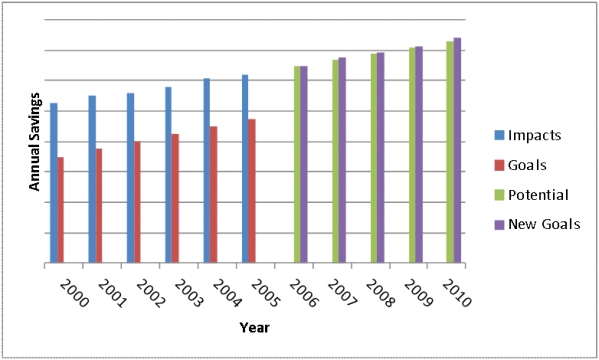
As an example, the following chart demonstrates the results of a potential study I saw a few years back.  The data have been removed and the years were different (I just pulled energy numbers and years out of the air but the graphic looks almost exactly like the one it mimics).  Look at the results of the study – it’s purely an extrapolation of what has been happening.  Congratulations.  The result is the goals actually caught up to what was happening anyway.

I plead guilty as well if I can’t get my hands on SOME sort of real data.  But how much do you suppose was paid to produce the results above?  No idea here but it’s pretty safe to say the answers were destined before the data were collected.

Tidbits

I came across this interesting study performed by engineers from Columbia University.  It shows energy intensity per square meter (don’t ask) of building footprint.  As I said, it’s interesting but not very useful.  It does not include building square footage so obviously the Chrysler building is going to consume more per square meter than some brownstones on the upper west side.

I also doubt the crude end-use analysis showing only 5-10% of electricity consumption from cooling.  These buildings probably require mechanical cooling half the year on average, some probably all year.  A bleeding edge cooling system will require 1.3 Watts per square foot at full load.  The actual average efficiency is probably half as good, doubling the power/energy required for cooling.  Throw on poor control of typical systems and it’s probably closer to 3 W per square foot on average and roughly 3 kWh per square foot for a good system and 4-5 kWh per square foot to middlin to poor one.  Now you’re in the neighborhood of lighting consumption.  End-use data from various sources confirm, cooling’s share of energy consumption is about 30% in the NYC climate.

Flying Rodents

Energy Efficiency1 comment

Before I get to this week’s rant, or I should say, this week’s primary rant, I need to share this with you.  Just before the holidays in Strange Magic,I tore into hands-free energy audit software.  All you need is an address and billing information and voila, there it is; an energy audit that tells you everything you need to know to cut your energy bills by a certain guesstimate.

This week I came across an apparent competitor to the one discussed in Strange Magic, so I viewed their online charting and graphics.  They present analysis via bar chart for various end uses; lighting, cooling, heating, miscellaneous, and so on.  They present current consumption and potential consumption for each of these, demonstrating a savings of course.  It took about three seconds for my eyes to pick up the fact that the ratio of all the end uses looked very similar.  Sure enough every single one of the seven end uses has a potential to save almost exactly 23%.  That will never happen.  It would be like every guy on a 12-player roster scoring exactly 10 points.  That isn’t how it works.  Ever.

Now dude, this is bordering on fraud if you ask me.  What did I say in Strange Magic?  The best you can do is guesstimate savings potential for the entire building with the information you can get from billing records and a street address.  Do not be fooled by this crap!

You old gray hairs like me would remember the days when they had cartoons before the movie started.  That was the cartoon, except for it is serious as a brain tumor.  On with the main attraction.

Our beloved California is once again “leading” the nation in energy efficiency policy.  This time the target is… drum rolllllll… the phone charger!  More accurately, all chargers – so-called “vampire loads”.  So this week’s rant features analysis and research conducted in my house.

I’ve seen a number of articles on this topic but this one from Energy Efficiency News seems like a good one.

This is California with 37 million people and so the numbers are incomprehensible until we start pealing back the onion.  These charger devices are reported to consume 8 billion kWh, or 8,000 GWh.  There are 12 million households in CA, averaging 11 chargers per household: 120 million chargers.  Do the math and you get 17 kWh per charger saved annually.  If they are saving energy 24/7/365; dividing 17 kWh per year by 8,760 hours/year results in 1.9 Watts saved every hour of every year for every charger in the state.  The article states that this is 40% savings, so the average charger wastes almost 5 Watts all the time according to California.  See nearby chart for clarification.

So is this reasonable?  Here are my findings using a “Kill A Watt” 120 Volt power meter:

  • My phone, Motorola Droid Pro smart phone:  Consumes about 7 Watts while charging, and turned on.  Once it’s fully charged, it cycles between 0 and 3 Watts, mostly on zero.  When the screen is turned off, you have to wait a long time before it gets a micro shot of 3 Watts.  So it uses almost nothing when plugged in, turned on, not in use and fully charged.  When it tells me it’s fully charged, unplug it to save energy, it would take 16 years to save a (one) kWh.  I’ll get right on that.
  • iPod Touch:  This thing is identical to the iPhone without the phone part.  It guzzles a whopping 3-4 Watts while charging AND in use.
  • Dell Mini Computer:  Booted up with the lid closed and monitor off uses 7 Watts.  With the monitor on, 11-12 Watts.  In use while charging full blast: 30 Watts.  Shut down with a full battery: 0 Watts.
  • Dell 4200, 12 inch laptop (my real computer): Booted up, running a bunch of apps, monitor on and charging full blast: 40 Watts.  All else equal with the battery fully charged: 16 Watts.  Shut down on a full battery: 0 Watts.
  • Rayovac battery charger with 4 AAA batteries: 3 Watts.  I don’t know how these things work exactly but they seem to consume consistent power.  The batteries are always warm – 3 Watts warm.

So first off, as one blogger pointed out, saving energy by eliminating “vampire” loads is crap.  Vampire loads don’t amount to squat.  I’ll tell you want does amount to 10% of squat: not shutting down equipment like computers, stereos, DVRs, and stuff like that.  But these aren’t vampire loads.  They are load loads for crying out loud.

The vampire loads with my electronic stuff, which has to be pretty typical of battery chargers, is virtually zero.

Back to the battery charging.  The power factor on these battery chargers is poor, at only 0.5 or so.  Could it be this is what the once-golden state is targeting?  Not so much.  Poor power factor simply requires more current on the wires from the generator to the device.  More current means more line losses.  Line losses from generator to point of use are roughly 10%.  So if we take 10% of 15 Watts (the remaining 0.5), ooh, ooh, 1.5 Watts.  Well I’ll be darned.

This is within the realm of possibility but probably not likely.  All of these 11 devices per household would have to be in use 24/7, at least (?).  The savings is probably closer to one third of that claimed, or perhaps a quarter.  The devices most likely use substantially less than 15 Watts on average – see the phone Wattages above.

But who gets the savings from power factor correction?  Not the consumer; at least directly.  Residential customers in every precinct I know of pay nothing for crappy power factor.  It all boils down to reducing losses by my guesstimate of 7 Watts per household, or a whopping 6 kWh per year per household.  You’d “save” more by reusing your towels a couple times per wash, in a couple weeks.

But remember, consumers don’t save.  It’s actually the utility that saves.  In a regulated market, some of that would flow to the consumer in the form of lower rates because the utility recovers more revenue for given assets: generation, poles, wires and fuel.  However, the amount is so tiny, it’s within the margin of error I’m sure most likely upgrading chargers is a waste of money for consumers.

Rambling on just a little more, The Washington Post report on this, calling it “vampire battery chargers,” says “Chargers waste electricity by continuing to draw electricity even when a battery is full and suck energy when laptops, cellphones, digital cameras and other devices aren’t plugged in.”

Chargers continue to draw power even when the battery is full?  Well duh!  The device is still running.  As I found in my tests, shutting down the device with a full charge and the thing plugged in results in ZERO energy consumption.  Maybe I should call Kill A Watt because their meters don’t work, apparently.  Chargers still draw power when nothing is plugged in?  None of mine do at least to the threshold of a tiny 1 Watt.

Lastly, the Times article says chargers waste up to 60% of what they consume.  What happens with this 60%?  Energy waste is almost always if not ALWAYS given off as heat.  We’ve established that laptops consume about 15 Watts provided by a “charger” – an electronic doohickey (rectifier or something like that) that converts 120 Volts of alternating current into a few volts of direct current for computer consumption.  This is the only place this ~50% waste can occur because my power cords aren’t melting.  A 15 Watt CFL from my laboratory heats up to about 160 degrees.  My charger: 85 degrees, while delivering 16 Watts.

It’s been a while since my heat transfer courses but I can promise the heat loss from the CFL is a complicated model because of the geometry.  However, it is safe to say it has a lot more surface and better orientation to enhance heat transfer.  That being the case, if both the CFL and the charger are wasting 15 Watts, the charger should be much hotter due to its small size (next to Bailey’s paw for scale) and lousy heat transfer characteristics.  So I conclude there is very little real energy loss from these devices.  To cover the phones, their charger physical size and profiles are much smaller and not warm at all.

I declare these vampire losses to be more of a flying rodent loss and somebody, preferably a team of engineers should spend a day or two, determining the real savings because it isn’t 2 Watts per charger as claimed.

And BTW, the power factor of that CFL 0.59.  Uh oh.

Replacing the Burger

Energy Efficiency, Sustainability1 comment

The race is on to develop and deliver next generation successful energy efficiency programs.  There is indeed innovation in the marketplace.  The days of what I call “hamburger selling” will end, probably in the next decade.  Selling EE in these cases is like selling hamburgers – who can sell the most and the cheapest hamburgers that people will eat.  The product is unsophisticated – lighting, primarily.  The market is huge and opportunities ubiquitous.  Marketing and selling the burger is the name of the game and will be for a few more years.

In the past five years, energy efficiency has spread like wildfire across the country and although it’s a little twisted, if you consider all the vegetation, grass, trees, shrubs, and scrub as EE potential, the wildfire has consumed only the grass.  The grass will soon be gone.  How will the shrubs, scrub, and trees be reeled in?  It will require a combination of technology, but more so intellect and selling things (programs) people want.

What will this look like?  I’m not telling because it’s intellectual property, but I will say I can see it beginning to happen in the residential sector.  Last week we attended the Midwest Energy Solutions Conference hosted by the Midwest Energy Efficiency Alliance, in Chicago.  As I mentioned in The Super Genius Grid, somebody will develop an app to make EE into a game or social media thing of some sort.  Sure enough, this is beginning to happen via residential behavior-based programs.  One such program is delivered by Efficiency 2.0.

Part of the next swath of EE will be developing programs that people want to buy or participate in.  That’s what E 2.0 is about.  It amazes me how consumers respond – irrationally all the time – which helps explain the iPhone, iPad, iThis, iThat, iOther and the i-got-to-have-it.  The E 2.0 program offers points and awards to “empower” customers to reduce their energy consumption.  They partner with communities to compete with one another and to offer free money for spending at local businesses.  Like mom and apple pie – who wouldn’t want that?  The winning community gets a free solar panel for one of their schools – woohoo!

The E 2.0 program is a psychological program (my term) where communities are profiled as to where they shop, what they buy and all this stuff, like grocery club cards do.  They see what you buy and they provide coupons and discounts for that stuff or related stuff.

If I got the message correctly, consumers don’t want useful real information, which as I understand it is what OPOWER delivers.  OPOWER, again per my understanding provides data on how your bills compare against those in your community and how you compare against yourself in past years.  They tell you if you turn your thermostat down 2 degrees no one will notice and you’ll save $50 per year (asterisk, asterisk).  This seems like useful information to me but the message I got from E 2.0 and a somewhat similar provider, Simple Energy, is that customers want gimmicks, games, prizes, lotteries, and free stuff, NOT information.

Apparently consumers like lotteries and this is obviously true when it comes to state lotteries and the gaming industry.  I officially gambled once, in Vegas.  It was a stop on a road trip to California and when in Vegas…  I played the quarter slot machines starting with $10.  I think I plunked 40 quarters into the machine consecutively with no wasting time winning anything, at all.   I was done in 5.75 minutes and hooked like a crack addict.  No really – I said, “Boy that was fun.  Let’s get moving.”  I don’t even like “illegal” office pools, like Super Bowl, er I mean, “The Big Game” or the NCAA tournament where there is a 100% payout and no taxes.  I have no interest in dumb luck.

I avoid as much as possible anything with unfavorable odds including insurance, gambling, and investing.  “Investing” in an insurance policy because the premium seems cheap relative to the policy amount is stupid and a loser all day.  I already told this story a while back.  Gambling – ever seen a millionaire gambler?  Not for long.  If you believe in the possibility of wealth creation via gambling you probably believe in water running uphill.  Investing – fund managers claim they can beat the market.  Bull.

Ran in the ditch there a little but needless to say, to me information is useful.  Games: don’t have time and who cares?  However, this is very similar to old-school marketing versus “stupid” social media.  I get it and I’ll get with the program.

The E 2.0 guy said people don’t care so much about what their neighbors are using for energy.  Whoa!  This flies in the face of the OPOWER message to compete against your anonymous neighbors.  Why do people not care what their neighbors use?  Because everybody thinks they are different – just like you did in high school, when you wore the exact same kind of stupid stuff everyone else wore; listened to the same music; had the same sneakers; watched the same TV shows and on and on.

I can vouch for everyone thinking they are unique.  Large energy users included, think they are different than everyone else when, in fact, the first and second laws of thermodynamics are universal.  Sure facilities are different.  That’s why we need to look at stuff and analyze stuff specific to them but we don’t have to have been born in the building and spent our entire living breathing lives there to know what’s going on.

This is the challenge, however – savings from these programs run a few percent of consumption, maybe 2%-5%.  This may not sound like much but it is I believe including all customers and that would be huge.  The challenge is how to measure and verify savings on such a tiny scale.  These numbers are far down in the weeds.  If a kid leaves home for college it will have more impact – my unscientific guess that I would pretty well guarantee.

The other problem that the E 2.0 guy nonchalantly said is that when the program is pulled, all that remains is the measures implemented – the ENERGY STAR stuff, CFLs and whatnot.  Like leaving Weight Watchers, people go back to Twinkies, Ding Dongs and diet soda.

In the end, it comes down to prizes, dumb luck, games and gimmicks (which most people prefer apparently) versus benchmarking, competition, action and generating wealth for the sake of generating wealth.  That is, the E 2.0 versus the OPOWER way of thinking.

The race is on!

Tidbits

One other thing I noted in a separate session at the conferences was that in 2007, James Inhofe and Hillary Clinton slipped a provision into a law to require ground source heat pumps be evaluated against alternatives for HVAC system replacements on a 20 year life-cycle cost basis – for every new federal facility / system replacement.  Senator Inhofe is Mr. “climate change is the biggest fraud of our time”, but he supports efficient heat pump systems.  Why?  Could it be the International Ground Source Heat Pump Association is headquartered in Stillwater, home of Oklahoma State with board members including from big companies?

In the DUH column this week, suburbanites with efficient McMansions and a 40 mile commute use more energy than inner-city dwellers.


It’s Knowledge, Stupid!

Energy Efficiency, Government, Sustainability, Tax Stuff, Utility Stuff0 comments

I’ve spent most of my career in energy efficiency marketing and selling energy efficiency to clients and anyone who might listen.  Come to think of it, I marketed and sold to a lot of people who didn’t listen, to be sure.  So no one is safe.  A major component is removing barriers; also known as excuses, and sometimes bad ones.

Selling EE is very challenging but rewarding and it’s the way it should be rather than jamming laws down the gizzards of the public by the dysfunctional, corrupt, and clueless bunch in Washington.  Last week a guy actually presented a bill to ban the installation and even the purchase of compact fluorescent lamps for the federal government.  What happened to right wing consumer choice line?  I had to read it twice to believe my eyes.  What a sophomoric ideologue.  Meanwhile, Rome continues to burn as they can’t agree to cut spending in any substantial way whatsoever.

This week I bounced across this report by the Environmental Defense Fund regarding barriers to EE and maybe how to overcome them.  So I took a look to see if I was missing anything.   It includes the usual laundry list: lack of capital, risk aversion, and split incentives for leaser/leasee.

My first rant from this document regards one so-called barrier for municipal, university, school, and hospital (MUSH) facility owners.  Ironically, I first came across this acronym last week in a position listing for an ESCO (performance contractor).  It said they needed people skilled in dealing with MUSH.  I thought MUSH possibly meant the substance in the craniums of federal bureaucrats.

Anyway, back to the MUSH barriers – the report says one barrier for MUSH that for-profit enterprises don’t have to deal with is shortage of staff.  I about sprayed my nutty nuggets and milk all over my laptop.  That is a clueless statement.  You’ve heard the statement, “Caution, Men Leaning on Shovels Next Two Miles” for government road guys.  Since both state/county governments, as well as for-profit companies, do major roadwork like resurfacing highways, I always observe the workers and I can generally tell whether they work for government or for a contractor.  Workers for contractors stand in one place to drink water but that’s about it.  Have you ever seen a backhoe with a couple guys in the hole its digging and four or five other guys making sure it’s being done right?  Those guys work for the government.

Even ten years ago I would listen to government facility people responsible for energy efficiency sit and bellyache while they watched Bob Barker during their half hour morning break.  “Gotta do the same work now with four guys that a dozen used to do.”  Blah, blah, blah…

Want to know where this is true and the workload has actually increased?  Utilities.  Utility sales people or account managers as they may be known have been RIF’d (let go) en masse in the past 10-20 years – in some cases as many as 75% of them are gone.  It is not unusual for a utility that had 50 account managers twelve years ago now has 12 or 15.  Meanwhile demand for energy keeps increasing.  The storms go on.  The outages, while rare, continue to occur.  And EE goals sure as heck have not gone down, but rather have increased substantially.

Another barrier for manufacturing that I don’t see in the document: TIME.  Lack of time is a major barrier to EE in manufacturing facilities.  You’ve heard of the “jobless recovery”.  Many companies are making a lot of money and hoarding cash but they are not hiring people, and Washington can’t figure this out.  There is a name for this (making more money with the same head count): productivity.  I know this is Greek as hell (pun intended) to a Washington.  For-profit enterprises are in business to make money.  Hiring workers is a necessary downside, except in consulting where people are the product.  Bottom line: they don’t have people standing around leaning on shovels that can be freed up to deal with EE projects.

The other major barrier to EE the paper seems to omit is a major one: lack of knowledge or understanding energy efficiency and how to determine return on investment.  I put forth that most Americans cannot calculate a 4th grade “word problem” (remember those when you were in grade school?).  For example, how much money would Timmy save per year if he trades in his 18 mpg SUV for a 28 mpg vehicle of some sort.  That’s as easy as it gets.  It’s easier than determining savings from a CFL I bet, because people don’t know what a kWh is let alone what a kWh costs.  Consider some other ingenious and much more complex energy project bungles and follies we have experienced with custom efficiency program evaluations:

  • Water was being pumped several hundred feet vertically to a reservoir that supplied a water treatment station for distribution to end users.  The treatment plant was on an elevation near the source from where the water was pumped to the reservoir.  Probably like right here in La Crosse.  At one point somebody had a great idea.  Take advantage of the water’s elevation to generate electricity ala hydro-electric generation as the water flows back “downhill”.  But that wasn’t the project at hand.  The turbine had already been installed years ago.  The project at hand was to take the turbine out and actually use the elevation as a source of water pressure for the plant rather than using pumps.  Rather than extracting energy with a turbine and adding it back with a pump, both of which have significant inefficiencies and of course maintenance costs, just let gravity do all the work!  Awesome!
  • A chilled water system for a large healthcare campus has problems.  A new large building is added to the plant, but the system can’t meet the loads due to a pumping system problem.  The chillers have plenty of capacity.  Chilled water is being short circuited they say, and the buildings are not getting enough flow, somehow (our investigation is underway now).  Savings are achieved by shutting a chiller down because now the load can be met by fewer, more loaded chillers.  Major chunks of piping are being replaced.  Pumps are being idled.  Savings equal nameplate kW.  That’s not how it works.  At all.  First, this has engineering boondoggle written all over it.  Either the system was designed and approved by someone who doesn’t understand fluid dynamics, or system control is the problem.  I would bet on the latter and I would question the need to spend hundreds of thousands on piping replacement.  It may be as simple as the new building is moving so much water that flow reversal in the chiller water loop is occurring and this can be fixed, possibly with controls.  At any rate, this was an engineering screw up.  Should ratepayers help pay for the fix?  It’s a good question.
  • A cereal-making process cannot tolerate high relative humidity as this makes sugar and other powdery stuff clump up and make a mess.  The process guys shut down the outdoor air on the air handlers that condition the space.  What about the massive exhaust fans?  They made the problem worse by drawing in gobs of untreated air with exhaust sucking humid outdoor into the facility.  The stupid exhaust fans!  Don’t blow off the exhaust fans!  They can cause a lot of problems like frozen pipes and frozen water coils, comfort problems, and process problems.

The bottom line is, there is huge opportunity for EE in commercial and industrial facilities but there are no neon signs, blaze orange paint, or a tipoff like an incandescent light bulb – or textbooks pointing out how to recognize and achieve the savings.  Lack of knowledge and expertise to make systems function properly AND save energy is an enormous barrier.

If you are interested in reading more on barriers – Christopher Russell pretty well nails it.

Outrage of the Week

The EPA, the organization substantially responsible for scaring the dickens out of industry and business, the ones with the new insane proposed ozone limits, the ones who implement their own policies with an end-around on congress, the ones largely responsible for your electric bills going up… Is moving their Region 7 HQ in Kansas City from their current downtown urban center location to 20 miles out, paving over farmland and having their workers poison us all with their weapons of mass destruction on four wheels.  Nice job Lisa Jackson.  This guy from the National Resources Defense Council is pissed!

written by Jeffrey L. Ihnen, P.E., LEED AP

CFL Mud Wrasslin

Energy Efficiency, Government, Investments, Tax Stuff0 comments

As you must know, last week congress failed to pass a repeal of the incandescent light bulb with their “Better Use of Light Bulbs” (BULB) act.  There you go right there – God awful marketing.  Who comes up with this junk?  Why does every bill have to be called an “act”?  It’s like every scandal has “gate” attached to it.  Do the Millennials even know where gate comes from?  Climategate.  Memogate.  Blagogate.  Filegate.  Macacagate.  Monicagate.  Nannygate (2 each).  Travelgate.  Troopergate.  Guess who has the most gates.  I don’t know but I’ll bet Bill and Hillary have to be in the best and finals round.  “I am not a crook”.

I was tipped off to a Wisconsin Public Radio joust between a liberal from the National Resources Defense Council (NRDC – Left) and a conservative from the “Center for Energy and the Environment” a wing of the Competitive Enterprise Institute (CEI – Right).  I like the masquerading name of CEE, which is also the name of a non-profit, not to be confused with non-competitive, from Minnesota.  The radio show was entertaining to behold and I thought I would share some of the arguments of both sides.

Left – This is not a ban on incandescent light bulbs.  In the words of Dr. Evil, Riiiight. C’mon.  That is exactly like saying beer shall be limited to 3.2% alcohol and it must also weigh in at less than 90 calories per 12 oz serving.  No ban on beer here!

Right – Big business is teaming with the environmentalists to lobby congress for this – to make gobs of money. LOL!  Light bulbs aren’t made in the US, nor are they made by US companies.  Philips – Dutch.  Sylvania – German.  The CFL market is dominated by TCP, a Chinese company.  If you look hard you’ll find GE CFLs, made in China.  But the CFL isn’t why Imelt spends all his time in Washington.  He’s after bigger fish.

Left – This regulation is good for consumers.  Sorry but this is another knee slapper.  Let’s ban pizza.  Clearly that would be a victory for consumers – salt, fat, and enough preservatives to keep your dog around, odor free, for months after he passes on.

Right – Expensive halogen incandescent lights will soar in price once the incandescent ban goes into effect.  I doubt it.  This is like the merger of Sirius and XM satellite radio.  There will still be plenty of competition for light bulbs.   Competition has already made CFLs practically free to purchase.  Good luck against that.

Left – People don’t have time to determine life cycle cost and what is the best deal for them – therefore, take away the “bad” choice.  This clearly smacks that you are too stupid to live on your own – aka, the nanny state.

Right – CFL light quality is horrible. This is a bogus argument.  The only drawback indoors to CFLs is they take a minute to come up to brightness.  Otherwise you can’t tell the difference using a warm white CFL against an incandescent bulb.

Left – Halogen technology has been around for a long time but it has been too expensive for the market.  This mandate will drive down their cost.  Probably.

Right – People really hate CFLs.   Sure.  That’s why my mother has a house full of them (even the hideous cool white ones) and my brothers use them exclusively on the farm because they last a loooong time, and happen to save energy.

Left – He can’t imagine a better policy that actually results in more choices.  This may have been the stupidest argument of the interview.  Let’s ban cable TV and see if we get more choices for TV.  Good grief.

Right – Energy use will increase because the money that people used to send to the utility will now be used to buy more stuff (made in China from coal-fired power – my comment).  There is some truth to this I believe.  I discussed this in upside down consequence of EE last fall.

Left – A caller fears corporations more than government.  Criminally corrupt and crappy corporations eventually go out of business.  I wish I could say the same about corrupt crappy government.

Right – Why do we need to ban a harmless incandescent light bulb?  We didn’t ban horses and buggies or typewriters. There is some truth to that.  I had an electronic typewriter with memory and a tiny little LCD screen when I was a freshman in college.  Anybody need a cool toy for a toddler?

Right – People may resort to candles.  Candles are dangerous.  They start fires.  Ok.  This was the stupidest argument of the interview.

Right – A caller from Oshkosh tells us, he will show them.  He has stocked a lifetime supply of incandescent light bulbs for himself.  Congratulations.  Stay off that guy’s lawn or prepare for the consequences.  I wonder if he was smart enough to accurately estimate how many he needs??

Right – We already suffered through the low-volume toilets.  Good grief.  I’ve seen low volume toilets that outperform 5 gpf models.  Have you experienced the old lazy toilets, like in an old hotel where the water goes around and around and around for about 15 minutes, ending with a wimpy flush?  They don’t very well handle things with a specific gravity less than 1.0, if you know what that means.

Left – Extra cost for CFL is paid off in seven months at 10 cents per kWh.  This is not an unreasonable estimate.  Per the estimated hours of use to achieve this, hardly any of the lamps useful life is used up.

Right – But it will take a lot longer to return investment where energy markets are freer and cheaper.  Weak.

Right – This is a broad overreach of the nanny state.  See, this is my problem with this.  It’s a total waste of time and political capital and meanwhile, Rome burns.

Speaking of the nanny state, how about focusing on setting the current corrupt and incomprehensible heinous tax code ablaze?  Corrupt?  Exhibit A: General Electric – $5 billion in ONSHORE profits, $0.00 US income taxes last year.  CEO Imelt has overseen the company’s fall from $55 when he took over in 2001 to about $19 today.  Congratulations.  Why he isn’t among the unemployed is beyond me.  Moreover, Art Laffer, a very in-tune economist and his colleagues estimate America spends a staggering $430 billion on tax code compliance.  To put this in perspective we consume – consume, not import – roughly $730 billion in oil per year.  And people whine about high gas prices!

Perhaps the only thing more insane is borrowing 40 cents on the dollar spent by the feds.  How about putting full resources and muscle of the CEI behind this atrocity?  Who cares about light bulbs?

In the end the CEI guy had no leg to stand on.  However, the NRDC guy should have pointed out that if they skipped the ban, the guy in Oshkosh would have eventually seen the light (pun intended) and started to use CFLs.  Like the horse and buggy days, I think incandescent bulbs would have gone away by market forces, maybe in a few years??  We will never know.

written by Jeffrey L. Ihnen, P.E., LEED AP

EE, Policy, and Irony

Energy Efficiency, Government, LEED, Stimulus0 comments

As my crop of silver hair continues to expand, I have become more of a historian, particularly when it comes to cause and effect, and peoples’ behavior.  I step back and observe what is happening and what has happened as a result of this or that policy.  Theories are nice, and they may be well thought out and make sense but if they fail miserably, should we double down and try it again?  Policy isn’t like launching rockets or breaking the speed of sound.

For those things, you can test, observe failure/problems and make adjustments.  For example, Chuck Yeager was the first to break the speed of sound in an airplane.  As he did so, the vehicle, which looked like a beer keg with wings (tap included), shook violently and about blew apart.  Why?  Because it had straight wings, not “delta” shaped wings.  The tap of the keg was led by a shock wave that emanated back in a V, kind of like the wake behind a boat.  The straight wings resulted in the ends leading the beer keg’s shock wave and the portions closer to the fuselage were safely behind the shock wave.  There is a large difference in pressure upstream and downstream of the wave causing instability and the violent vibrations.  They learned.  Sweep the wings back so the entire wing is post shock wave.  All supersonic aircraft have since been designed that way.  Google for pictures of the Blackbird, Concorde, Stealth Fighter, F-14, 22, and a gazillion others and you can see this delta wing design.  You don’t see this on your basic subsonic A320 passenger jet.  Mechanical engineers should already know this.  If not, they went to the wrong school or slept through fluid dynamics.

Policy, on the other hand, does not work this way in my opinion because policy affects infinite variables and you are dealing with peoples’ decisions on a macro basis, not physics.  When accounting for decisions made by 300 million individuals followed by a chain reaction of decisions that is limitless, you will get the same results from the same policy every time.

Keynesian theory (stimulus), for example has failed, what a thousand times, not counting the depression?  But we keep trying.  See this damning report by two Ph.D. economists, one from The Ohio State University and one from the University of Western Ontario.  The Act “saved or created” 443 thousand government jobs and “destroyed” about 1 million private sector jobs.  I wonder if the study was funded by ARRA!  LOL!  Has anyone seen Joe Biden lately?

I could write a book regarding why it doesn’t work on a macro level, but let me just provide some reasons believers give for it not working: it wasn’t enough money ($800 billion is almost $3,000 for every man woman and child in the country – how many flat screen TVs from China do we need?), it doesn’t work during deficit spending, the financial crisis, the Bowl Championship Series, La Nina, Rosie quit The View, people were busy preparing for the apocalypse that failed to materialize over the weekend  – you name it.

Likewise, it’s been a bomb for energy efficiency.

  • Utility and regulatory stakeholders in Iowa opined they couldn’t wait for the funding to stop so people would get off their hands and get in the game again.  Now that ARRA is wearing off, an objective observer can see this happening – the economy improving, slowly.
  • Cash for clunkers miniscule EE impacts.  Over an AESP conference lunch last week, I visited with an engineer from Southern Company, Alabama and he said the Honda and Mercedes plants in their service territory were running around the clock, full tilt.  Post cash for clunker they were running at half capacity.  And savings?
  • A long time ago, I said the money going to EE needs oversight to ensure it isn’t wasted.  Well lo and behold, a few weeks after this we bid as a sub-consultant to evaluate the funds spent in California and won the project.  We haven’t seen a nickel’s worth of work yet.
  • With a business partner’s lead, we pursued pilot work to pursue some ARRA funds, despite my vowing not to pursue ARRA funds.  Result: $130,000 lost in work we will never be paid for.
  • We had a “shovel ready” LEED® project for a new federal building ready to go.  After dragging on for months, our LEED services were value-engineered out of it.  Did the OSU guy capture this?
  • In the past couple weeks we considered going after some DOE EE evaluation work with one of our best clients but dropped out once intelligence revealed a competitor was going to low-ball it with their “government rates”.  Reverse price fixing.  I wonder how the rest of their clients feel about this??

What else is ironic is I would say our industry is quite progressive, yet when politically favored are in power, EE gets the shaft.  Consider WI, which during the recession prior to this one, the Democratic governor Jim Doyle, almost collapsed the state’s energy program by taking HALF the budget dollars rather than cutting spending elsewhere.  In speaking with Californians last week at AESP, the same thing is on the table in Sacramento, with a Democrat uber-super-duper majority.  I said, I bet there’s uproar over that.  Not a peep.  How could this be?  Unions Trumpka EE, get it?

Meanwhile, on the right you have people like Rand Paul with his kooky bill to undo the incandescent ban; Glen Beck waxing hysterically that George Soros will use the CFL as a tool to overthrow the US government and Media Matters will control your smart grid connection; Bush and hydrogen; and of course there is a considerable faction of right wingers that would just as soon gut all EE efforts and drill, mine, build power plants, and power lines willy nilly, and waste resources per market forces.

Finally there is this triple lindy irony: the incandescent ban, signed into law by Bush, hated by right, generally applauded by policy people in our industry, is causing much angst for program people.  It’s taking with it a gravy train of easy savings for EE programs.  An entire cottage industry is developing to rationalize the legitimacy of maintaining these savings.  There’s a problem though.  I can get CFLs on Amazon.com for less coin than the less efficient halogen.  We may actually see incentives for throwing away working incandescent light bulbs (just guessing).

Will the Republicans dismantle our industry?  It’s probably not going to happen in Wisconsin.  A friend (Shaw) of a friend (Koch) of the governor is the administrator!  What a hoot – a story for another day.

written by Jeffrey L. Ihnen, P.E., LEED AP

Biscuit Discipline

Energy Efficiency0 comments

Like any respectable pets, our dogs Bailey and Atlas have us trained, very well.  I roll out of bed on the weekend, slog downstairs to make a strong mug of coffee, light a fire (in the wood stove), sit in my chair to read the paper and then the dogs position themselves in their kennels with their entitlement look.  They were trained since puppyhood to like being in their kennels so when they kennel up, they get a b-i-s-c-u-i-t.  We have to spell certain things out or use aliases to avoid undesired reactions.  For example, we say “There is a bushy tailed mammal on the bird feeder” lest we get the dogs going bazookas scratching up the wood floor, knocking things over, and ruffling floor rugs into piles.

Everything that has resulted in kenneling in the past is now used to leverage a biscuit for the entitlement dogs.  After taking them outside for a wiz, they get in the kennel for a biscuit.  Don’t get a biscuit?  Whine incessantly.  When I come down the stairs in the morning to put on shoes for work, they get in their kennels.  After their morning and evening meal.  In the kennel.  When I come in from filling the bird feeder.  In the kennel.  Their willpower is staggering.  Crack open a beer on the weekend, WOW.  Get the food out or prepare for the consequences – barks with a pulse wave that will take out a communications system.  It is time to eat, NOW.  After the meal, it’s time for a rawhide – NOW.  The rawhides are like their post-meal cigar.  Lastly, to get them to go outside for a late night wiz before bed, they won’t budge from wherever they’re snoozing unless I break out the ice cream bucket.  You remember faking sleep as a kid?  That’s what they do for the ice cream.  They each get a “bite” of ice cream, which I don’t think touches their digestive system until it lands somewhere in the middle of their small intestine.  They have a pneumatic ingestion system – like a vacuum cleaner.

As I have been in the energy efficiency business for some fifteen years, I am coming to the conclusion that nearly all energy efficiency measures have a strong behavioral component.  Almost nothing escapes the effects of behavior.

In Upside Down Consequence of EE, I expanded on the fact that in many cases, energy efficiency actually increases total energy consumption on a global basis.  There is rebound effect, which refers to consumers using energy efficient equipment much longer than they otherwise would because they perceive the thing in question to use a tiny fraction of energy compared to what it replaced would use.

Energy cost is very much like a tax.  The less people pay into local, state, and federal cash infernos, the more they have to use for themselves.  Hardly anyone other than perhaps some survivors of THE Great Depression, buries their money in the backyard or stuffs it under their mattress.  They either buy stuff, which takes energy to produce and deliver to their home or they may invest it in companies that provide goods and services, both of which consume energy.  As you read this you are probably consuming energy because you are employed by the energy efficiency market; otherwise you might be lying in bed, unemployed or out collecting nuts and berries between unemployment checks.  You’ve got office equipment, facility energy consumption, transportation energy to get to work (if you walked, it takes energy to cook the extra oatmeal).  You are a walking, talking testament to this phenomenon.

Actually, I have no problem with these phenomena.  Smart utilities understand this as well.  They know energy efficiency doesn’t mean less consumption, it means getting more from every BTU and Joule.  It falls in the nebulous regime of “saved or created”; one where we would have consumed XYZ if it weren’t for these programs.

More examples.  One of my gripes about the ban on incandescent lights is that I have certain applications where the incandescent bulb is the best solution.  These are applications where I need light for a few seconds to pick stuff out from the shoe pile, closet, or pantry.  My last incandescent flood light burned out in my main thoroughfare to the garage.  Unlike some other anonymous occupant of my house, I am obsessively habitual about turning stuff off when it is not needed.  Since the CFLs take at least a minute to come up to brightness, they are training me to leave them on because I hate dim more than I hate wasting energy.  So instead of having 86 Watts of lights on for five minutes when I get ready to go out for a run in the morning, I have 39 Watts burning for an hour.  Do the math.  CFLs waste energy.  I don’t care about this “little” difference in consumption.  In the garage, due to the same issue, I have a light on a timer that controls a CFL to burn in the morning and evening darkness.  Rather than maybe a 200 Watts for two minutes, I have 26 Watts for several hours.

In addition to loathing of pathetic light levels, and I’m talking about less than 20% of decent office lighting, I have in the back of my mind the fact that turning lights on and off shortens their life, or more formerly speaking, it increases mortality rates.  On top of that, I know I cannot or will not just throw CFLs in the garbage.  There is all kinds of crap in there, in addition to mercury.  What is in the big whomping base thing?  It isn’t play dough.

I am a breathing and probably irrationally reasoning laboratory for actual energy efficiency impacts.  Impact evaluator, I’m your worst nightmare.

This article discusses more of these issues and as I read it, I thought this would get a lot of blowback from many in our industry.  But I think there is a lot of truth to it, except driving more because a gallon a gasoline goes further.  Driving enjoyment or tolerance and gas mileage are inversely proportional.  Who wants to take a Prius out for a tire-screeching exuberating drive on the winding roads in the beautiful countryside around here?  That’s just wrong.  You need at least something like my tiny Acura which gets a respectable 30 mpg.

Darn.  I didn’t get nearly as far as planned.  I will have to continue this discussion with an extension to nearly every other measure and technology, later.

Click here to see the cartoon version of this week’s Energy Rant.

Tidbits

If you have read this blog, you know I don’t support ramming energy efficiency down the public’s throats.  I was not in favor of the ban on the incandescent bulb, and you can see why above.  (Yes, I can buy a more expensive halogen)  However, I would not move to repeal the law, if that makes any sense.

I have had a great interest in politics and macroeconomics for over twenty years, essentially since college.  There is decent policy, really bad policy and everything in between.  I’ll just say that I’m all in favor of gridlock and government shutdowns because if they aren’t passing laws, they aren’t damaging the country.

As they say, good policy makes for good politics.  A law may be extremely unpopular to some but if it’s good policy, the opposition will melt away over time.  Then there are bills that are just stupid.  They are nothing more than antagonizing the other side; a stick in their eye, and they make for really bad politics.  Which brings me back to the repeal of the incandescent ban.  Take a look at these incredibly stupid comments by Rand Paul.  That will land you on the island of political loons.  Who knows – they may push this through, but it wouldn’t be good politics.  Appealing to just 20% of your most rabid constituents and otherwise only talk radio people or far out bloggers is really moronic and self defeating to one’s overarching objectives.

written by Jeffrey L. Ihnen, P.E., LEED AP

← Older posts