Archives

Monthly Archives: May 2012

Misguided Benchmarking

Energy Efficiency, Uncategorized0 comments

Unfortunately, some products and services in life still require cash – coins or paper.  Some of the last places I use these anachronisms include taxis, and… and tips, or an occasional soda machine.  Oh and the beloved antique parking meters and toll roads in some places.  Here is something to consider: if the meter only takes coins, skip it.  You’ll spend $50 of your time finding a few bucks of quarters somewhere and running to the meter every hour or two – all to save a $10 parking ticket.

A few times a year when traveling with others, we need cash or coins for a parking meter.  How much money do you have?  Nothing.  Nothing.  Yes.  Nothing.  Yes?  What does that mean?  As an answer to, “how much money do you have?”, “yes” is about as useful as some benchmarking results I’ve seen.

There is benchmarking, and there is BENCHMARKING.  Most consultants say they do it, but it typically varies somewhere between almost useless and misleading information.  Why?  Because they tell you how many coins and bills they have in their pockets and not how much MONEY they have in their pockets.

The typical benchmarking reports energy consumption in Btu[1] or kBtu (thousand Btu) per square foot.  The value of a Btu of energy depends on its form.  Is a hunk of wood with 100,000 Btu worth more than a therm of natural gas (80 cents on my last bill), or 30 kWh (more than $3 on my last bill) – each with approximately the same Btu content?  A chunk of firewood with equal Btus to that of a therm of natural gas is worth less than the natural gas, and natural gas is worth less than equal Btus in electrical form.  Why?  Because natural gas and electricity are more useful and flexible forms of energy.

In every benchmarking thing I’ve seen, all Btus (electrical and fossil) are mixed together. In some cases, the electrical Btus, which are worth five times as much as fossil fuel Btus, count the same.[2]  This is worse than worthless because it can be terribly misleading.

Recently in a meeting I quipped, “I hate it when fossil and electric Btus are mixed together for benchmarking.”  The guy next to me said, “Well, it’s like city mpg versus highway mpg.”  Come again?  I bit off a piece of my tongue and mentally rolled my eyes.  This is exactly the same as valuing one dollar bills the same as five dollar bills.  It’s worse than worthless.  It is misleading.

Other benchmarkers at least true up the Btus to provide some sort of apples to grapefruit comparison.  They use source Btus, which are those thermal Btus back at the power plant used to generate the electricity.  These are then added to fossil fuel Btus from the site (building).  This is better but still not very useful.

ENERGY STAR® for commercial buildings uses this method to determine the energy score of a building.  This source energy comparison serves its purpose quite well for ENERGY STAR, but what it fails to tell the owner is, where is the opportunity – what fuel, and what might the opportunity be worth?

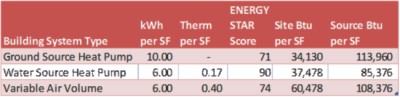
The chart below, for example, shows energy intensity[3] for three hypothetical elementary schools, each with full air conditioning, and each with realistic energy consumption.  You can see how terrible site Btus are for comparing energy performance, but yet amazingly, that is what some in our industry use.  It can easily provide upside down results as shown – the worst building has the lowest site Btu consumption because all the Btus used at the site are expensive electrical Btus.

Useful benchmarking takes a human brain with experience because buildings are rarely as clean cut as these in the example.  Buildings are used in different ways, particularly in the summer.  They have additions, sometimes many, with different types of systems.  They may share meters and almost always have multiple meters.  Just knowing if you have all the meters, and only the right meters, takes experience and expertise to flag something that simply does not look right.

Did I mention some buildings, especially schools and some industrial facilities, are only partly cooled all year?  ENERGY STAR® benchmarking for these facilities is going to be somewhat to very misleading. To qualify for the ENERGY STAR®, you can’t cheat, letting occupants swelter in hot weather.  In other words, you can’t earn the ENERGY STAR® by letting the occupants freeze in winter, cook in summer, and sit in the dark all the time.

If your benchmarking tool, or guy, can’t tell you whether a building is a fossil fuel hog or an electricity hog and then convert it to a ballpark energy saving potential in dollars, call somebody else.  You can’t buy stuff with a payback and you can’t buy stuff with an ENERGY STAR® score.  What you need to know is, “What can I do about my cash flow?”


[1] Btu = British thermal unit – heat required to raise the temperature of one pound of water one degree Fahrenheit.

[2] It takes three Btu of thermal energy to produce a Btu of electricity but it also takes power plants and transmission and distribution to deliver to the customer; thus the multiple of five rather than three.

[3] Energy use per square foot or “SF”.

Boredom or Drone?

Energy Efficiency0 comments

Last week’s AESP Spring Conference in Baltimore wrapped up with Dr. Julie Albright’s presentation, The Social Utility – great stuff. I had already attended a similar presentation by Dr. Albright, apparently during last fall’s conference (crap for memory here). As the title suggests, the subject is social media: LinkedIn, YouTube, Twitter, Facebook, Pinterest, and dozens of offshoots that aggregate and/or process information from these sites into a preferred presentation. It’s mind blowing.

Dr. Albright’s presentation includes generational views of these things – the people aspect. There are three generations of folks in the workforce today, from old to young: boomers (born 1946-1964), Xers (through 1982), Yers/millenials (through 2000). The latter two are known as, tech adopters, and the digital natives, respectively. Boomers vary from adopters to stonewallers.

A stonewaller has not yet accepted the dumb phone or the spreadsheet. Cable TV and the compact disk are current technologies for them. They only forward crappy jokes via email, have a 12 year old desktop (computer) less powerful than most wristwatches, and they are fine with a 40 pound CRT, which you can probably find as a relic in the Smithsonian museum of science and technology somewhere.

As a tech adopter, I did not use a computer, unless I had to for class, until I got out of college. This was pre-Windows, pre-Dell, and pre decent coffee. I did use a crude spreadsheet my senior year, and I have to say, that was the point computers went from an evil nemesis to something useful to me.

As a web 2.0, I do social media for two reasons: marketing and recruiting. I seriously don’t give a crap about it otherwise, just yet anyway. Ostracists can grouse and ignore these at their own risk. A growing slice of the working population (millenials) would die without social media. One of Dr. Albright’s slides said something to the affect that most social media addicts value it more than air, water, and food. And I thought to myself, “These are the same freaks who pick a college because it’s green – air, water, (environment), or facebook?”

Do YouFaceTwits have any problem-solving skills? Is there any creativity there? Every waking hour requires information bombardment – visual and/or audible. One guy in the AESP lamented his kids were always interrupted by social media and couldn’t finish their homework. The room erupted with applause! I blame it all on the DVD.

In my day, we didn’t fly to California for vacation, we drove. Two parentsand four kids packed in a four door “sedan” with vinyl seats. Toys were made of steel and plastic with wheels, or action figures. Games were imaginative or challenging – like name the make and model of every car going the opposite direction down the freeway. When we got cranky and out of line, we got yelled at or threats to stop the car. Xers know what happens then (YouFaceTwits, the answer is not “take a pee”). In fact our school bus driver would slam on the brakes if we were running around or causing a ruckus on the bus. He’d probably get hauled away in cuffs and put on the national child beater list today. Millenials? Nahda. Pop DVD after DVD in the player for an audio/visual pacifier. Visual/audio bombardment from age 2 on.

Here’s the thing I couldn’t more agree with: “boredom” fosters creativity and breakthroughs. Digital bombardment snuffs this out every second of the day for YouFaceTwits. The Wall Street Journal reported on this a little over a year ago.  The article covered a couple findings from university studies: people with ADHD, which I swear I’ve always had, did better in various fields from art to science because they can’t focus on things for long periods of time. They daydream, which is what people do when they are bored. Gee, I wonder why I always sucked at standardized tests with reading comprehension from boring irrelevant stories that serve no purpose whatsoever. These sections just bored the living hell out of me. Would Einstein, Newton or Picasso do well on a standardized test? Do Zuckerberg, Gates, and the late Steve Jobs have college degrees? Boring!

As reported in the WSJ article, scientists found that tuner outers are generally less creative. Why? Filtering information and limiting views rather than letting it all in, including seemingly useless information, inhibits breakthroughs. Think about this. Twitter? Facebook? Useless information? Maybe as one guy said, Alex Rodriguez’s hair gel does matter.

I run about 45 minutes every weekday and maybe 1.5 hours average on weekends. I’d rather be tied to a gurney all day in a black room at 105F than run on a treadmill with a TV blaring in front of me. I’m frequently asked, “Don’t you get bored?”, No. I let it all in. It’s one time I don’t force my brain to do anything. After processing data while sleeping, it’s amazing what it will process when awake and conscious but not forced to do anything – and not being bombarded with artificial stimuli. Try it sometime.

Ballad of Willie Widget Man

Energy Efficiency0 comments

As I created Widget Man last week I couldn’t get Elton John’s Rocket Man out of my head, so naturally I started to think parody.  A warm up may be good to get your rhythm.

Willie Widget Man goes sumpin ike iss:

They set my goals so high, I cried
Two percent, holy crap!
Why they gotta be high as a kite like that?
I miss the fruit so low, I miss old code
It’s not easy for me now
It’s such a mindless rite
 

And I think it’s gonna be a damn hard time
No light bulbs anywhere for me to mine
Like my showerheads, the flow’s so low
Oh no no no
I’m a Widget man
Widget man, throwin’ CFLs at every home
 

And I think it’s gonna be a damn hard time
No light bulbs anywhere for me to mine
Like my showerheads, the flow’s so low
Oh no no no
I’m a Widget man
Widget man, throwin’ CFLs at every home
 

This ain’t the racket that it used to be
I don’t know where to turn
Do I need an enginEEEEERring PhD?
No grasp physics, I can’t understand
Just a basket weaving Degree
Oh widget maaa-aaa-aaa-aan
Widget man!
 

And I think it’s gonna be a damn hard time
No light bulbs anywhere for me to mine
Like my showerheads, the flow’s so low
Oh no no no
I’m a Widget man
Widget man, throwin’ CFLs at every home
 

And I think it’s gonna be a damn hard time
Yes I think it’s gonna be a damn hard time
It’s gonna be a freaking hopeless hard time
I think I’ll find a hole crawl in to die
 

Widget Man
by: jlihnen

Widgetman

Energy Efficiency, Government2 comments

Widgetitis: Obsessive compulsion to build canals with teaspoons – or meet program goals with showerheads.

A short story about economist Milton Friedman from The Wall Street Journal sort of sets the stage for effectively meeting program/portfolio goals in big chunks:

Milton recalled traveling to an Asian country in the 1960s and visiting a worksite where a new canal was being built. He was shocked to see that, instead of modern tractors and earth movers, the workers had shovels. He asked why there were so few machines. The government bureaucrat explained: “You don’t understand. This is a jobs program.” To which Milton replied: “Oh, I thought you were trying to build a canal. If it’s jobs you want, then you should give these workers spoons, not shovels.”

Widgetitis is a term I “coined” this week for the title of my ACEEE paper to be presented in August at the Summer Study for Energy Efficiency in Buildings.  The context is obsession with products and stuff which have evolved to the point of diminishing returns, total free ridership, and grasping for rather absurd widgets to get savings goals.  Meanwhile, Rome burns with buildings hemorrhaging energy like a severed jugular in a Freddy Krueger movie.  Some examples, Jeff?

My favorite: the programmable thermostat.  We have evaluated these things all over the country and the savings are abysmal for numerous reasons which I explained in a past brief.  If the customer gives a damn and would program the thermostat, they would already be manually controlling their old fashioned thermostat precisely per their occupancy patterns.  My mother, for example, turns the stat down when she goes to bed or leaves the house for whatever reason.  She may leave the house for her grandson’s evening ballgame or a weekend away, or she may spend the night watching TV and the weekend hosting guests.  Do ya think a programmable stat is going to save anything here?  No!  It will waste energy and make Mom angry.  The person that doesn’t give a damn will put it in override all the time.  The person that does give a damn will override it for manual control.

The occupancy sensor for lighting.  For reasons similar to the programmable thermostats, savings for these things can run in the red.  People who care turn the lights out when they leave the room.  For these applications, occupancy sensors waste energy when they replace manual switches as the controller leaves the lights on for a while after the room is vacated.  This delay is necessary.  Otherwise, lights would turn off every time an occupant sits or stands still.  Which brings me to the next point; the damn things turn the lights off while you work studiously.  You have to move about four feet to trigger an infrared sensor.  Blinking your eyelids will almost trigger an ultrasonic sensor.  When I walk into our supply room controlled with an infrared occupancy sensor, I’m 5 paces into the room before the lights come on.  Good thing I know where the X-Acto knives are stored or I may hemorrhage like that Freddy Krueger victim.

Computer control software.  This is software that is installed on a network server and shuts down or puts corporate and school computers to sleep.  The problem again is, many/most people shut down their computers normally at 5:00, but to be safe, these systems don’t shut them down till 7:00 resulting in longer run times.  And who uses a desktop computer now days?  People use laptops, tablets and iPads that burn an incredible 23 Watts max and they take them home at night!

Server farm virtualization.  Technology moves so fast that those suffering widgetitis weren’t able to catch this virus.   Whoa, that’s like a quadruple pun – like a double eagle, a 75 foot swish, a 109 yard kickoff return, back to back perfect games, or hitting for the cycle twice – in one game!  I know as much about body embalming as I know about computer networks, but server virtualization includes loading up machines and making them work at full(er) capacity rather than have five times as many partly loaded machines.  The objective is to reduce the number of servers required and energy savings come along for the free ride.  Virtualization saves money by requiring less hardware and is therefore, an undisputed free rider – not to mention that it would crash benefit/cost tests.

Dishwasher pre-rinse heads.  I know less about this technology than embalming.  Obviously it reduces water (presumably hot water) consumption for commercial dishwashers.  I don’t know about you, but to me cleaning dishes is like fighting fires.  You can dribble water forever or blast it for a second.  This may be a perfectly viable measure, but Rome continues to burn.

The most recent case of widgetitis came to our attention recently – a doozer: tight sealing damper blades for a skyscraper to reduce infiltration.  Rome burns.  I’m sure everything else in the building is running in tip top shape, milking every bit of value from every Btu consumed.

The crux of my ACEEE paper is to eradicate widgetitis in new construction programs.  When I see new construction reports that only include occupancy sensors, daylighting controls, energy recovery, efficient this that and the other, more insulation and better windows, why bother?  Ok.  There, this provides some benefit cost information for decision making but does it bring innovation to the table?

All these criteria and specifications can be legislated – meaning they can all become part of the code and there is an end of the road for this across the board.  Two examples that have reached the end of the road: motors and exit signs.  Then what, Widgetman?  There will still be plenty to do in new buildings and even more for existing ones.

Innovation: the creation of something in the mind.  Widgets, while vast, are limited. Applying, assembling, and controlling them to minimize energy consumption is not.