Better than Doritos

Last week we looked at the financial benefits of energy efficiency as compared to the stock market. I’m going to take this a few steps further, as forewarned last week.
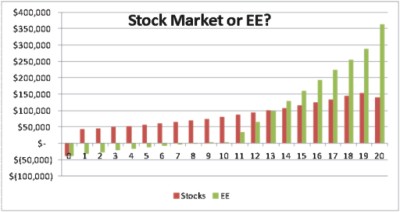
In both cases we start with the $39,000 investment and the stock market simply grows at its long-term average of 7.5% (Dow Jones Industrials). Obviously, a smooth appreciation of your investment is not the case and if you don’t have a strong stomach, you should avoid equities. Why is it called the Dow Jones Industrial Average anyway? It’s full of service companies, banks, and retailers. It includes Microsoft, but not Apple, which has over twice the market capitalization. A company like Apple, which is absolutely huge, would probably make up half the movement in the DJIA.
The EE investment on the other hand immediately starts paying dividends – actually net cash in the bank to the tune of $6,200. This dividend shrinks as the interest payments, which are tax-deductible, go away until the lease/loan is entirely paid off. Over this period, the stocks, on average, would catch up to be almost exactly the same after 10 years. However, in the 10th year, the $30,800 annualized payments for the EE investment disappear and suddenly the investment starts earning 115% of the initial investment, year after year, for the next 10 years.
You may notice the dip at the end of the stock market valuation in year 20. That is the capital gains tax whack of 15% you have to pay when you cash out, wiping out the last few years of gains. There is no capital gains whack on the EE investment. All tax implications have run their course as they affect the annual energy savings, interest payments, and depreciation. Actually, in year 20 when the EE investment reaches the end of its useful life, the remaining value of the investment is fully depreciated. Since the depreciation period is 39 years, like that of any facility, almost 50% of the depreciation occurs at the end of life, resulting in a $44,000 surge in after tax income which is almost equal to one year’s energy savings.
Aside from generating over 250% the wealth generated in a stock market investment over a 20 year period, EE offers the very attractive benefits of risk mitigation and certainty for return on investment.
Energy prices are volatile and today there is as much uncertainty in energy prices as there has ever been, which is why investors and companies are sitting on the sidelines hoarding cash. Specifically, nobody knows how many power plants the EPA will eventually shut down. Will they allow hydraulic fracturing that has produced the glut and current rock bottom prices for natural gas to continue? The beauty of investing in energy efficiency is if prices go up, you save even more than you projected. Rising prices is not a good thing, but by investing in energy efficiency you have insulated yourself against this and even improved your ROI. Conversely, if energy prices fall, your ROI drops, but who cares? You are paying less and your profit, or after tax income, improves.
In IPO Return, Treasury Risk, I described the low risk in energy efficiency, in most cases. Whoever determines the savings potential must not be a dufus, hack, or cheat.
Everyone knows there is always competition for scarce capital within an organization. Very few investments (uses of capital) have the certainty of EE. If a manufacturer decides to add another line of production, they better hope demand for the product increases as projected. And by the way, what is the return on that product? 10%? What ROI does a grocery store facelift have? Is that going to result in $363,000 capital formation over the next 20 years?
How about risk in plain old strategy against competitors or to sedate rabid mobs of protestors? In this article, Holman Jenkins compares and contrasts McDonald’s response to heat from child obesity activism to that of Pepsi, which of course makes soda with the poisonous high fructose corn syrup and other salt/fat bomb stuff people, including me, love. Nacho cheese Doritos – mmmm! They were awesome in 7th grade and they are awesome in 2012. McDonald’s strategy was to add healthy stuff to their menu. Never mind, because nobody buys happy meals with apple slices. It makes them feel better just knowing healthy stuff is available (not making this up). Pepsi, on the other hand, apparently messed with its product line with poor results, no stock market gain in 5 years. The bottom line is business is fraught with risk at every turn. It’s very difficult to beat the low risk and high return of energy efficiency.
The only “downside” with energy efficiency is its potential for a given end user is capped. It’s like short selling a stock. The most you can make is the entire value of the sale. The most energy you can save is the total you are paying now. However, energy efficiency is far safer than shorting a stock. The downside of shorting a stock is infinite. There is minimal downside risk to energy efficiency.

Finally, to look at a couple factors, it is interesting that end of life value varies linearly with down payment and with corporate tax rate. The percent down makes little difference. Lower taxes are clearly a boon to energy efficiency.
Next week: I’ll be sure to find something to gripe about.
Facility Management, Taliban Style
Possibly the greatest thing about energy efficiency is there is no limit to learning. In what other occupation can engineers work with social scientists, urban planners, economists and 16th century Mongolian art majors? Last week I attended a presentation by Christopher Russell, energy efficiency and finance swami, or is it guru? The higher ranking one. Or maybe I should just call him Colonel Russell.
His presentation started with the tale of two college campus facility managers, Doug and Dave as I recall, with names changed to protect the guilty. I’ll call them Dick and Harry for double protection.
It doesn’t happen very often, but every once in a while a person tells an energy efficiency program or project fable that I find myself violently agreeing with. In this case, Doug, er I mean, Dick was presented as an all-too-familiar customer representative/facility manager. His attitude is “energy is a necessary evil, a fixed cost, and not a resource to be harnessed,” and his idea of success is to keep the phone from ringing with problems and complaints. Gee, this sounds just like many HVAC and automatic controls contractors. Just slap it together, stop the phone from ringing, and move on to the next project. I don’t care what the energy consumption looks like, just stop the complaints. Who cares what the energy implications are? But I digress.
Doug Dick is a status quo thinker. He believes the pie is fixed and everyone must fight like a boorish thug for their budget. Then, once his slice sequestered, hoard it, and if necessary, spend it to (god forbid) reduce the budgeting leverage for next year. This is standard practice for government, by the way, including the Navy (at least back when I was there).
Dick Doug is eventually handed a mandate from on high to reduce energy consumption in campus facilities by XX%. Hire an energy efficiency professional to best determine maximum return on investment? Hell no. That would cost a lot of money, make Dick look dumb (he thinks), and the EE pros will recommend a slew of projects that upper management may get their hands on, which results in Dick having to do even more stuff! Rather, Dick decides to be proactive for a change and implement an expensive project that will drag on a couple years to keep the greens off his back. In this two year span, he thinks the fad will blow over… and then it hit me. Dick, the facility manager, is like the Taliban. He is dug in, resistant, and will never surrender. He will weather the storm and wear down his adversaries with brutally intransigent patience.
I have a great deal of passion for energy efficiency or I wouldn’t be in this business for 16 years. Reasons include; non-renewable resource preservation, saving money and increasing profit, risk mitigation, and all that sustainability stuff. However, thanks to Mr. Russell’s analysis and one question I asked, something like a cold fusion miracle occurred. He used an example, but I made up my own. A detailed assessment for a new energy management system has been completed and the project data is shown in the table nearby. I’m not going to puke all that information back at you in words, but I would just point out the lousy 5.8 year simple payback. Most customers would laugh and tell you to get lost because they only do projects with a simple payback of 2.0 years or less. A million years ago, I wrote an Energy Brief explaining why simple payback is a terrible metric to make decisions with. One reason it is lousy, as discussed way back then, was because payback has nothing to do with wealth. For example, what does a 2 year payback tell you about how much working capital the project will generate? I can’t buy lunch with a payback.
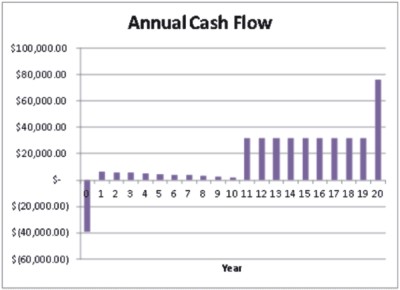
The annual cash flow shown includes the 15% down payment the smart guy, Dave, er Harry represents the plunk down of $39,000 for this project. Over the 10 years of the loan there is a positive cash flow (savings greater than payments) of about $2,000-$6,000, depending on the interest paid on debt, which is tax deductable. That looks pretty cool but still not that hot, Jeff.
Then we have the cumulative cash flow, and wow, this is suddenly becoming impressive. At the end of the 20 year life of the project the cumulative cash flow is $360,000 for a not-too-shabby internal rate of return of 18% on the original $39k down payment. Or you can do nothing and destroy $585,000 in capital on wasted energy[1]. Try to get that kind of return in the stock market[2]! Speaking of which, I have that comparison too.
Warning: Place your index and middle fingers over each eye socket before gazing at the chart – to keep your eyeballs from popping out of your skull.
I apologize for the positive message this week. This was a pathetic rant. Next week I will discuss other features and benefits for investing in energy efficiency.

[1] Note this is for demonstration purposes only. The wealth created by doing the project is
[2] 7.5% compounded average gain since 1972
3 and Out
The New Scientist published an article by an economist saying that now is the perfect time to implement “long-overdue environmental regulations requiring US power plants to reduce emissions of mercury, arsenic and other toxic metals”. And the added cost will be a boon to the economy. That’s what the textbooks say, so it must be right!
As the article states in one place, yes, retrofitting power plants will create jobs somewhere, and the higher cost will be passed on to consumers. Do they equally offset on a macroeconomic level? I severely doubt it but no one can prove that.
In another theory, he claims added regulation is neutral because the Federal Reserve will juice the economy with low interest rates. We’ve had negative real interest rates for years. Capital is practically free. Mortgages are about 3.5% – zero in real terms as inflation is almost this high. What are home prices doing? Still falling. How’s that juice working for you? It’s doing well with increasing gasoline prices valued worldwide by the sinking U.S. dollar – sinking because of negative interest rates! House payment savings are going in the gas tank and grocery bag.
Regulation is likely to create jobs, the article says, for three reasons. First, capital is not scarce but opportunities for investment are. It is clear the author has never run a company. Recessions offer precisely the opposite. They produce shakeouts. Overleveraged, poorly managed companies go out of business or their stock prices fall, making them targets for acquisition – friendly or hostile. Normally, recessions provide opportunity for well-run companies to emerge with greater margins and market share.
Second, the article says increased energy costs are unlikely to be passed on to consumers (directly opposite of what it says above) because companies have no pricing power. With profit margins at 45 year highs, companies can easily absorb the price increases with reduced profits. OMG! What a ridiculous statement. The author has clearly never had to answer to a board of directors and shareholders. Yes. We will voluntarily not raise prices just because we can. You’re fired.
The third reason is Alan Greenspanesque in its gibberishness, so it is simply copied and pasted: “the boost to employment provided by new investments accompanied by muted price responses will not be neutralized by the Federal Reserve, at least not in the next few years, as it has committed to holding interest rates low until unemployment returns to more normal levels.” Sounds good. Translation: jobs created from this investment[1] will not be offset by higher interest rates as the Fed Chairman, Ben Bernanke, will keep interest rates low until full employment returns.
Ever heard the terms stagflation or misery index? Stagflation is a crappy economy with soaring inflation. The misery index is simply the unemployment rate added to inflation. These peaked in the late 1970s and are rising to painful levels again. The theory that low
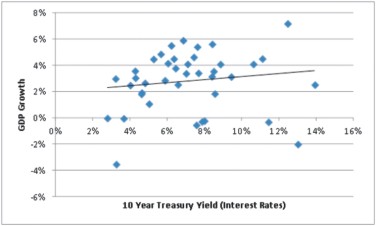
interest rates juice the economy is totally bogus, but yet we follow the ignoramuses like the Ben Bernanke who don’t look at history and instead follow the holy textbook. The chart nearby clearly shows low interest rates are associated with poor economies. Precisely the opposite of what the article implies. Data are from each of the most recent 40 years.
Yeah, but Jeff, you rube, the low interest rates move us to the dots in the middle where higher growth is present. Not so fast. I’ve got that clearly covered too.
The next two charts are what the president, congress, and the Federal Reserve would learn something from if they opened their minds and dropped the mud for a while.[2]

Thirty years ago interest rates were more than double what they are today and growth averaged 5% over four years of the recovery. We haven’t had 5% growth since 1999 and that lasted one year. The deficit, however, in the past three years is three to four times the average over the previous 37 years when it held pretty much flat. It hasn’t mattered but it does now.
Are spending and low interest rates working per the holy textbook? Uncertainty in a wide range of business – critical issues including taxes and energy-related regulation that we can control – is also a major brake on the economy.
Will emission controls ruin the economy? No, but stop with irrationalizing that it will help as described. While we are at it, let’s learn something from history rather than buying what the economics textbook is shoveling.
[1] Investment: Money that is invested with expectation of profit. I don’t think scrubbers produce profit for anyone.
[2] Sources: Bureau of Labor Statistics, Federal Reserve, World Bank.
Chester the Energy Advisor
We are from the government and we are here to help. Kaboom! That would be my door slamming in their collective faces.
A number of years ago, and just recently I was reminded of it again, the federal government was selling it’s handouts to citizens – actually advertising free stuff, food or services are common. This is perverted. We do not have people starving in the streets of this country and this is a lock because if we did, the media would be all over it like flies on watermelon rinds. Quite the opposite: we have a type 2 diabetes explosion, especially among the poor. But I shall cease writing on this topic and switch to energy efficiency, which has a parody problem – ambulance chasing programs.
Program portfolios for years have been relying almost exclusively on lighting projects for savings, even in legacy markets. But one thing that can be said about lighting is at the end of the week[1], they result in real energy savings that are quite reliable and accurate whether it is a custom (customer specific savings) or prescriptive measure (average savings for all applications/projects). In the big picture over many years, the programs clearly impact technology adoption and market transformation and I believe whether contractors or customers realize it or not, the programs make things happen that wouldn’t otherwise happen.
When I started in this industry in the mid-1990s, T8 lamps with electronic ballasts still had a lemon reputation in many markets because the first of these had design flaws that resulted in premature failure on a large scale. For example, ballasts would fail en masse within a year or two. Soon, in barely 20 years since their introduction to the market, they will serve as standard practice, no longer eligible for incentives. The lighting gravy at the end of the tunnel is not far off; LED technology is upon us and rather than serving as bleeding edge demonstration projects, they are now becoming the norm where reliability is critical and labor cost for maintenance is substantial.
Most custom and process (industrial) efficiency programs consist of money and goals in pursuit of projects. Like the federal government, they are campaigns to give money to customers who are doing projects anyway and don’t need the money and probably don’t want the associated hassle. Like lawyers chasing ambulances to redistribute money, programs are essentially like a strategic air command with radar and satellite reconnaissance in search of projects to act upon – like a rooster taking credit for the sunrise. They inject themselves with the grace and need of a cop at a frat party.
It is reasonable to expect that states new to EE will have weak custom and process efficiency programs and they will take the waste-high vegetables[2] (lighting) first. Mature programs should have a well-groomed force of energy efficiency experts and “trade allies” in the territory. Programs should be leading customers down the EE trail rather than being a nuisance. It reminds me of the cartoon, featuring Chester, the little dog, as the program energy advisor and Spike the industrial customer.
Chester harasses Spike repeatedly being smacked aside. Spike finally relents to the suggestion of beating up a cat (Sylvester), which sounds easy but he is sliced like fine cheese by an escaped panther as a result of Chester’s great idea.
Programs must do far more than hurtling cash at industrial customers for new light bulbs. Lighting is the least of their concerns because it is nearly the least of their major end uses of energy. Industrial customers need value and assistance from programs. They need value in the form of expertise to identify and/or quantify energy impacts of major process and supporting system modifications and optimization. The production guys may know something is costing the company tens or hundreds of thousands of dollars per year in waste but without nailing down the numbers accurately, the bean counters will snub the project. Assistance in the form of shepherding projects to completion is the assistance they need, probably more than a cash incentive. This may include simple drawings, control concepts, or simply getting a contractor on site and showing them conceptually what is needed and develop a cost estimate. As a customer, they just want to sign “here”, as customers do when the FedEx guy drops off a stack of shipped goods.
Large C&I customers are a different specie than residential and small commercial customers. They are far more practical and logical in weighing costs against benefits whereas consumers are emotional, rarely logical, prejudiced, predisposed, and political.
[1] Keep your eye out for twists on overused idioms.
[2] As opposed to the pejorative low hanging fruit.
A Radical Idea
This week I was gleeful to find American Council for an Energy Efficient Economy released a study on my two favorite subjects on which to rant: taxes and energy efficiency! Yeah!
I blogged about tax-distorting effects of EE about a year ago in EE V IRS,with many of the same arguments noted in the recent ACEEE paper. The ACEEE paper points out that:
- Since the cost of energy is a business expense, it is tax deductible and therefore, the tax code penalizes to the tune of 35% the bottom line improvement from saving energy. As I mentioned in EE V IRS, the United States had the second highest corporate tax in the electrified world and this week; congratulations (!), we’re number one as Japan has dropped theirs below ours.
- On the flip side, when companies invest in EE, 35% goes to the government.
- The EE investment is depreciated over time. This I discussed last week in Petroloons .
First, one sharp criticism of the above logic: not taking is not giving. In other words, avoiding tax payments to the government is not the same as getting something from the government. This drives me crazy. It’s the same as saying I give our company a case of soda every day because I haven’t been shoveling the contents of our soda cooler into my bag every night (steeling it) for myself. Do murderers save the lives of everyone they don’t kill? Ok.
Jack Kennedy was absolutely correct stating that cutting and simplifying the tax code results in efficient allocation of capital. Today, the tax code is corrupting with carve outs, societal engineering, and tax breaks for all kinds of crap that ties capital up in stupid stuff.
The feds tax repatriated capital, that is, money earned by US companies overseas and already taxed overseas by countries in which they operate. This is insane. Bring cash back home for investment and it first gets a 35% whack taken by Uncle Son of Sam? Washington likes to bash these companies for doing stuff overseas and the “tax breaks” they get for moving jobs overseas. The “tax break” is not getting slapped with a double tax. Not murdering is not the same as saving lives. Ok.
Another distortion is tax on capital gains and dividends. Trillions of dollars are parked in stupid stuff, like Apple’s $100 billion stash of cash. Why such a ginormous pile of cash? A major reason is shareholders don’t want to pay tax on dividends. Likewise, capital in equity in mature companies and starving the next generation of wealth creators. When an investor considers a 15% loss right out of the gate by divesting one place to invest in a better place, 15% is a huge barrier.
Any tax reform must lower barriers between capital and where it is best invested. This is what JFK meant by efficient allocation of capital. Now, on with the three ACEEE recommendations:
- Tax revenue, not earnings – a “radical” idea. Actually, this would be a sales tax or value added tax. Eliminating the current abomination and switching to a revenue neutral sales tax would be fantastic for the economy (and ¾ of Washington DC lobbyists would find themselves out of work). Capital would flood into the country and be cut loose from unproductive proverbial stuffed mattresses.
- The second is a “more surgical” approach that puts a cap on tax deductable energy costs. Bad idea. This would penalize energy intensive companies and distort the market again, nudging companies that produce jobs overseas.
- The third is a “more complex but perhaps more elegant approach”. Complex to me is butt opposite of elegant, but ok. This option would develop a standard deduction for energy costs that varies with the type of business. Screeeeeeeeeeaaaaaaaaach! Needle across the record. This again would be a market-distorting, game-the-system, screw-the-system approach akin to Rick Santorum’s proposal for zero income tax for manufacturers. Suddenly, everyone is a manufacturer. How does one define manufacturing? Is a brew pub a manufacturer (hardly) or a service company? Is printing manufacturing? We print stuff for sale. You get the point. Just imagine if we set this tempest loose. We should be generating wealth and not playing games to avoid the taxman.
Jeff Ihnen’s solution: Create revenue neutral tax cut by eliminating all market distorting tax breaks and carve outs, and eliminate the double taxation on repatriated greenbacks (I believe this was in the Simpson-Bowles committee that was/is entirely ignored). Here is a “radical” idea: let utilities invest on the customer’s side of the meter. Energy efficiency is a resource. There is concern about the old utility business model based on a forever growing market that doesn’t work anymore (because the market isn’t growing). So let’s allow utilities to invest in energy efficiency on the customer side of meter and let them earn their weighted cost of capital as they do selling energy. This fixes the problem of losing revenue and profit to EE and greatly reduces the tax-distortion and hassle of EE by making EE an operating expense rather than purchased assets.
Amen. Where do we start?