No Pain? No pain.
This will blow your mind. How many large power plants (500 MW) does it take to cook the thanksgiving turkey across the nation – just the ones cooked with electricity? Answer is provided below. Guess. Don’t be a loser. Guess.
I’ve seen perhaps 100 ads for dust collecting contraptions that everyone including the buyers know will end up under the bed, in the closet, or basement, and finally onto the garage sale to somebody else who will decycle it. These include the things like the Ab Buster 5000 (just made it up), junk you sit on, junk you rock on, junk you push/pull, slip/slide, squeeze or shake. They get body builders that spend 5 hours a day in the gym pumping real iron, doing real body building, to demonstrate the use of this crap with a voiceover of something like, “You will notice results in 5 days with just 15 minutes a day”, which is technically true. In 5 days the sedentary person’s gut, arms, or legs will be burning of lactic acid. The reality of course is, the schmo that buys this stuff is thinking they may look like the dudes and babes on TV if they buy the dust collector. I suppose that every once in a blue moon the stuff is actually used.
I’m more in favor of Rocky Balboa type training – simple stuff, like pulling a log through waste deep snow in Siberia. I run and the only weather or conditions not fit for running are those that might kill me or give me permanent brain damage. That would be limited to excessive heat. Everything else varies from great (minus -30F or 35F wind and rain in the dark or above 85F) to perfect (everything between 0F and 85F). There’s very rarely a legitimate excuse for not running. Real influenza, 103F body temperature, and barely being able to sit up in bed qualifies. I was there four years ago. There are practically no equipment requirements. Most requirements are provided by the state: that is roads, sidewalks, and when necessary bike trails (BORING). The roads are always open.

You really only need one pair but a couple of these are for ice and snow and the rest have varying degrees of mileage so I can bleed a thousand miles per pair by rotating new, old, new, old.
Compare this to the gym. And speaking of BORING, OMG, I was in Scottsdale at the Hotel Valley Ho a couple weeks ago; a fantastic 1950s retro hotel with a beautiful pool, patio area with immaculate greenery. As I was on my way out the door at O’Darkthirty to run, I noticed a row of treadmills on the second floor indoors overlooking the outdoor pool area. They were in use at least, but I was thinking what is wrong with those people? Why would you run in place staring at CNN with an iPod ruining your eardrums next to a stinky guy, in stale, stagnant air? I’d rather run laps in a Wal-Mart parking lot – or the Hotel parking lot, Interstate 5 in Southern California, or the tarmac at JFK in the rain. In this particular case, it was just above 50F and perfect outside, plenty of sidewalks and not much traffic.
Maybe people need an excuse (gym) to “work out”. I don’t get this. Treadmills are stupid (see above). Free weights cost not much compared to a few months of gym membership. Stationary biking can be had for a decent $100 doohickey attachment and a $50 tire for the bike you already have (no one does stationary biking unless they bike for real). There is nothing more brain damaging than riding a stationary bike. If you want to live forever, ride a stationary bike because an hour seems like 8 hours, like reverse dog years. Note THIS stuff is not dust collection material. Only obsessive hard core people use this stuff – triathletes, for example use it in Wisconsin winters. Nobody on TV sells stuff that actually works and gets used. No BS here.
In “Oh Behave” and “Biscuit Discipline” I attempted to make a point that information to save energy or to be healthy alone is not enough. Energy efficiency requires somebody, preferably multiple bodies if not all bodies being involved with constant favorable behavior to sustain savings over time. Both EE and fitness require persistence and activity over time. Grapefruit diets? Not so much.
Long term health and EE have this in common. Neither include simply buying your way to success. Ready?
Switching gears just a little, last week I came across this pyramid for energy efficiency in homes, which I thought was pretty cool. (Although as I type that, I’m thinking, wait a minute, the USDA food pyramids were complete flops, unless one rationalizes it was successful with the “created or saved” sort of government metric.) It seems its creator has prioritized things very well for a residence. It has renewable energy with the highest complexity and investment and I would add poor return on investment.
This spurred me to generate one of these for commercial buildings. The pyramid base – the best stuff – the raw vegetables, fiber, and omega 3 of energy efficiency is retrocommissioning, operations, maintenance, and discipline to stay with it. At the top: seven layer chocolate cake with chocolate drizzle and whipped cream – renewable energy. By the way, it takes just over 100 large power plants to cook the TG bird I mentioned above!
Payback ranges and percent of total facility savings potential are guessed for each category of measure. They are all wrong, so let’s just get that out of the way now. Misguided applications of practically any technology can have 200 year simple paybacks. Results can be all over the place and depend on many things possibly the greatest of which is, what is there now and how it is being used prior to implementation. The years noted of course represent a range of typical simple paybacks for the technology. The percentages represent the portion of TOTAL facility energy consumption the technology can achieve. Note for renewables I have a high of 100%, representing most likely a wind turbine. This can be done as Spirit Lake Schools (Iowa) had done many years ago. They were generating wind energy long before wind turbines sprouted like chia heads in the surrounding areas.
The chart is for commercial facilities only; NOT industrial and manufacturing facilities.

*Building envelope measures can have fast paybacks if the existing condition is terrible. For example, no roof or attic insulation – and in the case of flat roofs, the roof is pealed off anyway for replacement.
Tidbits
Some folks are proposing a switch to using lumens as the metric for selecting light bulbs for purchase at your favorite home improvement store. This would be in lieu of incandescent wattages or equivalents thereof. Uh huh. Around 1980 the US was going to be the last country on the globe to convert to metric units. You know – base 10 everything with common sense conversions like a milliliter equals a cubic centimeter. Fuggedaboutit! Not gonna happen. Funny thing is, by mid-engineering-school career, every engineer clamors to use metric only. Six months out of school they are polluted by old timers who like incomprehensible units like mass in units of grains – and so the insanity lingers perpetually.
Peer Review This, Please
This week I provide my own analysis of raw data to nail this Jell-O to the wall, and I’m done. It’s all good. Does anyone know what the “O” stands for? Orama? Jell Orama?
First a recap from last week from which I got some blowback. But would you believe it if I told you I received substantially more support and backslapping from critics of climate change? As with any highly charged issue, readers/observers tend to attack on a hair trigger anything that challenges established positions and assign you to a broad group of in-duh-viduals to which you do not associate. For example, since I couldn’t stand the Washington Redskins, I must have been a Cowboy, Giant, or Eagle fan. No. I simply could not stand the Redskins when I lived in the suburbs of Gomorra in the early 1990s. That’s all. Period.
Now, consider last week’s message from me:
- The Berkeley Earth Surface Temperature (BEST) team released a report stating the earth’s temperature had increased 0.9C over the past century. I said this is entirely believable.
- I said I have no reason to believe the team doesn’t have geniuses (really) that use the most sophisticated and best analysis methods possible.
- I said, not so directly, that somewhere north of 99% of the population hasn’t a clue how difficult it is to “merely” measure and track the earth’s temperature. It is extremely challenging and an art as much as science, like engineering and energy efficiency is.
First, I set out to take some consolidated data and look at it in a different way, and the results of that analysis, which provides some interesting findings, are provided in the epilogue below.
While reviewing any analysis of ginormous piles of data, I typically say, “Yeah, yeah. Just give me the frickin’ data and I’ll do my own analysis”. So that’s what I did this week.
The United States Historic Climatology Network, the National Oceanic and Atmospheric Association and the National Climate Data Center provide weather station data for thousands of locations throughout the U.S. I think a sample of weather station data should loosely support the 0.9 degree C (1.62F) estimated temperature increase over the past 100 years. So I downloaded four rural stations and four urban stations – two each in the Midwest and California – to test them against the BEST estimate.
The results of these weather stations indicate local temperature increases over the last 125 years, normalized to a century average an increase of just over 2 degrees F – a smidge higher than the BEST estimate for the nation. As a last check I thought, what if CA and the Midwest are freaks in the overall data set, so I added far away Norfolk, VA to the data set. It had more temperature change than the rest at about 3.7 degrees F increase normalized to the last century.
I used monthly average temperatures over these periods and used a linear fit to the data. I thought, well what if there is something weird about using monthly data rather than annual mean data, so I checked that. Hardly any difference as expected.
Urban areas warmed about twice as much as rural areas (2.66F versus 1.23F). Ironically, this was one of the things for which my analysis last week was lambasted. Eat your heart out. Berkeley probably shouldn’t count as an urban area since it is heavily affected by the bay, but there are surprisingly few urban stations available for data. My crude analysis without any hokey dart-board, pin-the-tail-on-the-donkey adjustments for urban heat island effects and other things is consistent with the BEST results. Based on this, I would guess that if I assigned a monkey to do the same thing for the thousands of sites as I did below, the temperature increase in the past century would be reasonably close to the BEST estimate.

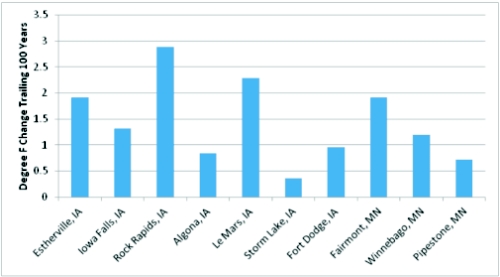
The other thing I picked on last week was the aforementioned pin-the-tail-on-the-donkey “adjustment factors”. I noticed in my two Midwest rural station data that the difference between the two was stark. Surprise! So, I looked at data from a tightly clumped group of stations all located within a 1.5 hour drive of where I grew up (except Iowa Falls, full disclosure). I know these towns. They are dinky and probably average about 5 stoplights apiece. There should be no heat island but there is plenty of possibility for oddities. In fact, I am typically of the opinion when we calibrate energy models against actual weather data, that we should just use the closest weather station because measuring ambient temperature is far more complicated than anyone would imagine. This is because of sensor location and localized phenomena including direct and indirect radiation, adjacent equipment, and whether it is in free air flow in the shade.
Well golly. Just as I said last week, the century-long temperature change amongst them is all over the place. Note, Storm Lake and Le Mars are just down the road from one another and there is almost a 2 degree difference between them. This is what I meant by down in the grass of uncertainty. The estimated temperature change over the century is less than the randomness introduced by measurement “errors”. My case rests.
The average normalized increase for these 10 towns was 1.44 degrees, slightly less than the BEST 1.62 estimate.

So Jeff, why bother? Because like many other things, I don’t trust what the talking heads are telling me until I do my own analysis – which granted is crude but consistent with recent findings. People have agendas and my agenda is to convince myself of what is reasonable.
Epilogue
The following was my path toward doing my own crude analysis to test the BEST study. It also delivers some interesting results.
Climatic data, sources, studies and analyses are so vast, you can find a scientific “peer reviewed” study that will tell you whatever you want to hear or whatever you want to believe, on either side. By the way, let me talk about peer review a little. Peer review is supposed to include unbiased critical review of someone else’s work. It is used as a club to beat back opposition to whatever the subject at hand is. However, I would say “peer review” is only a bit more credible than, “It is on the internet, so it must be right.”
Breathe deep. Calm down. Stay with me on this.
Ironically, much of the climatic data and analyses on climate change come from NASA. I was on the sofa with a 103F fever in 1986, the day after dah Bearsss clobbered the Patriots in Super Bowl 20 or somewhere in that neighborhood – BTW, dah Bearsss had a crushing defense and a good quarterback – hated, but good. I watched on live TV the Challenger blow up. Poof. Do you suppose the design of the space shuttle was reviewed, re reviewed, and peer re-re-re-re-re-re-reviewed? I’ll bet so. But yet something as simple as thermal expansion (and contraction) of material was not properly accounted for, causing a catastrophic explosion. There were apparently even warnings from engineers that were ignored. The consequences of this human error and later not addressing it were obvious for everyone to see. An error in the analyses and algorithms to clean and process historic temperature data with miniscule changes on the other hand could survive in perpetuity.
Let me also throw this on the table. I can stand to review something about once, maybe twice, and then I can’t take it anymore. I’m not going to catch an error if it wallops me upside the head, so I get a cold peer review from someone else unfamiliar with the work. Are there any cold peer reviewers left for climatic studies? I couldn’t do it. I’m telling you, it is natural and easy to overlook things when you’ve looked at similar studies a hundred times.
As I mentioned last week in regard to modeling and predicting a reasonable range of outcomes to calibrate an energy model, a modeler needs to have experience and sound methods for cross checks that are relatively simple. In modeling a building for example, you may want to see what the model is doing for a single room – as in, what are the heating and cooling loads, the temperature, the air flow every hour and in what season (heating, cooling, or shoulder months) is it most important to test your hypotheses.
Unfortunately, much creativity and creative thinking went out the window or down the drain with the advent of PCs, spreadsheets, and many other powerful mass-number-crunching applications. For personal example, everyone who went through the nuclear Navy as I did had to take a graduate curriculum in nuclear engineering. In our case, we were to “design” a reactor core – that is, fuel, control rods, poisons and stuff like that for a 15 or 30 year fuel supply, without refueling, that is. The next step was to design a reactor plant to in one way or another maximize ship speed, which boils down to maximizing power to weight ratio while maintaining safety (which the Soviets didn’t so much care about so they had an advantage). Well back in the day of $100 calculators you can now buy for $5.99, engineers had to be creative at optimizing things. As of our turn in the early 1990s, we could turn the PC loose on grinding out thousands of scenarios, brute force. The moral of the story is, the heavy lifting computers provide has displaced a lot of critical thought and gut feel for reasonable results and trouble shooting for that matter.
So given all this I set out to do my own “research” to see what I could find. A billion and a half data points for 40,000 sensors is overwhelming. I’ve reviewed many of nearly incomprehensible climate studies that are all over the place (results wise) with a myopic view of one factor it seems. I looked up some simple data – what are the warmest years on record? If the planet is heating substantially by human release of CO2 it would serve that records would be piled up in the past few years and they would fall in line more or less with time. According to the US Historical Climatology Network, an Oak Ridge National Lab organization, the 25 warmest years in the past century are as shown in the plot below.

Sure enough, there have been many records in recent years, but there are also records clumped about 1940. There are also obviously more record high years around 2000. HOWEVER, the average of the record highs in the 1940s clump is 54.13F and the average of the record highs in the 2000 clump is 54.11F, slightly lower. Note that the latest warmest year on record for the above chart was 2006. I didn’t chop it off there on purpose. That is what was readily available. A couple recent records could raise the average for the 2000s clump, but I would say not by much.
This presentation of credible data indicates forces other than human release of CO2 are at least significant.
I also plotted the warmest average temperatures sorted as shown in the plot below. If somebody in our office gave me results that look like this, I would ask, what’s with the three distinctive step changes, especially the big one from 54.9 to 54.5? There appears to be something “un random” about the data. Figure that out and tell me what you find. Two of those three in the warmest clump are recent and the third was from the 1930s.

The annual USHCN data reflect the above chart with generally warm years about 1940 and 2000 with a cooling trend in the 1960s and 1970s, a period when there was also substantially less volatility in temperature swing from year to year. Why? I have no idea but I’m sure somebody can rationalize it. Also not so ironically, I think it was 1974 when Time, the magazine, produced its infamous front page article that the next ice age was at our doorstep. So much for that apocalyptic forecast.
Bombast from the Heresiarch
I’ve moaned about global warming, aka, anthropogenic climate change, aka man-made global warming off and on over the past couple years so this week let’s get down to business.
I’m all in favor of cost effective, as in benefits/cost ratio, reasonable environmental policy, resource preservation, and the minimization of irreversible damage. I wouldn’t be passionate about what I do or spend Saturday mornings doing this rant every week if I weren’t. I am also a professional engineer, which carries ethics of protecting the public health and well being. Well being would include financial soundness, which is where the cost effectiveness thing comes.
The Berkeley Earth Surface Temperature (BEST – cute) team recently released its analysis of 40,000 land based thermometer readings over two centuries – 1.6 billion data points. This analysis/report has captured much hype as of late. They cleaned the data for things like readings of 5000 degrees C, Fahrenheit/Celsius mixups, and this sort of thing. These are easy but then it gets much more difficult.
If you have ever surveyed for anything with widely varying results (not yes/no or who will you vote for questions), you know there will be all kinds of gaps that need filling. And there are bad eggs you need to discard, like say a sensor that is on a parking lot as shown in the article. There are heat island effects in urban areas where sensors are more densely packed. This needs to be accounted for. Good luck with that over 200 years of societal development. From horse buggy, dirt streets, and no air conditioning to what we have today – various roofing materials, road and building materials, air conditioning, and you name it. How for the love of Pete does one account for this?
To digress for a moment, the proponents tend to view one metric in isolation at a time and not look at the whole picture and make points that are likely true but not relevant. For example, Google the BEST stuff for reviews by various Johnny-come-Latelies and you will see that the BEST team has proven that urban heat island effects have negligible effect on climate temperature, and therefore, that isn’t the cause of the warming planet (it’s CO2, stupid). This misses the point. The point is, the data set includes an enormous volume of data from these urban areas and as I mention above, how in the heck do you account for that over decades and centuries of human development? Ride around any city with an old guy who has lived there his entire life. “This used to be the edge of town” (it’s now home to a shopping mall built in 1970). This used to be all cornfield (now it’s a watering hole – gasoline stations, fast food restaurants and strip malls – for the interstate that was built in 1965, and it is filled with homes for as far as the eye can see). The temperature readings in a corn field will be much different in precisely the same location when that location becomes a shopping cart coral on a parking lot. What do you do with that? Even if the thermometer was and is downtown for the past 100 years, the city’s boundary growth can have a very significant impact on that.
Anyway, you can talk till you’re blue in the face about calibrating the statistical model for progressive urbanization, and I’m here to tell you, it will be wrong. It’s a guess. Period. One could waste his time modeling these effects for every single affected temperature station but it would be full of assumptions until the model results look right. More on this below.
The data do not include temperatures over the oceans that cover 70% of the earth’s surface. Further discussion is not required. It speaks for itself.
A dirty secret: people are prejudice to their beliefs and desires and will tweak data until they get what they think is right or what they want. For example, entities like utilities for SarbOx compliance (sometimes) and government agencies (almost always) that need to show rigorous and fair evaluation of bidder proposals develop scoring breakdowns for various selection criteria. E.g., experience – worth 20% of the total score, technical approach 30%, price 30%, and so on. BTW, if it’s government project you are bidding for, it doesn’t matter what they say, price is 100% of the score.
The proposal review team reads the proposals and may interview the finalists. In the end, I’m here to tell you, they select the bidder they are most comfortable with, or the team that will tell them what they want to hear, or the team with the lowest price even though per the math it makes negligible difference, or the team they used last time (you won’t see “risk of switching horses” as a criterion). When it’s time to document the scores, magically the scores work out to support the selection. There really isn’t anything wrong with this. This is combination of subjective, gut-feel, emotional, and rational factors used by humans to decide something. Do guys use score cards to decide whether to marry their girlfriends? Don’t answer that. Some probably do. Case closed. Anyway, the law says they need to develop scoring criteria but the scoring is totally subjective – even the pricing part is. Why bother?
Back to the BEST study. The results indicate the surface temperature increased 0.9C over the past century. Congratulations. This is entirely believable but it’s also far down in the grass known as uncertainty. This is my educated guess, but in order to arrive at a result this believable with the above unavoidable unknowns and uncertainties would require a lot of data scrubbing, tweaking, and model massaging until “reasonable” results pop out. Ask any engineer who models anything. They have an idea of what the outcomes should look like. If they don’t, they are fired. Assumptions, factors, inputs, boundary conditions, and equations are massaged. Victory is declared once the results look “reasonable”. Well jeez man, if you have a massive gob of data with 5000C and god knows what other unfounded anomalies buried in there – and mathematical/statistical models are used to bridge gaps – where does one declare victory? 0.9C sounds good to me! Really, I can believe that.
Look, I’m not in any way whatsoever belittling or doubting for a second the expertise of the team that did this analysis. I have no reason to believe these guys aren’t geniuses and used the best methods and their work is technically error free even.
What about temperature-taking technology, accuracy and precision over the past 200 years? Change a little?
But what about the oceans?
I’ve already used up my space for the week so this will have to be a series of rants because I’m not done.
The good news in my opinion is, from objective commentary and assessments of this study, there appear to be serious and objective analysis happening, still. They’re not all packing Kool Aid for the Algore train to Guyana.
I will continue discussing anthropogenic climate change next week, unless I change my mind. Forget the anecdotal rebuttals. I’ll address them later.
Tidbits
Last week I beat up the Occupy Wall Street movement for not focusing on right problem – crony capitalism, essentially rich donors to politicians who then return the “investment” 10 fold. It’s money laundering for campaign money. It’s actually far worse. George Kaiser bundled $50-$100k for the President’s campaign prior to the half billion dollar loan to build the Solyndra plant. Picking a number near the middle of the reported donation, that’s 7,000 fold return on investment – and consider he was a bundler, which means he’s essentially panhandling from all his friends so it isn’t even all his money. If I’m reading it correctly, Kaiser provided his own venture capital to Solyndra but put his money in front of taxpayer money to pull it out first if the Hindenburg went down, and it did.
Occupying Ignorance
Have you had your fill of Occupy Wall Street, (OWS) which has spilled over into dinky, surrounding, wannabe towns including one nearby with a population of a whopping 4,000? Apparently, these in-duh-viduals are protesting rich people and the fact that the rich keep getting richer and the poor, well, are the poor. My response: that’s life. Life isn’t fair. I don’t like the word “fair”. Rather, I like “not cheating”. “Fair” is too often used by whiners. Some of these OWSers are self described anarchists and communists. Oh yeah, there you go. That’s what we need is communism. There’s a model of equal outcomes. How is that Venezuela model working?
I have not a covetous cell in my body. Steve Jobs, or at least his widow, is a multi-gazillionaire having lead his company from the brink of collapse in the 1990s to the world’s most highly valued company, ahead of Wal-Mart, Exxon Mobil, and Microsoft. Speaking of Microsoft, as Steve Jobs once said, Bill Gates has never developed any innovative products in his life, but yet he is a billionaire because he was good at steeling ideas within the law, I guess, and developing a monopoly. Good for him!
The real problem and reason the OWS whiners are misguided is crony capitalism. The DOE and administrations dish out billions of dollars to crony campaign donors who in turn send a big chunk back for reelection campaigns, before or after their ill-conceived company fails and the executives walk away with millions. Or it’s egg before the chicken. The cronies donate a bunch of money and get their investment in government back 10 fold once their guy gets into power.
Let’s see… in the underground economy, there is a name for this: money laundering. So all OWSers should be marching on and petitioning Washington, the root of their grievances. You have to understand the problem to solve it. This is clearly a bipartisan activity and nothing new. However, I would say the recent fanning of the flames, pitting citizens against one another is a bit unprecedented and shameless. Watch the hand! You guys get in a food fight while we (Washington) continue to rip you off.
While I have not a covetous cell in my body, I have billions and billions of cells of rage against crony capitalism, money laundering, cheating, dishonesty, malfeasance, and vast wastes of money and resources.
As mentioned before, Washington should, like utilities have done in recent years, get back to their core business of protecting and defending its citizens against enemies, foreign and domestic. This is the only thing they do remarkably well, although I’m sure there are gobs of waste, but how many plots have been busted and bad guys destroyed in the past decade or so?
Washington is a horrible venture capitalist because (1) they make decisions based on politics and not favorable or acceptable risk/reward, which follows with (2) they are using other peoples’ money so they obviously do not care. It seems there are failed green energy, green jobs companies and/or scandals in the paper each day. Or take my favorite, ethanol. Many are concerned about our ability to feed ourselves as the planet takes on its 7 billionth human, this month or thereabouts. Meanwhile, over 4 billion bushels of high energy corn go to make a tiny dent in our fuel needs and negligible impact on our petroleum imports. That’s roughly 30 pounds of corn for every human on the planet, or maybe 50,000 calories – enough to keep an offensive (as in the team with the ball) lineman going for a couple hours. No. Really it’s enough human fuel for 20-30 days for a mortal human being.
Similar to OWSers, there are end users of energy that whine about high energy costs and hate their utility as a result. Isn’t it ironic that nobody seems to care about energy costs, as in the total cost of running a business, except when prices rise? And end users should consider what is driving prices upward: I would guess the vast majority of price increases is due to emission regulation and construction of wind farms. These things are legislated at state and federal levels. I, unlike the prima donnas (think JFK junior, hypocrite in chief) living in population centers and telling everyone else how to live, do not mind the sight of these behemoths on the landscape.
On a side note, other hypocrites for renewable energy and lower energy cost protest construction of transmission lines from where the wind blows to where people live and wind doesn’t blow. In addition to transporting renewable energy to population centers, it adds reliability and more supply options to the grid. More options mean lower prices. The solution is simple if you ask me. See I-90 in southern Minnesota. Just run the transmission lines down the damn ugly interstate highways where there is already immanent domain and land! It’s flat. It’s open. What? Would it mess up the beauty of billboards for Wisconsin Dells, gentlemen’s clubs, and truck stops? This is a no brainer. What for the love of Pete is all the hassle about? And there aren’t even any dairy cattle near the interstate to pick up the electromagnetic waves causing birth defects like four headed two legged calves.
Whining end users share a loser trait with the OWSers – they would be far better off taking control of their own well being rather than itching and moaning about something they have little control over. And by the way, the control they do have is mainly with their corrupt finaglers in Washington. Very few are accountable. These people represent the very few competitive congressional districts, states, or the entire country, while most are not accountable. The unaccountable include political appointees like Lisa Jackson running the EPA, or Bonnie Fwank and Charlie Rangel, each of whom would have to be caught live on national TV steeling an armored car and maybe running over a few pedestrians to not get reelected. I don’t think felons can be elected from their jail cell but who knows. Felons, dead people, pets and alternate personalities can and do all vote.
For-profit end users that howl about their energy costs are very likely to have more energy cost reduction opportunity than those who don’t. This is Jeff Ihnen’s untested hypothesis. Why? Because the howlers don’t like, and in some cases, detest their energy provider and do not trust them. Detestment (a new word) does not foster cooperation, which is extremely helpful, bordering on essential to control energy consumption and cost.
I have also yet to come across a for-profit, with a strong efficiency track record at the corporate level, howl about their evil energy providers. Well known EE champions with track records that fit this profile include 3M, Pepsico, General Mills, and Simplot.
The message to end users of all shapes and sizes is first control what you can best control – yourself and your organization, and second, pay attention to what’s going on in state and federal governments – each of which are big drivers of energy supply, regulation, and generation sources – the primary drivers of energy price.
Tidbits
I thought this was a great headline for an opinion piece in Saturday’s Wall Street Journal, by Holman Jenkins: “Hooray, A Financial Firm Fails”, describing of John Corzine’s MF Global collapse. What’s even more impressive is that Corzine, formerly of Goldman Sachs, formerly U.S. Senator, formerly New Jersey Governor, is in the admiral’s club of crony capitalists. Failure is progress. Eat your heart out.