Archives

Monthly Archives: June 2011

EE V IRS

Energy Efficiency, Government, Investments, Tax Stuff, Utility Stuff1 comment

Warning: I am not a CPA or tax attorney, and I do not have 63 years available to determine for myself that all contents of this rant are correct.

A couple years ago I wrote an Energy Brief about the need for life cycle cost analysis to make the right decisions for selecting the best option for an energy project.  Since that time, we haven’t exactly been living up to this ideal, in large part because we’ve been doing a lot of work for profit-driven enterprises.

Life cycle cost analysis for non-profits is pretty easy.  It includes first cost, borrowing cost, if any, maintenance, effective useful life of the measure(s), and energy cost.  It gets much more complicated for profit seekers because of tax laws.  In general, profits that are taxed equal revenue minus expenses.  Energy is an expense and therefore, a dollar of energy savings is not (even close to) a dollar added to the bottom line.  Another perverse element of taxes is that when a customer invests in equipment they have the pleasure of paying property tax on that equipment.  I learned this as we bought a bunch of office furnishings and invested several hundred thousand dollars for our new office space downtown.  Then over time the stuff can be depreciated and subtracted from earnings.

Corporate bean counters roll all this junk together and spit out something around a two-year payback requirement.  But there is likely some subjective risk-aversion quotient in there also.  The payback requirement isn’t an arbitrary qualification for an investment in EE.  Rather it is a simplified way to boil all these factors into one easy-to-understand metric.

I would guess most readers do not know that the US has the second highest corporate tax rate in the industrialized world, behind Japan, but just barely.  Coincidentally, these two countries among the most debt ridden countries in the world, including misers like Greece and Italy.  Surprise!  Pile on state taxes and companies can be staring at close to 50% marginal tax rates, the tax on the next dollar of earnings.  Iowa of all places has a top rate of 12%.  Texas on the other hand has no personal income tax OR corporate tax on profits.

Since the end of the recent meltdown that began in 2008, Texans have generated as many jobs as 47 states plus the District of Columbia, combined.  Our most populous and once golden state California has since contracted.  Without Silicon Valley – Apple, Google, and Facebook alone – the once golden state would be a burned out smoldering carcass.

Texas: 733,000 new jobs in past 10 years (no other state topped 100,000)
California: minus (negative) 624,000 in past 10 years (dead last)

You do the math.  Probably the most hilarious non-comic event I read about was Gavin Newsome, California’s lieutenant governor and a band of dimwits, er I mean congress persons from Sacramento recently traveled to Texas, on California taxpayer money, to see why Texas was stealing all of California’s jobs.  These people should be fired for that alone.  As a friend of Californians, I would have asked the pilot to drop them off in Havana and quickly get the hell out of there.

The challenge to do EE with for-profits is when companies are making good money, they don’t so much care about reducing cost as they are with increasing output, expanding and making more money.  This is compounded with the nearly 50% tax hit against EE impacts.  When companies are operating in the red, they of course tend to reduce cost but without spending money to do so.  Eliminating jobs or furloughing is an easy, very effective way to reduce cost with virtually no immediate cost.  Energy efficiency costs money now and returns savings later and furthermore, it is difficult to save energy on a production line that is sitting idle in the dark.

When companies are losing money, they want an extremely quick payback as they are risk averse and they want to see investment paying off as quickly as possible.  When companies are making money competition for capital is brutal as they have a lot of demand for it for expansion.

These all remind me why utility-sponsored performance contracting eliminates these barriers for most profit-seeking enterprises.  For the growing company with shortage of capital, such a program provides capital with virtually no carrying (borrowing) cost because the program uses the would-be cash incentive to buy down the finance rate.  For the customer running in the red, the project provides an immediate positive cash flow, guaranteed.  Of course the money losing enterprise needs to be financially sound and not an immanent risk of insolvency.

Depending on the corporate bean counter and tax attorney, a performance contract may be declared a lease, or an operating expense to avoid the property tax and depreciation hassle.  I believe this also helps it fly under the Sarbanes Oxley radar and associated red tape if they want to play with that fire.  Sarbox is a toxic residue from the remains of Enron scum mixed with brilliant Washington opportunists who always attempt to avoid the last collapse with a suffocating mélange of hellish regulation.  The most recent straightjackets and matching millstones are rolling out at banks, credit card companies, and brokerage houses near you via the Dodd-Fwank bill.

Maybe if rather than beating on companies that move and expand business overseas, Washington would provide us with a competitive business climate and knock off the myriad of carve-outs for politically connected money-grubbing schmoozer-losers…  We could revive manufacturing, move demand for energy from overseas to this country where we can do something about it, and increase return on EE investment by creating more after-tax income.

written by Jeffrey L. Ihnen, P.E., LEED AP

Cheater Pumpkin Eater

Energy Efficiency, Government, Utility Stuff0 comments

Many states have opt-out provisions for major consumers of energy so these consumers do not have to pay into EE programs.  The reasoning typically goes something like this:

  • They are major users of energy so they naturally are going to cut energy cost to increase profit; they can take care of themselves
  • They shouldn’t have to provide outside subsidies to these programs
  • They don’t participate in the programs so why should they have to pay in

The facts are these concessions are required to get EE laws (bills) through legislatures and/or governors.

Consider that typical opt-out regulations require that these end users must develop, implement, and in some typically very lame fashion report their results.

Let’s use Minnesota as an example.  Minnesota has a pretty high bar for customers to be eligible to opt out with a minimum of 20 MW, or 20,000 kW in demand.  According to my calculations, such a customer might have an annual electric bill of something close to $10 million.  If the EE rider (charge) is 1.5%, this means they would pay $150,000 into the program.

To avoid paying this $150k, the end user must write its own energy efficiency program, document activity and verify savings.  Is that going to happen?  Maybe, but not very well.  I don’t know about Minnesota but we have reviewed opt-out customer plans for program evaluations in other states and they go something like this:

“We’re going to save energy.”  The end.

The opt out provisions in some states have no teeth.  As evaluators, we are left to evaluate plans like that provided above but we are not allowed to ask questions and we are no allowed to go on site to see what they are doing.  So our customer-specific evaluation report looks like this:

“Based on the [lack of] information provided, we find no reason to make adjustments to savings.”  What else can you do?  I’d like to say, I don’t think these guys intend to do squat but, wouldn’t be prudent.

Energy efficiency programs are weird things, partly I guess because utilities are fully regulated monopolies in most places.  Theoretically, programs benefit all customers because EE as a resource is less expensive than power plants, more wires, and more fuel consumption.  If some customers want to waste energy like crazy, the effects aren’t just enjoyed by those end users.  This drives up prices for everyone served by the same monopoly.  Similarly, peoples’ right to choose a gas guzzler doesn’t just affect their fuel costs.  Their participation in driving up demand puts upward pressure on fuel prices for everyone.

So IF these companies that opt out are not doing anything to reduce consumption or demand, they are having an adverse impact on the rest of us.  To claim they don’t want to subsidize EE programs for others is like saying; “We should only have to pay taxes for the road from my factory to the interstate.  We don’t need no other stinking roads.”

The major challenge with residential and small business programs is they are difficult/impossible to deliver cost effectively.  Many, if not most do not pass the myriad of tests, including the Total Resource Cost, or TRC test.  On the other hand, portfolios, all programs always pass the TRC or why have them.  Obviously, from a program perspective, large commercial and industrial programs are cost effective.  Why?  Economies of scale.  Program administration costs and other overhead are relatively puny because large C&I projects are relatively – you guessed it – large!

Does anyone, home-owner, school, hospital, major corporation shoot for 1.5% energy savings?  I don’t think so.  I’ve never seen this.  Why bother with something so dinky?  You can’t even measure it.  Theoretically, since programs have this sort of goal for all end users combined, huge opt-out customers only have to meet the same goal.  Why go through all the reporting and overhead hassle to save a paltry 1.5%?  Nobody is going to do that.  So if opt-out customers really are going to have an energy-saving plan, it’s going to be for something substantial, probably averaging in the 10% range, which is what we typically see for huge industrial end-users.  If you are going to save that kind of energy, why not be in the program and take the incentive limit of half or three quarters of a million dollars (typical) nearly every year?  Believe me when I tell you some end users do this and they are loving it.

So add it all up:

  • To save a relatively tiny share of consumption, opt out customers theoretically inflict a bunch of red tape on themselves.
  • If they really are doing energy-saving projects or plan to, they are passing up a bunch of free money from other customers, including probably from their competitors!
  • Why shouldn’t their projects be subject to evaluation like all other programs?  This is a bit like the cops being on the mob’s dole.

I would say end users that opt out are either not very smart business people because they can easily suck more money out of the system than they pay in, or they don’t want to pay in and they have no intent to reduce consumption and demand.  What else is there?  There are no cost effective measures left?  Uh huh.  And my dog is the reincarnation of Winston Churchill.

Tidbits

Last week the unthinkable happened in Gomorrah, er I meant Washington DC.  (No, it wasn’t about the narcissistic congressman from Queens.)  The US senate in an unbelievable act of “bipartisanship” voted to end the $6 billion ethanol tax subsidy.  See Galactically Stupid.  However, apparently it is not expected to pass the house because of garbage attached to the bill and because tax policy is to begin with the house and the president opposes dumping the subsidy.  Some repubs are against any tax “increases”.  Does this mean tax cheats that haven’t filed for several years should just keep cheating too?  Too bad I’ve been paying taxes.  I would really appreciate the tax omission grandfather act (TOGA, TOGA, TOGA!).

How bizarre is this?  The president and house are “united” against the bill and the senate dems are carrying the thing to a 3:1 win, with considerable repub support.  This is truly bizarre but nevertheless, some amazing progress.

written by Jeffrey L. Ihnen, P.E., LEED AP

Oh Behave

Energy Efficiency3 comments

I swear we were introduced to the food pyramid when I was in grade school but a little web searching gives me just a couple – the one from 1992 and the new and improved one in 2005.

The 1992 edition is shown below.  If you can’t read it, good.

1992 Food Pyramid

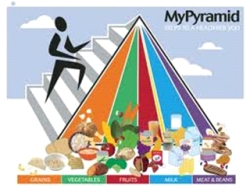
The 2005 vertical colorful edition with the stickman and skewers for hands and feet follows.

2005 Food Pyramid

For 2011, the USDA has switched to this brilliant “plate” that looks like a pie chart developed by a group of kindergarteners employed by Microsoft, except I really don’t think anyone would want their brand tied to this thing.

2011 Food Pyramid

The purpose of these things is supposed to improve the health of Americans.  In 1992 the obesity rate in the US was nearly all below 14% for every state in the union.  Only six states had higher rates, Wisconsin being one of them – fried cheese curds and bratwurst.

Due to its success in 2005, they rolled out an improved version.  By this time only four states were as good as Wisconsin was bad thirteen years prior.  Let me try a different angle on that.  By 2005, all but four states had MORE than 20% obesity.  We improved from only six states with more than 14% to all BUT four states ABOVE 20%.

By 2009, the last year for which data are available, only Colorado is below 20%.  Thirty-four states are over 25% and nine of those are over 30%.  It appears that since these brilliant tools rolled out that obesity rates increased from 10-15% to 25-30%.  Progress.  A picture is worth 742 words.  Data are depicted in the nearby US Obesity Rates chart.

This is the brainchild of the USDA, the same organization that floods schools with subsidized fat-bomb food.  Meanwhile, there wages a war against soda and salty snack foods companies but the real culprit is the USDA that peddles this crap.  Surprise!

Despite being bombarded with data, having nutrition labeling on everything, including in some jurisdictions (NYC) on menu items served by mom and pop restaurants, the trend continues.  Why?  Americans on average don’t give a hoot or maybe they just don’t want to change; don’t want to give up anything.  Give me pills, sugar free this and that, fat free this and that, none of which work.  For most people, the solution is simple. Eat less and lower fat and sugar filled crap.  And get more exercise.  What good is a cartoon chart or for that matter, more nutrition information?

And so it will be with energy efficiency.  The smart grid and smart meters are anticipated to be the second coming of Jimmy Carter for energy efficiency.  There’s a problem with this mentality.  People have to give a hoot.  We can bombard people with information at every turn but one has to give a hoot to save energy.

Consumer behavior programs are important to the EE business, but as far as I know this primarily only includes turning stuff off or turning it down.  Nearly every single EE technology, retrofit, replacement, upgrade, and modification requires a strong element of behavioral discipline.  About the only thing I can think of that may lack behavior to avoid snapback (erosion of savings due to behavior change) is a refrigerator and freezer.  I can’t imagine people standing in front of the refrigerator with the door open thinking, “I’m going to look at this stuff in the refrigerator a little while longer because I have an ENERGY STAR® refrigerator now.”

EVERYTHING else can have snapback and erosion of savings over time, if not immediately.  Efficient lights use no energy so leave them on all the time.  I have an efficient furnace now so I’m going to maintain a New Delhi climate in my house.  I have trouble keeping it cool in this building so I’m going to turn the chiller down to 40F and not bother to change it back.  Never mind that chilled water temperature may not even be the problem.

At Michaels’ La Crosse office, we have about three acres of west facing glass that unfortunately does not have good thermal characteristics.  Anybody who knows anything about EE knows solar loads on cooling systems are huge.  Yet our high quality three acre’s worth of roller blinds are only about 30% deployed on average as the solar energy pounds away.  I’ll report back to see if this shaming worked.  If not, I’ll list the names of everyone sitting closest to unprotected windows.  I’ll see if threats work!  No.  I take it back.  I want to isolate the shame effects from the threat effects.  I’ll report on the shame effects in a month and if that doesn’t result in 100% compliance, I’ll do the threat test the following month.

Here is a really twisted perversion of energy efficiency: some technologies often result in more energy consumption, consistently.  Consider occupancy sensors for automatic lighting controls.  The first thing I did on my computer when we moved into our offices downtown was go to wattstopper.com to find information for the sensor on my wall to see how I could neuter it, and I did so immediately.  I set it to be manually switched on and auto off.  My overhead lights are used about 20 minutes per year – sometimes in the winter when I’m gathering up my stuff to go home, and sometimes for meetings with old bats who can’t see.  Otherwise the high pressure sodium streetlight outside is plenty.

I’m hard wired to shut stuff off when I’m not around or using stuff.  However, I’ve been trained by our occupancy sensors in other rooms to leave stuff on.  We even have a sticker on one switch that says Leave the Lights On!  More progress!  I would just as soon fix these with a 34 inch Louisville Slugger.  Occupancy sensors are clearly meant for users who don’t give a hoot.

On top of all this, occupancy sensors punish hard work.  I was told years ago that if you sit absolutely still for the delay period (adjustable from maybe a minute to a half hour), the lights may go out.  Bull.  You have to do a fourth quarter Bucky jump around to keep the lights on.  It isn’t easy working while jumping around.

Jump around, jump around, jump around

Jump up, jump up and get down

Jump! Jump! Jump! Jump! Jump! Jump! Jump! Jump!….  (thank me for seeding this inspiring tune in your head for the rest of the day)

In case you haven’t attended a Wisconsin Badger football game, be sure to check it out.

Programmable thermostats are probably the worst thing that ever happened for energy savings.  We’ve inspected hundreds of these things for program evaluations.  They don’t save energy because in order to save energy you have to give a hoot.  If you give a hoot, a programmable thermostat is a nuisance.  A classic example included a recent verification of an installed programmable stat in a church.  Prior to the installation, they turned their manual stat back for all but a handful of hours needed for occupancy each week.  Post implementation, the heat is on 8-5 every day of the week.  The program implementer should be fined but even so, what was wrong with the manual stat in this case?  And if you’re sitting there, thinking, “I have a programmable thermostat and it is programmed according to my actual schedule, saving energy.”  Really?  Obviously you give a hoot.  Go home and replace it with a manual one and save more.  BTW, people who don’t give a hoot just put these in manual override all the time.  So unlike occupancy sensors, they provide no benefit whatsoever to anyone.

Our industry has an awful lot to do.  This is another reason I am not in favor of in-your-face mandates.  We’ve got to sell people on energy efficiency, or else their obstinance will undo the good deed.  People have to give a hoot and behave!

written by Jeffrey L. Ihnen, P.E., LEED AP

Machete to Sustainability

Sustainability0 comments

This Geography guy really needs to get out of the classroom and the city for that matter once in a while.  Modern agriculture is probably demagogued and more poorly understood than energy efficiency, and since this opinion piece addresses both I will dispense with its shredding.

I grew up on the farm 30 years ago in southern MN and northern IA, and I stay in touch spending a week each year reliving my childhood farming days.  My elder brothers still run the place.  They grow maybe 2,500 acres of corn and soybeans and raise and market maybe 25,000 hogs per year.  To the ignorant, they would be perceived as ecology-destroying corporate/factory farmers.

Wrong.

When I was a kid, farm chemicals were more dangerous, less effective, and more heavily applied.  Yet since they were so ineffective, noxious weed and grass control was largely provided by tillage which is environmentally unsustainable in two ways.  First, it takes a lot more diesel fuel, obviously.  Second, erosion was rampant.  If there was one thing I always pressed my father to do as a kid it was to reduce tillage to leave more crop residue on the surface to reduce erosion – from both rainwater runoff and wind.

Back in those days, everything was plowed black – as in, all crop residue buried.  Why?  To bury grass and weed seed along with it.  The spring snow melt would leave three inches of topsoil in our grove (where the snow drifts / dirt dunes were) and road ditches.  Who knows how many tons per acre landed in Indiana or Tennessee?  Moreover, in the spring, we would typically have to scramble out to the fields to run rotary hoe to stop blowing dirt from sand blasting the young crop that just broke ground.

In total, we would make about seven or eight trips over the field to till, plant, cultivate (weed), harvest, and plow.  For soybeans, we would actually use machetes to chop weeds during the mid-summer heat.  Find a fourth grader who would do that nowadays.  Parents would be hauled away in handcuffs for child abuse and maybe reckless endangerment.  This one looks just like my Grandmother’s.   My father would sharpen them every morning before we took to the fields.  No sheaths, guards or any of that kind of crap either.

For livestock, we used to raise hogs and cattle in more “humane” ways in the open field.  This makes for a nice image to the Geography professor but in truth what would happen is the sows would root holes in the soil for a nice cool spot in which to snooze.  Soon they would give birth to a litter of pigs.  Then the rains come.  After having lain on and crushed two or three pigs, the remaining ones would be freezing in the cold water and mud.  Ninety degrees is perfect for these little guys – not 60F and mud.

The good old days weren’t so good.

Fast forward thirty years.  Unlike the Geography professor claims, farming has changed, hugely, and in the direction of sustainability AND increased productivity.  Most crops are now Roundup ready, meaning they are genetically modified to withstand Roundup, which otherwise kills everything rooted in the ground.  This may sound horrible but it only kills what it lands on and is benign to soil, doesn’t drift, and doesn’t run off.  What are the implications?  Fuel use is drastically reduced and the minimum soil tillage results in practically no soil erosion, which brings other benefits in addition to being intrinsically sustainable.

First, when I was a kid and everything was plowed black, soil erosion continuously uncovered rocks on hills and hillsides.  We used to spend weeks before and after planting hauling rocks off the fields – more child abuse.  Have you ever had your foot run over by a rock wagon?  Neither have I.  Rocks are not kind to expensive farm equipment.  It would beat the crap out of tillage equipment, planters, and god help you if you ran one into a combine.

Second, water erosion destroys crops.  First, as it washes down from highlands it takes crop along with the soil to the lowland.  In the lowland, crops will survive in standing water from the runoff for just a few hours.  With modern minimum tillage made possible with Roundup, erosion is practically nil.  In addition to preventing runoff, erosion, and associated crop destruction, residue, otherwise known as stover or trash, helps soil retain moisture to carry crops through dry spells.  It would be common to have 10-15% of our crop land flooded every year; now there is practically none.

The Geography professor claims 107 gallons of fuel are burned to produce an acre of crop.  This is crazy.  First, recent conventional thinking was that to break even a Midwest farmer needs about $500 revenue per acre.  That covers seed, rent or farm payments, chemicals, fuel, overhead, this, that, and the other.  Well 107 gallons is not far from $500 alone.  Second, it probably takes about a half gallon of fuel per acre each to plant and harvest and maybe another couple gallons for tillage (minimal) spring and fall .  That’s about three gallons per acre, direct.  Chemicals and fertilizers?  I have my Roundup booklet right next to me and that says it takes about 20 ounces per acre.  That’s a British pint, give or take a spit, per acre.  Does the fertilizer take the other 102 gallons per acre?  I don’t think so.  A ballpark estimate is 100 lbs per acre.  That’s probably in the 10-15 gallon/acre fuel equivalent, ballpark.  So, I’m seeing 20 gallons equivalent, maximum.

Note however, many modern factory farms produce their own fertilizer for free.  The Geography professor may think the factory farmers are ruthless dingbats, thriving on tortured, cramped, sick livestock, quietly dumping manure in the creeks because it’s cheap and easy.

The modern confinement barn where livestock is mass produced is always portrayed as a hellish inhumane place for livestock.  Wrong.  Sick, stressed, uncomfortable livestock does not eat or grow.  Growing is the key to making a profit.  It’s that simple and irrefutable.  The modern farm is as productivity centric and competitive as Wal-Mart is with its supply chain.  Adapt or die.  Everything revolves around keeping livestock healthy, dry, cool/warm, and frisky.  They even get lots of natural ventilation and daylight – how is your work station in this regard, by the way?

Back to the fertilizer.  The manure produced by the confinement barns provides nearly all fertilizer for the corn crop needed to feed the hogs.  Let me clarify this: the waste displaces an enormous amount of “artificial” petroleum-derived fertilizer – and it’s produced and applied locally.  It is knifed into the soil in the fall in precise quantities to maximize value of all fertilizer needs: potash, phosphate, and nitrogen.  Its nutrient content is better known than it is for a Snickers bar.  Typically, just enough is applied to satisfy the most abundant one of these so as to not over fertilize or waste any of it.  The remainder, which is hardly any, if any is made up by petroleum or natural gas derived fertilizers.

Fields are mapped for soil nutrient levels with GPS positioning systems.  “Fertilizer” application is adjusted continuously as it is spread to provide just enough per the specific needs of each location.  Resources are leveraged to the maximum extent possible.  Like any other business, sustainability, energy efficiency and profit are not exclusive competing interests in Midwest agriculture.

Did I mention, an acre of land today produces about 50% more crop than when I was a kid?  And another thing – crop genetics have improved such that grain drying, often provided by propane, a petroleum derivative, has declined significantly.

Is it perfect?  Heck no, but it’s a world better than most people realize and I could go on for several more pages regarding how much more sustainable and less abusive things are today compared to the “family farms” of the 1970s and earlier.  The only digression I see is the absence of machete wielding 4th graders earning a few bucks for college.

written by Jeffrey L. Ihnen, P.E., LEED AP